EST to CET Time Converter

EST to CET Time Converter

Aufstrebend AI Skill PRO

Geben Sie die Berechnung ein

Formel

T=(Hour (EST)×60+Minute+6×60)mod1440where{CET Hour=⌊T60⌋CET Minute=Tmod60\begin{gathered} T = \left(\text{Hour (EST)} \times 60 + \text{Minute} + 6 \times 60\right) \bmod 1440 \\[1.5em] \text{where}\quad \left\{ \begin{aligned} \text{CET Hour} &= \left\lfloor \tfrac{T}{60} \right\rfloor \\ \text{CET Minute} &= T \bmod 60 \end{aligned} \right. \end{gathered}
Nutzungsstatistik

Werbung

Ergebnisse

Central European Time (auto DST)
15:00 CET
Same day
Input interpreted as 2026-11-17 09:00 EST (UTC−5)
Central European Time (auto DST) 2026-11-17 15:00 CET (UTC+1)

On this date, Eastern Time is on standard time: EST (UTC−5).

On this date, Central European Time is on standard time: CET (UTC+1).

The result below uses fixed offsets all year: EST = UTC−5, CET = UTC+1.

Central European Time (CET)
15:00
same day
Time difference6 hours (CET is ahead)
Day shift0 day(s)

Nordamerikanische Ostküstenzeit in Mitteleuropäische Zeit, Stunde für Stunde

Nordamerikanische Ostküstenzeit7:19Dienstag, 17. November
Mitteleuropäische Zeit13:19Dienstag, 17. November

Jetzt: 7:19 Nordamerikanische Ostküstenzeit = 13:19 Mitteleuropäische Zeit

Geben Sie eine Uhrzeit ein, um sie in beiden Zonen zu sehen.

Gemeinsame Arbeitszeit an Werktagen: 9:00–11:00 Nordamerikanische Ostküstenzeit = 15:00–17:00 Mitteleuropäische Zeit. Meeting planen

Am Dienstag, 17. November 2026 gilt für Mitteleuropäische Zeit UTC+1 (CET).

  • Arbeitszeit (9:00–17:00, Montag–Freitag)
  • Aktuelle Stunde
  • Beide in der Arbeitszeit
Nordamerikanische Ostküstenzeit in Mitteleuropäische Zeit am Dienstag, 17. November 2026
Nordamerikanische OstküstenzeitMitteleuropäische Zeit
EST6:00 CET
EST7:00 CET
EST8:00 CET
EST9:00 CET
EST10:00 CET
EST11:00 CET
EST12:00 CET
EST13:00 CET
EST14:00 CET
EST15:00 CET
EST16:00 CET
EST17:00 CET
EST18:00 CET
EST19:00 CET
EST20:00 CET
EST21:00 CET
EST22:00 CET
EST23:00 CET
EST0:00 CET (nächster Tag)
EST1:00 CET (nächster Tag)
EST2:00 CET (nächster Tag)
EST3:00 CET (nächster Tag)
EST4:00 CET (nächster Tag)
EST5:00 CET (nächster Tag)

Nächste Zeitumstellung: 28. März 2027 um 01:00 UTC, UTC+1 (CET) → UTC+2 (CEST).

Nächste Zeitumstellung: 14. März 2027 um 07:00 UTC, UTC−5 (EST) → UTC−4 (EDT).

Zeitverschiebungen und Zeitumstellungen: IANA-Zeitzonendatenbank 2026f.

Fehler auf dieser Seite melden

What is the EST to CET Converter?

This tool converts a time given in Eastern Standard Time (EST, UTC−5) to Central European Time (CET, UTC+1). CET — used across much of continental Europe including France, Germany, Italy, Spain and Poland — is always 6 hours ahead of EST when both zones are on standard time. Enter any hour and minute and the converter instantly returns the matching CET clock time, plus whether the result rolls over to the next or previous calendar day.

How to use it

Type the hour in 24-hour format (0–23) and the minute (0–59) for the EST time you want to convert, then read the CET result. The "day shift" line tells you if the converted time lands on a different calendar day — useful when the result wraps past midnight.

The formula explained

EST sits at UTC−5 and CET sits at UTC+1. The difference between them is \((\text{UTC}+1) - (\text{UTC}-5) = 6\) hours. So to convert, simply add 6 hours to the EST time:

$$\text{CET} = \text{EST} + 6$$

If the total passes 24:00, subtract 24 and advance one day. Note this uses fixed standard offsets and does not model daylight saving (EDT/CEST), during which the gap may briefly differ near transition dates.

Werbung
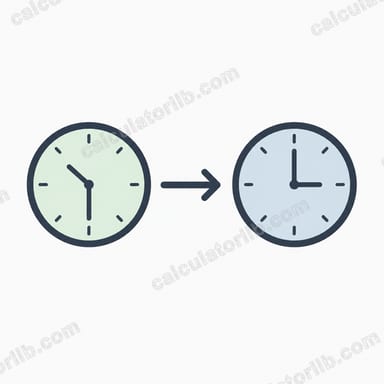
Diagram showing EST clock and CET clock six hours apart with a +6 arrow
CET is 6 hours ahead of EST, so add 6 hours to convert.

Worked example

Suppose it is 9:00 AM EST. Adding 6 hours gives 15:00 — that is 3:00 PM CET, on the same day. Another example:

$$20{:}00 + 6 = 26{:}00 \to 02{:}00$$

20:00 (8 PM) EST + 6 = 26:00, which wraps to 02:00 CET the next day.

FAQ

How many hours ahead is CET than EST? CET is 6 hours ahead of EST.

Does this account for daylight saving time? No. It uses the fixed standard offsets EST (UTC−5) and CET (UTC+1). During summer the zones become EDT and CEST, which can change the gap around the differing US and EU transition dates.

What time is 12:00 PM EST in CET? \(12{:}00 + 6 = 18{:}00\), i.e. 6:00 PM CET the same day.

Zuletzt aktualisiert:

Am beliebtesten in Zeit und Datum

Alle Zeit und Datum Rechner anzeigen