UTC to CEST Converter

UTC to CEST Converter

Emergente AI Skill PRO

Insira o cálculo

Fórmula

T=(UTC Hour×60+UTC Minute+2×60)mod1440where{CEST Hour=⌊T60⌋CEST Minute=Tmod60\begin{gathered} T = \left(\text{UTC Hour} \times 60 + \text{UTC Minute} + 2 \times 60\right) \bmod 1440 \\[1.5em] \text{where}\quad \left\{ \begin{aligned} \text{CEST Hour} &= \left\lfloor \tfrac{T}{60} \right\rfloor \\ \text{CEST Minute} &= T \bmod 60 \end{aligned} \right. \end{gathered}
Estatísticas de uso

Anúncio

Resultados

Central European Time (auto DST)
13:00 CET
Same day
Input interpreted as 2026-11-17 12:00 UTC (UTC+0)
Central European Time (auto DST) 2026-11-17 13:00 CET (UTC+1)

On this date, Central European Time is on standard time: CET (UTC+1).

The result below uses a fixed offset all year: CEST = UTC+2.

Central European Summer Time (CEST)
14:00
(same day) — UTC+2
Offset applied+2 hours
Time zoneCEST (UTC+02:00)
Day shiftNo

De UTC para Horário da Europa Central, hora a hora

UTC0:04terça-feira, 17 de novembro
Horário da Europa Central1:04terça-feira, 17 de novembro

Agora: 0:04 UTC = 1:04 Horário da Europa Central

Digite um horário para vê-lo nos dois fusos.

Em terça-feira, 17 de novembro de 2026, o Horário da Europa Central é UTC+1 (CET).

  • Horário comercial (9:00–17:00, segunda a sexta)
  • Hora atual
De UTC para Horário da Europa Central em terça-feira, 17 de novembro de 2026
UTCHorário da Europa Central
1:00 CET
2:00 CET
3:00 CET
4:00 CET
5:00 CET
6:00 CET
7:00 CET
8:00 CET
9:00 CET
10:00 CET
11:00 CET
12:00 CET
13:00 CET
14:00 CET
15:00 CET
16:00 CET
17:00 CET
18:00 CET
19:00 CET
20:00 CET
21:00 CET
22:00 CET
23:00 CET
0:00 CET (dia seguinte)

Próxima mudança de horário: 28 de março de 2027 às 01:00 UTC, UTC+1 (CET) → UTC+2 (CEST).

Diferenças e mudanças de horário: banco de dados de fusos horários da IANA 2026f.

Relatar um erro nesta página

What is the UTC to CEST Converter?

Central European Summer Time (CEST) is the daylight-saving time zone used across much of central Europe — including Germany, France, Italy, Spain, the Netherlands and Poland — from late March to late October. CEST runs two hours ahead of Coordinated Universal Time (UTC+2). This tool converts any UTC clock time into the equivalent CEST time.

How to use it

Enter the UTC hour (0–23) and minute (0–59). The converter adds two hours and shows the resulting CEST time in 24-hour format. If the addition pushes the time past midnight, it notes that the result falls on the next day.

The formula

The conversion is simply CEST = UTC + 2 hours. Internally the time is converted to minutes-since-midnight, two hours (120 minutes) are added, and the result is wrapped around a 24-hour (1440-minute) day so the clock rolls over correctly.

$$\text{CEST} = \left[\left(\text{UTC Hour} \times 60 + \text{UTC Minute} + 120\right) \bmod 1440\right]$$

$$\begin{gathered} T = \left(\text{UTC Hour} \times 60 + \text{UTC Minute} + 2 \times 60\right) \bmod 1440 \\[1.5em] \text{where}\quad \left\{ \begin{aligned} \text{CEST Hour} &= \left\lfloor \tfrac{T}{60} \right\rfloor \\ \text{CEST Minute} &= T \bmod 60 \end{aligned} \right. \end{gathered}$$
Anúncio
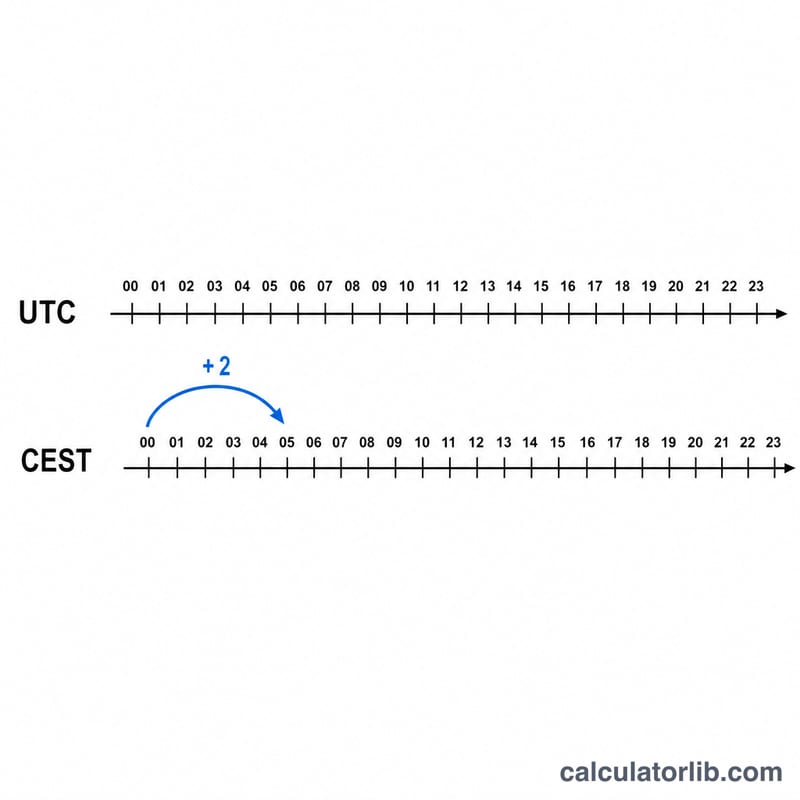
Number line showing UTC time shifted two hours forward to CEST
CEST equals UTC plus two hours.

Worked example

Suppose it is 23:30 UTC. Adding 2 hours gives 25:30, which is past midnight. Wrapping around 24 hours yields 01:30 CEST on the following day.

FAQ

When is CEST in effect? CEST applies during European summer time, roughly from the last Sunday in March to the last Sunday in October. Outside that window, central Europe uses CET (UTC+1).

What's the difference between CET and CEST? CET is UTC+1 (winter); CEST is UTC+2 (summer). This tool uses the +2 summer offset.

Does this account for daylight saving automatically? No — it always applies the fixed +2 CEST offset. Use it only for dates within the summer-time period.


Última atualização:

Mais popular em Data e Hora

Ver todas as calculadoras de Data e Hora