
What is the UTC to CEST Converter?
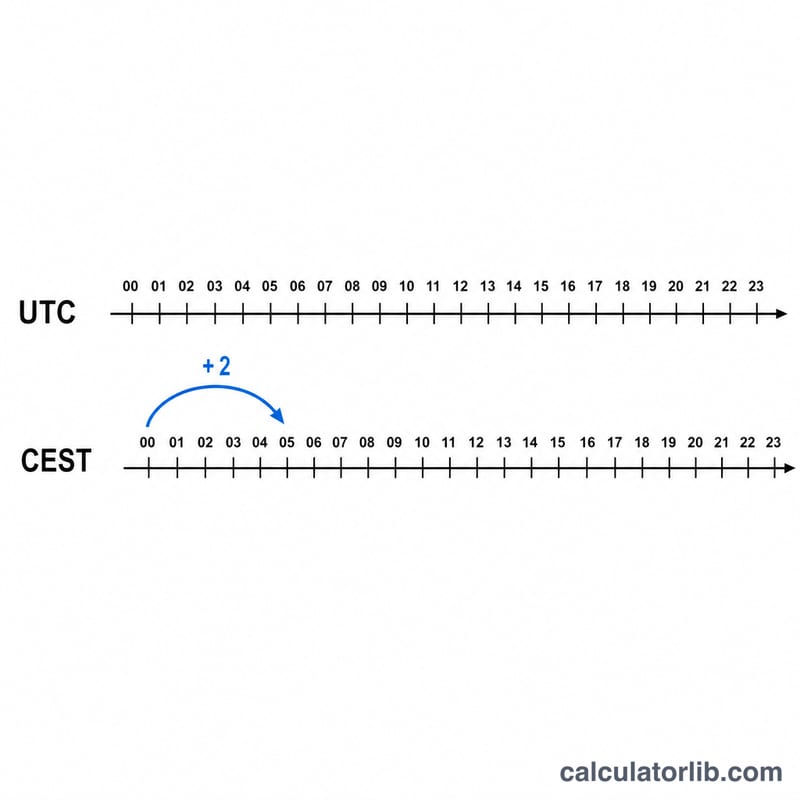
Central European Summer Time (CEST) is the daylight-saving time zone used across much of central Europe — including Germany, France, Italy, Spain, the Netherlands and Poland — from late March to late October. CEST runs two hours ahead of Coordinated Universal Time (UTC+2). This tool converts any UTC clock time into the equivalent CEST time.
How to use it
Enter the UTC hour (0–23) and minute (0–59). The converter adds two hours and shows the resulting CEST time in 24-hour format. If the addition pushes the time past midnight, it notes that the result falls on the next day.
The formula
The conversion is simply CEST = UTC + 2 hours. Internally the time is converted to minutes-since-midnight, two hours (120 minutes) are added, and the result is wrapped around a 24-hour (1440-minute) day so the clock rolls over correctly.
$$\text{CEST} = \left[\left(\text{UTC Hour} \times 60 + \text{UTC Minute} + 120\right) \bmod 1440\right]$$
$$\begin{gathered} T = \left(\text{UTC Hour} \times 60 + \text{UTC Minute} + 2 \times 60\right) \bmod 1440 \\[1.5em] \text{where}\quad \left\{ \begin{aligned} \text{CEST Hour} &= \left\lfloor \tfrac{T}{60} \right\rfloor \\ \text{CEST Minute} &= T \bmod 60 \end{aligned} \right. \end{gathered}$$
Worked example
Suppose it is 23:30 UTC. Adding 2 hours gives 25:30, which is past midnight. Wrapping around 24 hours yields 01:30 CEST on the following day.
FAQ
When is CEST in effect? CEST applies during European summer time, roughly from the last Sunday in March to the last Sunday in October. Outside that window, central Europe uses CET (UTC+1).
What's the difference between CET and CEST? CET is UTC+1 (winter); CEST is UTC+2 (summer). This tool uses the +2 summer offset.
Does this account for daylight saving automatically? No — it always applies the fixed +2 CEST offset. Use it only for dates within the summer-time period.