
What Is the Half Your Age Plus Seven Rule?
The "half your age plus seven" rule is a popular rule of thumb used to estimate the socially acceptable age range for a romantic partner. It is not a law or a scientific guideline — just a cultural heuristic that many people reference when thinking about age gaps in relationships. This calculator applies the rule in both directions so you can see the youngest and oldest partner ages it suggests.
How to Use the Calculator
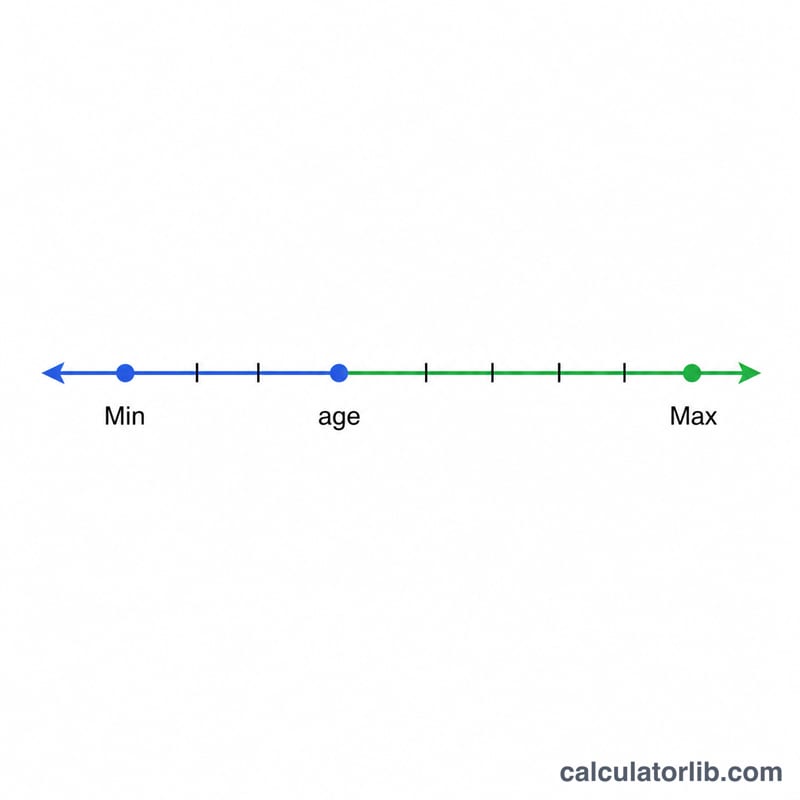
Enter your age in years and press calculate. The tool returns two numbers: the minimum acceptable partner age and the maximum acceptable partner age. Any age between these two values falls inside the rule's suggested range. Remember this is a lighthearted social guideline, not relationship advice.
The Formula Explained
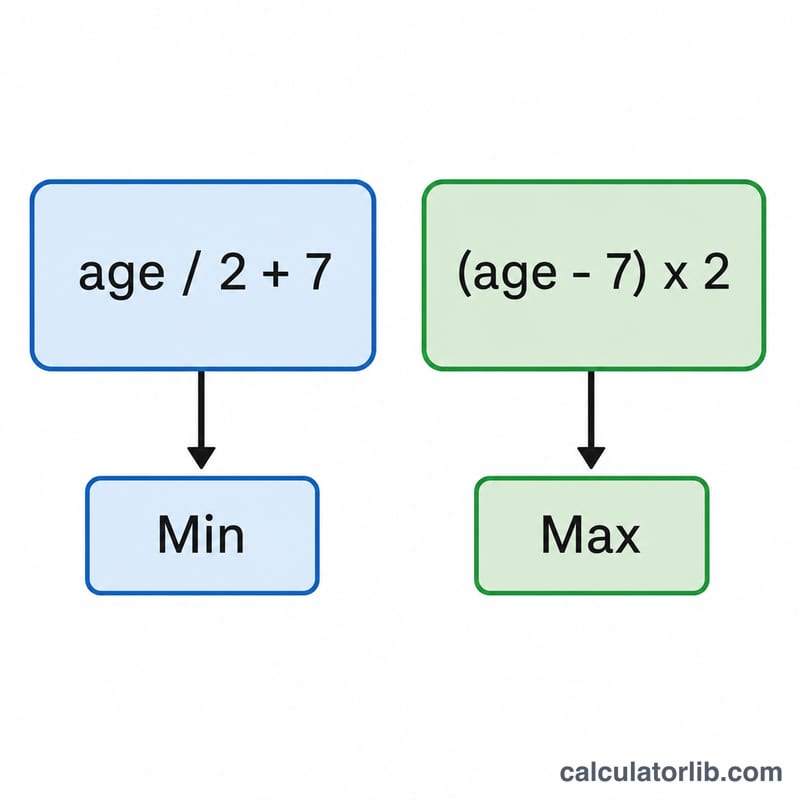
The lower bound is found by halving your age and adding seven: $$\text{Min} = \frac{\text{age}}{2} + 7$$. The upper bound reverses this calculation: $$\text{Max} = (\text{age} - 7) \times 2$$. Because the two formulas are inverses of one another, the rule is symmetric — if person A's age is acceptable to person B under the rule, then person B's age is also acceptable to person A.
Worked Example
Suppose you are 30 years old. The minimum acceptable age is $$30 \div 2 + 7 = 15 + 7 = 22.$$ The maximum acceptable age is $$(30 - 7) \times 2 = 23 \times 2 = 46.$$ So the rule suggests a partner aged between 22 and 46 years old, a range width of 24 years.
Acceptable Age Range by Age
The "half your age plus seven" rule sets a socially-suggested youngest and oldest partner age for any given age. The minimum partner age is your age divided by 2 plus 7, and the maximum partner age (the rule worked in reverse) is your age minus 7, multiplied by 2. The range width is simply the maximum minus the minimum — notice how it widens as you get older.
| Your age | Minimum partner age (age ÷ 2 + 7) |
Maximum partner age ((age − 7) × 2) |
Range width |
|---|---|---|---|
| 18 | 16 | 22 | 6 |
| 20 | 17 | 26 | 9 |
| 25 | 19.5 | 36 | 16.5 |
| 30 | 22 | 46 | 24 |
| 35 | 24.5 | 56 | 31.5 |
| 40 | 27 | 66 | 39 |
| 50 | 32 | 86 | 54 |
| 60 | 37 | 106 | 69 |
| 70 | 42 | 126 | 84 |
Fractional results (such as 19.5 at age 25) come from the division step and are usually rounded in everyday use. This rule is a lighthearted social guideline, not a scientific or legal standard — local age-of-consent laws always take precedence over any rule of thumb.
FAQ
Is this rule scientifically valid? No. It is a popular cultural rule of thumb, not a research-backed guideline. Use it for curiosity only.
Why does the range get wider with age? As your age increases, both the minimum and maximum bounds spread further apart, so older people have a wider acceptable range under the rule.
Does the rule work at very young ages? The rule is generally considered meaningful only for adults. Legal age-of-consent laws always take precedence over any rule of thumb.