What is the PST to IST Converter?
This tool converts a time in Pacific Standard Time (PST, UTC−8) to India Standard Time (IST, UTC+5:30). Because India is 13 hours and 30 minutes ahead of the US Pacific zone during standard time, the converter simply adds 13:30 to the PST value and rolls the result over to the next day when needed.
How to use it
Enter the PST hour (0–23, 24-hour clock) and minute (0–59). The calculator returns the equivalent IST time and tells you whether the result falls on the next day. For example, a late-evening time in California often lands the following morning in India.
The formula explained
The conversion is a fixed offset: \(\text{IST} = \text{PST} + 13\text{ hours } 30\text{ minutes}\). Internally the tool converts the PST time to minutes after midnight, adds 810 minutes (\(13 \times 60 + 30\)), then takes the result modulo 1440 (minutes per day) to wrap around midnight. The day offset is how many whole days were crossed.
$$\text{IST} = \left(\left(\text{PST Hour} \times 60 + \text{PST Minute} + 810\right) \bmod 1440\right)$$
$$\begin{gathered} \text{IST}_{\min} = \Big(\big(\text{PST Hour} \times 60 + \text{PST Minute}\big) + 810\Big) \bmod 1440 \\[1.5em] \text{where}\quad \left\{ \begin{aligned} \text{IST Hour} &= \left\lfloor \tfrac{\text{IST}_{\min}}{60} \right\rfloor \\ \text{IST Minute} &= \text{IST}_{\min} \bmod 60 \end{aligned} \right. \end{gathered}$$
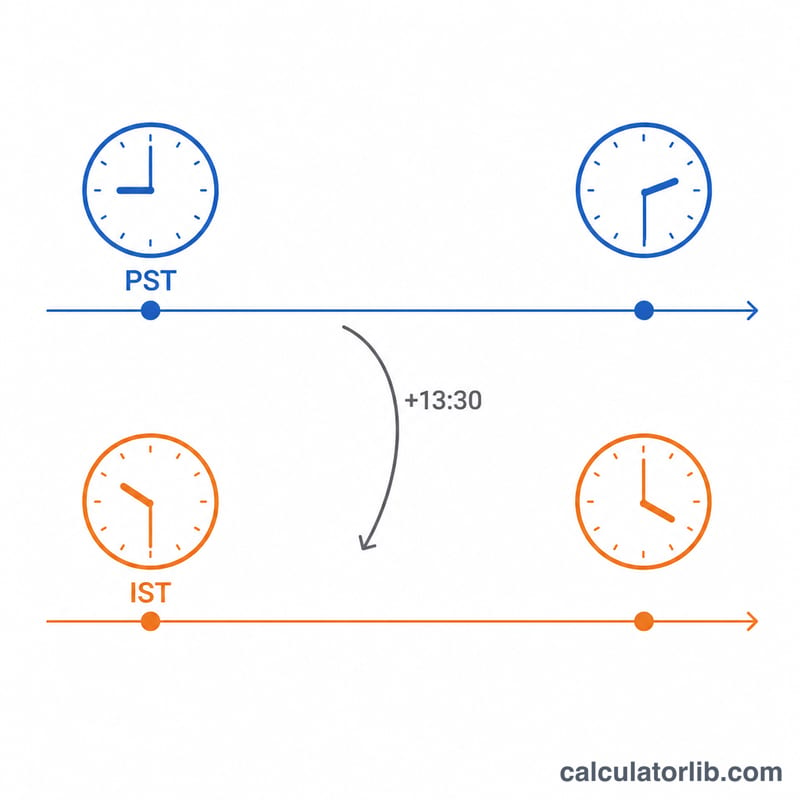
Worked example
Suppose it is 10:00 PST. Adding 13:30 gives 23:30 — so it is 23:30 IST the same day. Now take 20:00 PST: \(20{:}00 + 13{:}30 = 33{:}30\), which wraps to 09:30 IST the next day.
PST vs PDT: How the Gap to IST Changes
The US Pacific zone switches between standard and daylight time, but India does not. The gap between Pacific time and IST therefore shifts by one hour twice a year. This applies to regions that observe US-style daylight saving time; rules differ in other countries.
| Item | PST (Pacific Standard Time) | PDT (Pacific Daylight Time) |
|---|---|---|
| UTC offset | UTC−8 | UTC−7 |
| IST offset | UTC+5:30 | UTC+5:30 |
| Gap to IST | 13:30 | 12:30 |
| Typical period | Early November to mid-March (starts on the first Sunday of November) | Mid-March to early November (starts on the second Sunday of March) |
| Example: 9:00 AM Pacific in India | 10:30 PM IST (22:30), same day | 9:30 PM IST (21:30), same day |
| Example: 12:00 PM (noon) Pacific in India | 1:30 AM IST, next day | 12:30 AM IST, next day |
Key point: this converter uses the fixed PST offset of +13:30. During daylight saving time, subtract one hour from the IST result, or enter the Pacific time as if it were PST and then subtract an hour. For recurring meetings between California, Washington or Oregon and India, check which offset applies on the specific date, especially in the weeks around the March and November changeovers.
FAQ
Is IST always 13:30 ahead of PST? This converter assumes Pacific Standard Time. During US daylight saving (PDT, UTC−7) the difference shrinks to 12 hours 30 minutes, since India does not observe daylight saving.
What does "next day" mean? If adding the offset pushes the time past midnight, the IST result falls on the calendar day after the PST date.
Does India use daylight saving time? No. IST stays at UTC+5:30 all year, so only the US clock change affects the gap.