What This Calculator Does
The Lunar to Gregorian Date Calculator converts a date from the Chinese lunar calendar into the standard Gregorian (solar) calendar used worldwide. The Chinese lunar calendar is a lunisolar system used across China and much of East Asia for traditional festivals, birthdays, and astrological dates such as Lunar New Year. Because lunar dates shift each year relative to the solar calendar, this tool removes the guesswork and gives you the exact Gregorian equivalent.
The Three Inputs
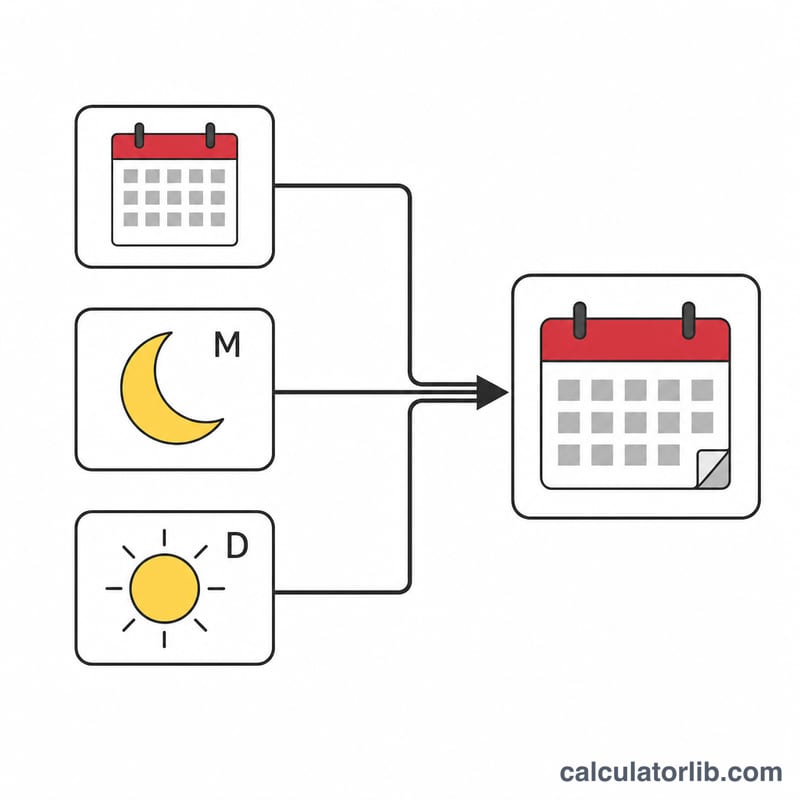
- Lunar Year – the year in the Chinese calendar (for example, 2024). This also determines the Chinese zodiac animal and the cyclical (Heavenly Stem + Earthly Branch) name for the year.
- Lunar Month – the lunar month (1–12). The Chinese calendar occasionally inserts a leap month, so you can also select a "leap" version of a month when applicable.
- Lunar Day – the day of the lunar month (1–30, since lunar months have 29 or 30 days).
How the Conversion Works
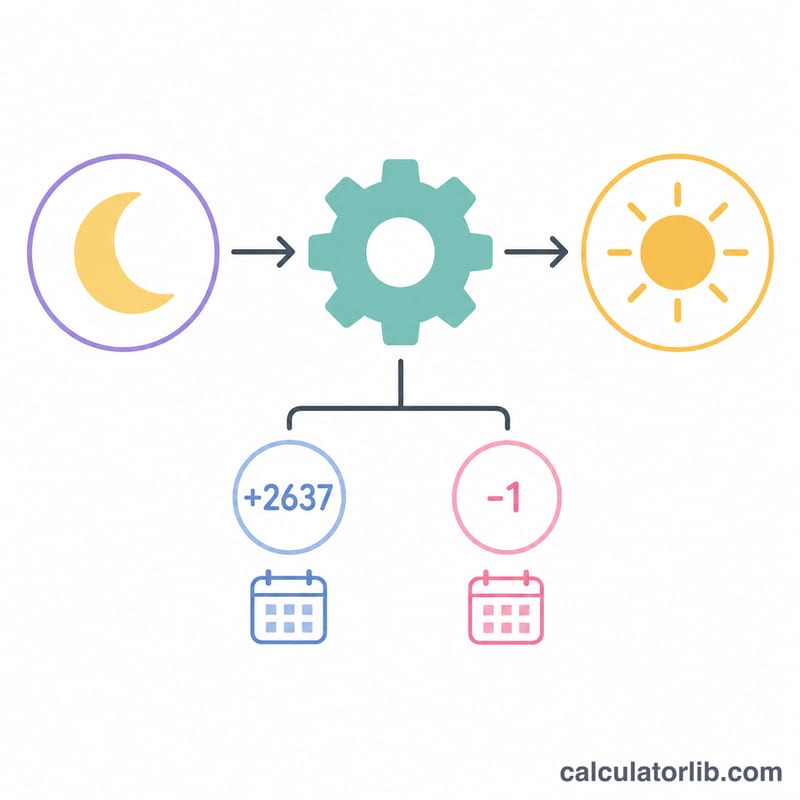
Internally the calculator uses the ICU (International Components for Unicode) ChineseCalendar, the same astronomical engine that powers many operating systems. It sets the extended year, month, leap-month flag and day of month, then reads back the corresponding Gregorian date. Astronomical new-moon and solar-term data is used to place each month accurately, which is far more reliable than a simple arithmetic offset.
The conversion can be expressed as:
$$\text{Gregorian Date} = \text{ChineseCalendar}\left(\text{ExtendedYear} = \text{Lunar Year} + 2637,\; \text{Month} = \text{Lunar Month} - 1,\; \text{Day} = \text{Lunar Day}\right)$$The tool also computes the zodiac animal as \(\text{zodiacAnimals}[(\text{year} - 1) \bmod 12]\) and the cyclical year name by combining one of the 10 Heavenly Stems with one of the 12 Earthly Branches.
Worked Example
Suppose you enter Lunar Year 2024, Month 1, Day 1 — the first day of the first lunar month, which is Chinese New Year. The calculator returns the Gregorian date 10 February 2024. The year 2024 falls under the zodiac animal Dragon, with the cyclical name 甲辰 (Jiǎ-Chén). Change the day to 15 and you will see the date of the Lantern Festival.
Frequently Asked Questions
What is a leap month? To keep the lunar months aligned with the solar year, the Chinese calendar adds an extra (leap) month roughly every three years. If your date falls in such a month, select the "leap" option for that month number.
Why do lunar dates change every Gregorian year? Lunar months follow the moon's cycle (about 29.5 days), so a 12-month lunar year is shorter than the solar year. This causes the same lunar date to land on a different Gregorian date annually.
How accurate is the result? Because the tool relies on ICU's astronomically calculated calendar, the conversions match official Chinese calendar tables.