How to Convert a Gregorian Date to the Maya Calendar by Hand
Every conversion goes through one intermediate number: the Julian Day Number (JDN), a continuous count of days that ignores calendar reforms. Once you have the JDN you never need to think about months or leap years again — the Maya cycles are pure modular arithmetic. All divisions below are integer (floor) divisions, and \(\bmod\) always returns a non-negative remainder.
Step 1 — Convert the Gregorian date to a Julian Day Number
For a date in the Gregorian calendar (proleptic Gregorian for dates before the reform):
$$a=\left\lfloor\frac{14-M}{12}\right\rfloor,\qquad y=Y+4800-a,\qquad m=M+12a-3$$ $$\text{JDN}=D+\left\lfloor\frac{153m+2}{5}\right\rfloor+365y+\left\lfloor\frac{y}{4}\right\rfloor-\left\lfloor\frac{y}{100}\right\rfloor+\left\lfloor\frac{y}{400}\right\rfloor-32045$$For a date in the Julian calendar, drop the two century terms and change the final constant:
$$\text{JDN}=D+\left\lfloor\frac{153m+2}{5}\right\rfloor+365y+\left\lfloor\frac{y}{4}\right\rfloor-32083$$Which formula applies depends on the date and the country. The Gregorian reform took effect on 15 October 1582 (the day after Julian 4 October 1582) in the Catholic states — Spain, Portugal, the Italian states and Poland–Lithuania. Britain and its colonies switched on 14 September 1752, and Russia only in 1918. Dates in the Spanish colonial sources used by Mayanists are therefore usually Julian before late 1582 and Gregorian after it. Note also that the JDN produced by these formulas is the one belonging to the noon that falls inside that calendar day, because Julian Days begin at noon Universal Time.
Step 2 — Subtract the correlation constant
The Maya Day Number (MDN) is the number of elapsed days since the Long Count base date 0.0.0.0.0 = 4 Ajaw 8 Kumk'u. Using the Goodman–Martínez–Thompson (GMT) correlation constant:
$$\text{MDN}=\text{JDN}-584283$$Step 3 — Break the MDN into the Long Count
Divide successively by the cycle lengths, carrying the remainder forward:
- baktun \(=\left\lfloor \text{MDN}/144000\right\rfloor\), remainder \(r_1\)
- katun \(=\left\lfloor r_1/7200\right\rfloor\), remainder \(r_2\)
- tun \(=\left\lfloor r_2/360\right\rfloor\), remainder \(r_3\)
- uinal \(=\left\lfloor r_3/20\right\rfloor\), remainder \(r_4\)
- kin \(=r_4\)
Write the result as baktun.katun.tun.uinal.kin.
Step 4 — Tzolkin (the 260-day round)
$$\text{number}=\left((\text{MDN}+3)\bmod 13\right)+1,\qquad \text{name index}=(\text{MDN}+19)\bmod 20$$The offsets +3 and +19 exist because day zero is 4 Ajaw, and Ajaw is index 19 in the list of 20 day names (see the tables below).
Step 5 — Haab (the 365-day year)
$$p=(\text{MDN}+348)\bmod 365,\qquad \text{month index}=\left\lfloor p/20\right\rfloor,\qquad \text{day}=p\bmod 20$$The offset +348 places day zero at 8 Kumk'u (\(17\times 20+8=348\)). Month indices 0–17 are the eighteen 20-day months; index 18 is the 5-day Wayeb, whose days run 0–4. The Haab contains no leap day, so it drifts against the solar year by about one day every four years.
Step 6 — A fully worked example: 2 October 2026 (Gregorian)
Inputs \(Y=2026\), \(M=10\), \(D=2\).
- \(a=\left\lfloor (14-10)/12\right\rfloor=\left\lfloor 0.333\right\rfloor=0\); \(y=2026+4800-0=6826\); \(m=10+0-3=7\)
- \(\left\lfloor (153\cdot 7+2)/5\right\rfloor=\left\lfloor 1073/5\right\rfloor=214\)
- \(365\cdot 6826=2491490\); \(\left\lfloor 6826/4\right\rfloor=1706\); \(\left\lfloor 6826/100\right\rfloor=68\); \(\left\lfloor 6826/400\right\rfloor=17\)
- \(\text{JDN}=2+214+2491490+1706-68+17-32045=\) 2461316
- \(\text{MDN}=2461316-584283=1877033\)
- \(\left\lfloor 1877033/144000\right\rfloor=13\), remainder \(1877033-1872000=5033\)
- \(\left\lfloor 5033/7200\right\rfloor=0\), remainder 5033
- \(\left\lfloor 5033/360\right\rfloor=13\), remainder \(5033-4680=353\)
- \(\left\lfloor 353/20\right\rfloor=17\), remainder \(353-340=13\) kin
- Long Count \(=13.0.13.17.13\)
- Tzolkin number \(=((1877033+3)\bmod 13)+1=(1877036\bmod 13)+1=5+1=6\)
- Tzolkin name \(=(1877033+19)\bmod 20=1877052\bmod 20=12\rightarrow\) B'en
- Haab \(p=(1877033+348)\bmod 365=1877381\bmod 365=186\); month \(=\left\lfloor 186/20\right\rfloor=9\rightarrow\) Yax; day \(=186\bmod 20=6\)
Result: 2 October 2026 = 13.0.13.17.13, 6 B'en 6 Yax, JDN 2461316.
A quick independent check: the famous date 13.0.0.0.0 has MDN \(13\times 144000=1872000\), so JDN \(=1872000+584283=2456283\), which is 21 December 2012 — and \(1877033-1872000=5033\) days is exactly the span from 21 December 2012 to 2 October 2026.
Tzolkin Day Names and Haab Month Tables
The index columns are the values produced by the formulas in the previous section, so these tables are the final lookup step of a conversion. The spellings in the first column follow the modern standardised Yucatec/Mayan orthography (with the apostrophe marking a glottalised consonant); the second column gives the colonial and older scholarly spellings you will meet in books, museum labels and software. Both name the same day — only the transcription differs.
Table 1 — The 20 Tzolkin day names
| Index | Standard spelling | Common alternatives |
|---|---|---|
| 0 | Imix | Imix', Imox |
| 1 | Ik' | Ik, Iq' |
| 2 | Ak'b'al | Akbal, Ak'bal |
| 3 | K'an | Kan |
| 4 | Chikchan | Chicchan |
| 5 | Kimi | Cimi, Kame |
| 6 | Manik' | Manik |
| 7 | Lamat | Lambat |
| 8 | Muluk | Muluc |
| 9 | Ok | Oc, Oq |
| 10 | Chuwen | Chuen, Chuwan |
| 11 | Eb' | Eb |
| 12 | B'en | Ben |
| 13 | Ix | Hix, Ix' |
| 14 | Men | Men, Tz'ikin |
| 15 | K'ib' | Cib, Kib |
| 16 | Kab'an | Caban, Kaban |
| 17 | Etz'nab' | Etznab |
| 18 | Kawak | Cauac, Kawac |
| 19 | Ajaw | Ahau, Ahaw |
The Tzolkin pairs each name with a number 1–13; the two cycles advance together, so a name–number pair such as 6 B'en repeats every \(13\times 20=260\) days. Because 20 is a multiple of neither 13 nor anything shared with it, the numbers cycle through all thirteen values for each name.
Table 2 — The 18 Haab months plus Wayeb
| Index | Month | Alternatives | Days in month | Haab positions \(p\) |
|---|---|---|---|---|
| 0 | Pop | — | 20 | 0–19 |
| 1 | Wo' | Uo | 20 | 20–39 |
| 2 | Sip | Zip | 20 | 40–59 |
| 3 | Sotz' | Zotz | 20 | 60–79 |
| 4 | Sek | Tzec, Zec | 20 | 80–99 |
| 5 | Xul | — | 20 | 100–119 |
| 6 | Yaxk'in | Yaxkin | 20 | 120–139 |
| 7 | Mol | — | 20 | 140–159 |
| 8 | Ch'en | Chen | 20 | 160–179 |
| 9 | Yax | — | 20 | 180–199 |
| 10 | Sak | Zac | 20 | 200–219 |
| 11 | Keh | Ceh | 20 | 220–239 |
| 12 | Mak | Mac | 20 | 240–259 |
| 13 | K'ank'in | Kankin | 20 | 260–279 |
| 14 | Muwan | Muan, Moan | 20 | 280–299 |
| 15 | Pax | — | 20 | 300–319 |
| 16 | K'ayab | Kayab | 20 | 320–339 |
| 17 | Kumk'u | Cumku | 20 | 340–359 |
| 18 | Wayeb | Uayeb, Wayeb' | 5 | 360–364 |
Day numbering: 0–19 or 1–20?
Two conventions are in use, and they differ by one for the same physical day:
- 0–19 (used here and by most Mayanists). The first day of a month is day 0, written in the inscriptions with the "seating" glyph (chum), i.e. "the seating of Pop" rather than "1 Pop". Wayeb runs 0–4.
- 1–20. Some popular publications and older works renumber so that the seating day becomes "1 Pop" and the last day "20 Pop" (Wayeb 1–5).
So the worked example above, 6 Yax in the 0–19 convention, would be printed as 7 Yax in the 1–20 convention. Always check which convention a source uses before comparing two dates — the underlying Long Count and Julian Day Number are unaffected.
Constants Used in the Conversion
The correlation constant
The correlation constant is the single bridge between the Maya count and the Western calendar: it is the Julian Day Number assigned to Long Count 0.0.0.0.0. The standard scholarly value is the Goodman–Martínez–Thompson (GMT) constant, 584283 days, named after Joseph T. Goodman, Juan Martínez Hernández and J. Eric S. Thompson. It is the value used by most Mayanist publications and is consistent with the 260-day count still kept by day-keepers in highland Guatemala.
A widely cited alternative is 584285 (the Lounsbury / "GMT+2" variant). Because a Long Count date maps to \(\text{JDN}=\text{MDN}+\text{constant}\), using 584285 shifts every Maya date two days later in the Gregorian calendar — so 13.0.0.0.0 falls on 23 December 2012 instead of 21 December 2012. Conversely, converting a fixed Gregorian date with 584285 yields an MDN two days smaller. Always state which constant a conversion used; a two-day disagreement between sources almost always has this cause.
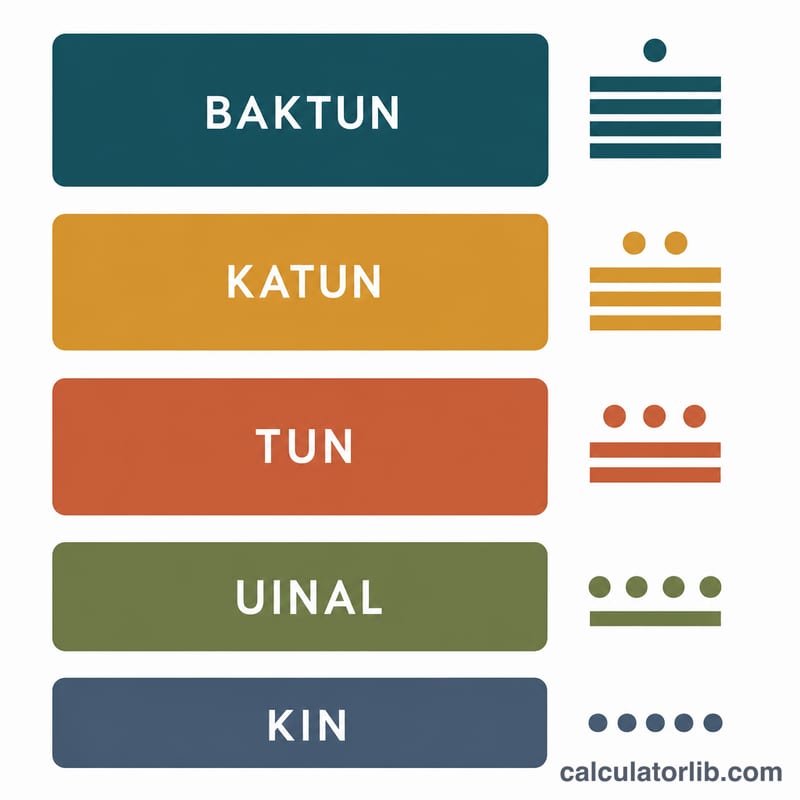
Long Count cycle lengths
| Unit | Composition | Days (kin) |
|---|---|---|
| kin | 1 day | 1 |
| uinal (winal) | 20 kin | 20 |
| tun | 18 uinal | 360 |
| katun (k'atun) | 20 tun | 7200 |
| baktun (b'ak'tun) | 20 katun | 144000 |
| piktun | 20 baktun | 2880000 |
The Long Count is almost pure base-20, with one exception: the uinal place runs 0–17 rather than 0–19, so that a tun is 360 days — close to a solar year. "Piktun" is a modern reconstruction for the next higher place; inscriptions rarely need it.
Round lengths
| Cycle | Structure | Length |
|---|---|---|
| Tzolkin | 13 numbers × 20 day names | 260 days |
| Haab | 18 months × 20 days + Wayeb (5 days) | 365 days |
| Calendar Round | \(\operatorname{lcm}(260,365)=18980\) = 73 Tzolkin = 52 Haab | 18980 days |
The greatest common divisor of 260 and 365 is 5, hence \(\operatorname{lcm}(260,365)=260\times 365/5=18980\). A full Tzolkin–Haab pair such as "4 Ajaw 8 Kumk'u" therefore repeats only once every 18980 days ≈ 51.96 tropical years — which is why the Long Count is needed to date an inscription unambiguously.
Epochs
- Julian Day Number epoch: JD 0 begins at noon Universal Time on 1 January 4713 BC in the Julian calendar (= 24 November 4714 BC in the proleptic Gregorian calendar). Julian Days are an astronomical convention, not a national calendar, and they run noon-to-noon.
- Long Count epoch: 0.0.0.0.0 = 4 Ajaw 8 Kumk'u = JDN 584283 = 11 August 3114 BC (proleptic Gregorian) = 6 September 3114 BC (Julian calendar). In astronomical year numbering that is −3113.
- The end of the 13th baktun: 13.0.0.0.0 = 4 Ajaw 3 K'ank'in = JDN 2456283 = 21 December 2012 (Gregorian), using 584283. This was the completion of 13 baktuns (1 872 000 days) from the epoch, not an endpoint of the Long Count, which simply continues into 13.0.0.0.1 and beyond.
One practical caution on era input: historians write 1 BC immediately before AD 1 with no year zero, while astronomers write that same year as 0. A converter that accepts a BC/BCE era flag normally handles the shift internally — but if you substitute years into the formulas by hand, use astronomical numbering (1 BC = 0, 3114 BC = −3113).