
What this converter does
The Hijri Date to Gregorian Converter turns a date in the Islamic (Hijri) calendar into its equivalent date in the Gregorian calendar used worldwide. Because there is no single universally agreed method for fixing Hijri dates, this tool lets you pick the exact calculation system used — a choice that can shift the result by a day or two. It is built on the well-tested ICU (International Components for Unicode) IslamicCalendar, the same engine used in many operating systems and software libraries.
The inputs you enter
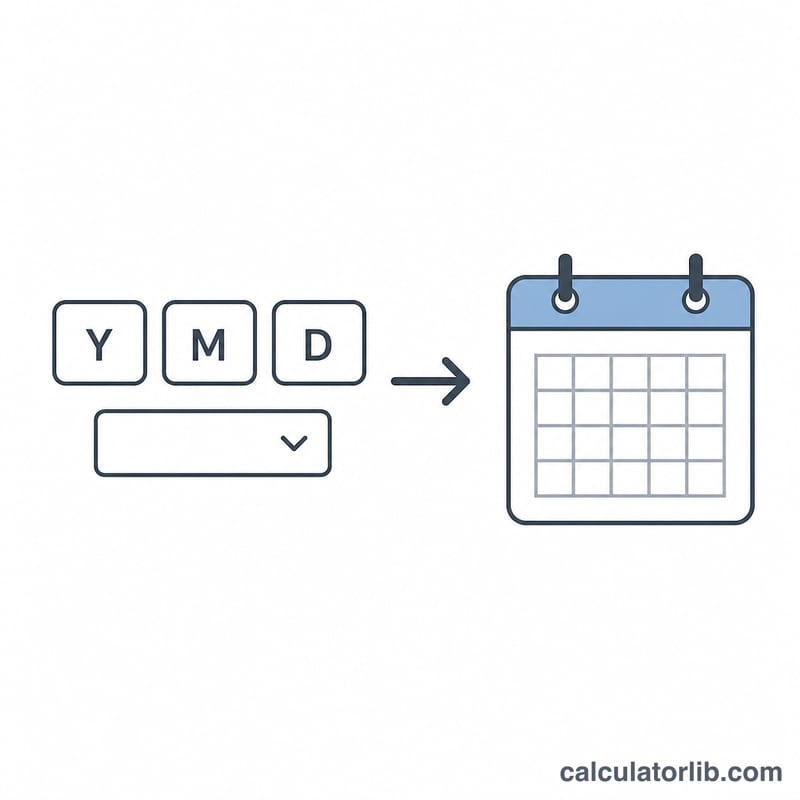
- Hijri Year – the Islamic year, for example 1446.
- Hijri Month – chosen from the twelve lunar months: Muharram, Safar, Rabi' al-Awwal, Rabi' al-Thani, Jumada al-Awwal, Jumada al-Thani, Rajab, Sha'ban, Ramadan, Shawwal, Dhu al-Qi'dah and Dhu al-Hijjah.
- Hijri Day – the day of the month, 1 to 29 or 30.
- Calendar System – one of four methods (see below).
The four calendar systems
- Umm al-Qura (Saudi Arabia) – the official civil calendar of Saudi Arabia, based on astronomical calculation of the new moon at Mecca. This is the default.
- Civil (Friday Epoch) – the tabular arithmetic calendar with the epoch on Friday, 16 July 622 CE.
- Astronomical – uses true lunar (sighting-based) calculation rather than a fixed arithmetic table.
- Tabular (Thursday Epoch) – the arithmetic calendar with the epoch one day earlier, on Thursday, 15 July 622 CE.
How the calculation works
There is no simple arithmetic formula. Internally the tool creates an ICU IslamicCalendar, sets the chosen calculation type, then assigns your year, month (converted to a 0-based index, so Muharram = 0) and day. ICU computes the underlying Julian Day Number for that Hijri date and translates it into the matching Gregorian year, month and day.
Worked example
Suppose you enter Year 1446, Ramadan (month 9), Day 1 using the Umm al-Qura system. The converter returns approximately 1 March 2025, the start of Ramadan that year. Switching to the Tabular (Thursday Epoch) system can return a date a day earlier, which is exactly why the system selector matters.
FAQ
Why do I get different Gregorian dates for the same Hijri date? Each system defines month lengths differently — Umm al-Qura and Astronomical follow the moon, while Civil and Tabular use a fixed mathematical pattern with different start epochs.
Which system should I choose? For Saudi official dates use Umm al-Qura. For historical or arithmetic conversions, the Civil or Tabular options are common standards.
Can the actual observed date still differ? Yes. Local moon sighting in many countries can move religious dates by a day from any calculated calendar.