From preparing solutions to maintaining a safe pool, this collection handles the numbers across a broad sweep of chemistry. Reach for the Molarity Calculator to set up concentration work, the Formal Charge Calculator to map electron distribution, the Half-Life Calculator for radioactive decay problems, or the Pool Chemistry Calculator to keep chlorine and pH in balance.
The Popular list shows which tools students, lab workers, and hobbyists use most; the Trending tab highlights calculators gaining traction right now. Every tool is completely free, needs no login, and works on desktop or mobile — ready whenever a reaction needs checking.
-
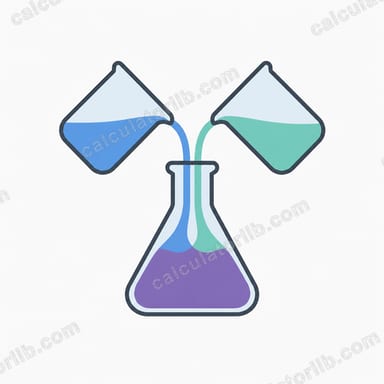
Final Concentration After Mixing Two Solutions CalculatorCalculate the final concentration when two solutions are mixed using C_final = (C1·V1 + C2·V2)/(V1+V2). Free, fast, and unit-agnostic.
-
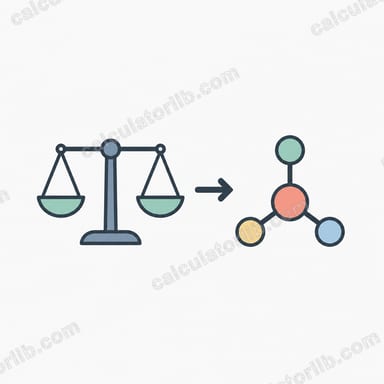
mmol to mg CalculatorConvert millimoles (mmol) to milligrams (mg) using molar mass. Enter the amount and molar mass to get the mass instantly with this free tool.
-
mg to mmol CalculatorConvert milligrams (mg) to millimoles (mmol) using molar mass. Enter mass and molar mass to get amount of substance instantly.
-
% w/v to mg/mL CalculatorConvert percent weight/volume (% w/v) concentration to milligrams per milliliter (mg/mL) instantly. Uses mg/mL = %w/v × 10. Free pharmacy & lab tool.
-
Hydrometer Temperature Correction CalculatorCorrect a hydrometer specific gravity reading for sample temperature versus calibration temperature using the water-density polynomial. Free online tool.
-
Water to Add for Dilution CalculatorFind how much water to add to dilute a solution from one concentration to a lower target. Uses V_water = V1·(C1−C2)/C2. Free and instant.
-
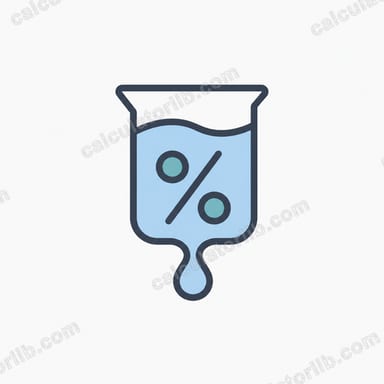
Percent Solution CalculatorCalculate weight/volume percent (%w/v) of a solution, or solve for mass of solute or volume of solution using the standard %w/v formula.
-
Percent Yield CalculatorCalculate percent yield from actual and theoretical yield. Free chemistry tool to measure reaction efficiency instantly with the percent yield formula.
-
mmol/L to mg/dL CalculatorConvert mmol/L to mg/dL for glucose, cholesterol, creatinine, urea and more. Uses mg/dL = (mmol/L × MW) / 10 with selectable molecular weights.
-
mg/L to Molarity CalculatorConvert a concentration in mg/L to molarity (mol/L) using the molar mass. Get results in M, mM, and µM instantly with this free calculator.
-
Percent Solution Dilution CalculatorCalculate how much stock solution and diluent you need using C1V1=C2V2 with concentrations in percent. Get V1 and diluent volume instantly.
-
PPM to mg/L CalculatorConvert ppm to mg/L instantly. Enter parts per million and solution density to get milligrams per liter. For water (density ≈1), ppm = mg/L.
-
Common-Ion Effect CalculatorConvert Ksp to molar solubility for any salt MxAy. Enter Ksp and stoichiometric coefficients to find s and ion concentrations in mol/L.
-
Wavelength to Color and Energy CalculatorConvert frequency to wavelength with λ = c/f. Enter frequency in Hz, kHz, MHz, GHz, or THz to get wavelength in meters and nanometers instantly.
-
Mass Percent to Moles CalculatorCalculate moles of solute from molarity and volume using n = M × V. Enter mol/L and liters to get the amount of substance in moles instantly.
-
Path Length from Absorbance CalculatorCalculate solution concentration from absorbance using the Beer-Lambert law: c = A / (ε · l). Enter absorbance, molar absorptivity, and path length.
-
% w/v to % w/w CalculatorConvert between % w/v, mg/mL and ppm instantly. 1% w/v = 10 mg/mL = 10000 ppm. Fast solution concentration converter for lab and pharmacy.
-
Percent by Mass of Element in Compound Calculator (with Mass in Grams)Find the mass of an element within a compound sample. Enter atoms, atomic mass, molar mass and total mass to get grams and percent by mass.
-
De Broglie Frequency CalculatorSolve the combined gas law P₁V₁/T₁ = P₂V₂/T₂ for the final pressure P₂. Enter initial pressure, volume, temperature plus final volume and temperature.
-
Grams per Gallon Fertilizer to PPM CalculatorConvert grams of fertilizer per gallon or liter into N-P-K ppm. Enter weight, nutrient percentage, and water volume to get parts-per-million instantly.
-
Grams to Moles CalculatorConvert grams to moles instantly. Enter the mass in grams and molar mass (g/mol) to find the amount of substance in moles using n = m / M.
-
Buffer pH CalculatorCalculate the pH of a buffer solution from pKa and conjugate base/acid concentrations using the Henderson–Hasselbalch equation. Free and instant.
-
Henderson-Hasselbalch CalculatorCalculate buffer solution pH with the Henderson-Hasselbalch equation from pKa and the conjugate base to weak acid concentration ratio.
-
Radioactivity (Becquerel) CalculatorCalculate radioactivity in becquerel (Bq) from the mass, half-life and molar mass of a pure radioisotope. Includes 23 isotopes and Bq per gram.



Frequently asked questions
What chemistry problems can these calculators solve?
The collection spans general chemistry (molarity, formal charge, partial pressure, percent ionization), nuclear chemistry (half-life), biochemistry (GC content of nucleic-acid sequences), practical water treatment (pool chemistry), and periodic-table properties (electronegativity). Whether you are in a classroom, a teaching lab, or treating your backyard pool, there is a relevant tool here.
How accurate are the chemistry results?
All tools apply standard chemical formulas and accepted constants — for example, Dalton's law for partial pressure and standard decay equations for half-life. Results match textbook precision for typical homework and lab-prep use. For safety- or code-critical work such as industrial chemical handling or regulated processes, verify against the governing standard and have a qualified chemist or engineer review your figures.
Is there any cost or registration requirement?
None. All calculators are free with no sign-up needed. Load the page, enter your values, and get results immediately — as many times as you like.
Do you store the chemical data or concentrations I input?
No. All calculations are performed in your browser and no input data is transmitted to or stored on our servers. Your concentration values, isotope data, and other figures remain entirely on your device.
How can I find the most-used chemistry calculators?
The category listing is ordered by real usage, putting the most popular tools at the top. The Trending and Recently Added tabs let you discover newer entries or spot which calculators are currently seeing increased traffic.