
What Is PPM to mg/L Conversion?
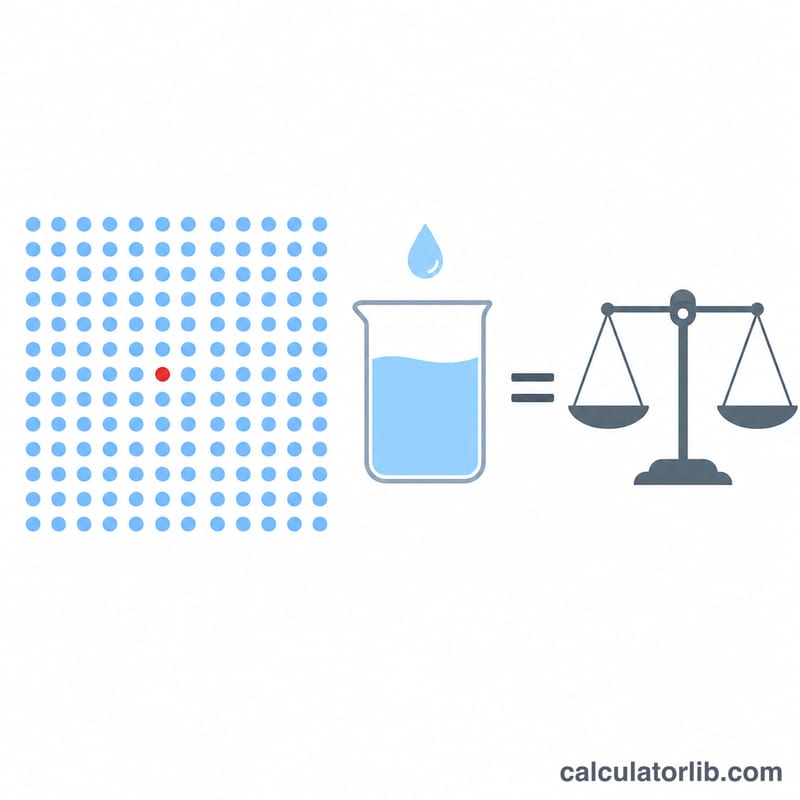
Parts per million (ppm) and milligrams per liter (mg/L) are two of the most common ways to express the concentration of a dissolved substance in a solution. PPM is a mass ratio — milligrams of solute per kilogram of solution — while mg/L is a mass-per-volume measure. The two are linked by the density of the solution.
How to Use the Calculator
Enter the concentration in ppm and the density of your solution in grams per milliliter (g/mL). Click calculate to get the equivalent concentration in mg/L. If you are working with dilute aqueous solutions such as drinking water, leave the density at its default value of 1, since the density of water is very close to 1.000 g/mL at room temperature.
The Formula Explained
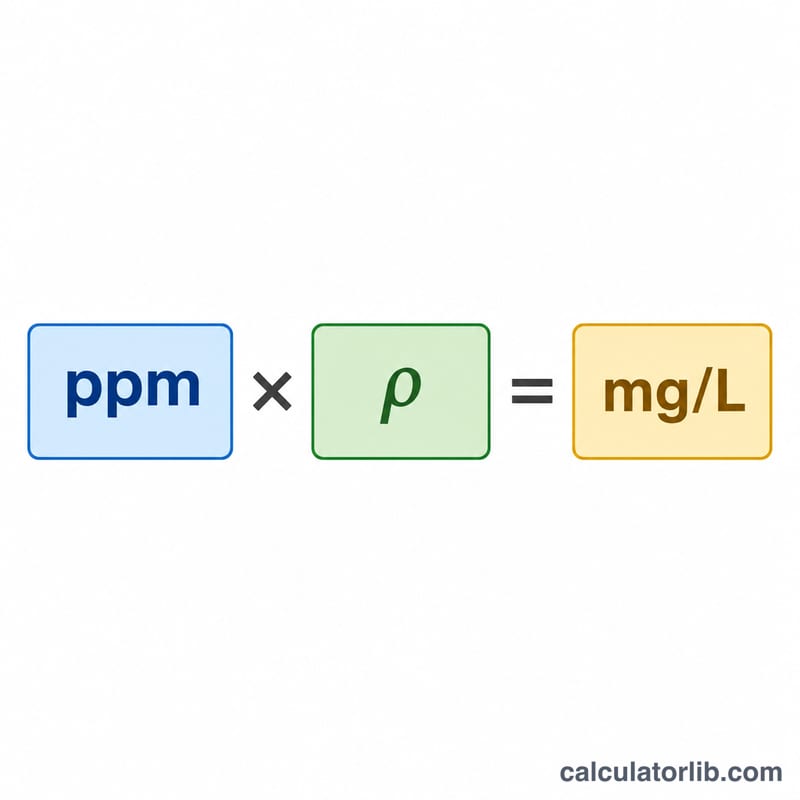
The conversion is: $$\text{mg/L} = \text{ppm} \times \rho$$ where \(\rho\) is the solution density in g/mL. A 1 ppm mass concentration means 1 mg of solute per 1 kg (1,000,000 mg) of solution. To convert that to per liter, multiply by how many kilograms occupy one liter — which is exactly the density in g/mL (or kg/L). For pure water, 1 L weighs 1 kg, so 1 ppm = 1 mg/L.
Worked Example
Suppose a brine solution has a chloride concentration of 500 ppm and the solution density is 1.05 g/mL. Then $$\text{mg/L} = 500 \times 1.05 = 525 \text{ mg/L}.$$ The higher density means each liter holds slightly more mass, so the mg/L value is a bit higher than the ppm value.
FAQ
Are ppm and mg/L always equal? Only when the solution density equals 1 g/mL, which is approximately true for dilute water solutions. For concentrated or denser fluids they differ.
What density should I use for tap water? Use 1 g/mL — the small temperature-related differences are negligible for most purposes.
Can I use this for gases? No. Gas-phase ppm (by volume) uses a different conversion based on molar mass and molar volume; this tool is for liquid solutions.