
What Is the PPM to PPB Calculator?
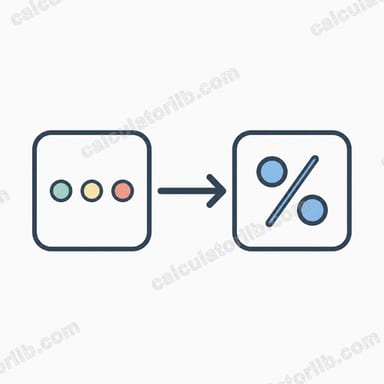
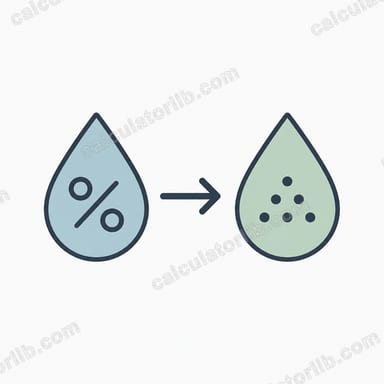
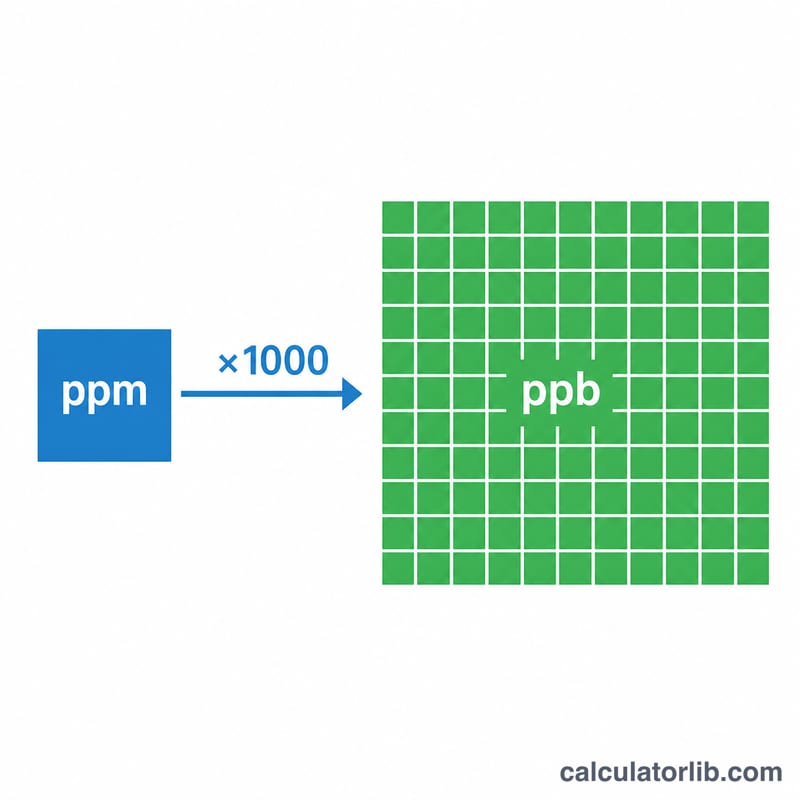
This calculator converts a concentration expressed in parts per million (ppm) into parts per billion (ppb). Both are dimensionless ratios used in chemistry, environmental science, water quality testing, and air monitoring to describe very small amounts of one substance dissolved or mixed within another. Because a billion is one thousand times larger than a million, 1 ppm equals exactly 1000 ppb.
How to Use It
Enter the concentration value in ppm and the calculator instantly returns the equivalent value in ppb. For example, if a water sample contains 0.5 ppm of a contaminant, the tool reports 500 ppb. This is handy when a regulation or datasheet quotes limits in ppb but your instrument reads in ppm.
The Formula Explained
The conversion uses a single, exact factor:
$$\text{ppb} = \text{ppm} \times 1000$$
One part per million means 1 unit per 1,000,000 units. One part per billion means 1 unit per 1,000,000,000 units. Since \(1{,}000{,}000{,}000 \div 1{,}000{,}000 = 1000\), every ppm value is multiplied by 1000 to express the same concentration in ppb.
Worked Example
Suppose a lab reports a lead concentration of 2.5 ppm in soil. To convert: $$\text{ppb} = 2.5 \times 1000 = 2500 \text{ ppb}$$ So 2.5 ppm is the same as 2500 ppb.
FAQ
Is the conversion factor always 1000? Yes. The relationship between ppm and ppb is fixed: ppb is always ppm multiplied by 1000, regardless of the substance.
Does this work for both mass and volume ratios? Yes, as long as ppm and ppb refer to the same type of ratio (mass/mass, volume/volume, etc.), the \(\times 1000\) factor holds.
How do I convert back from ppb to ppm? Divide the ppb value by 1000. For instance, \(2500 \div 1000 = 2.5\) ppm.