
What is the PPM to Molarity Calculator?
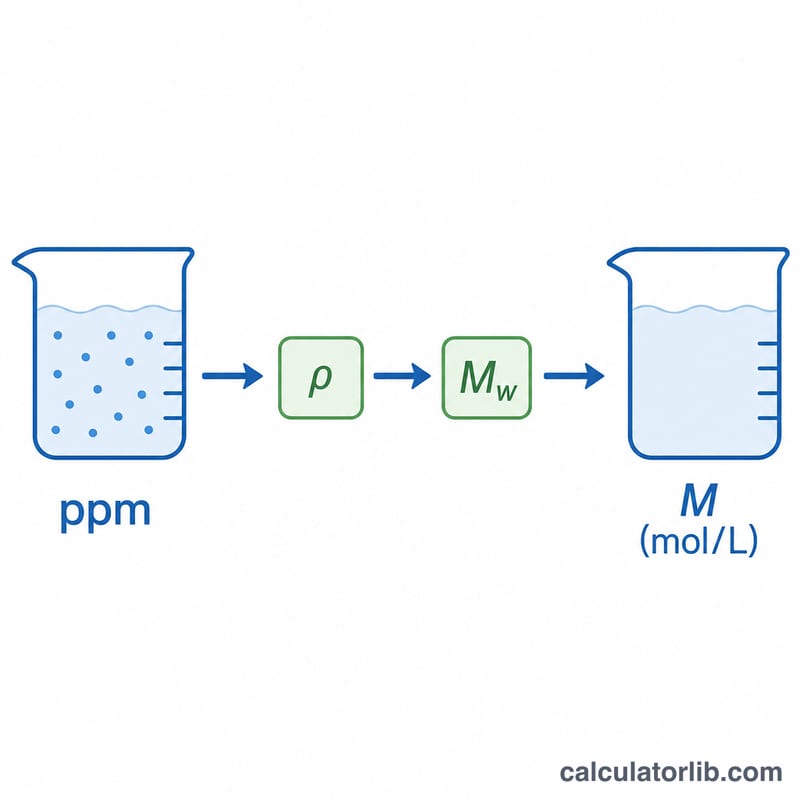
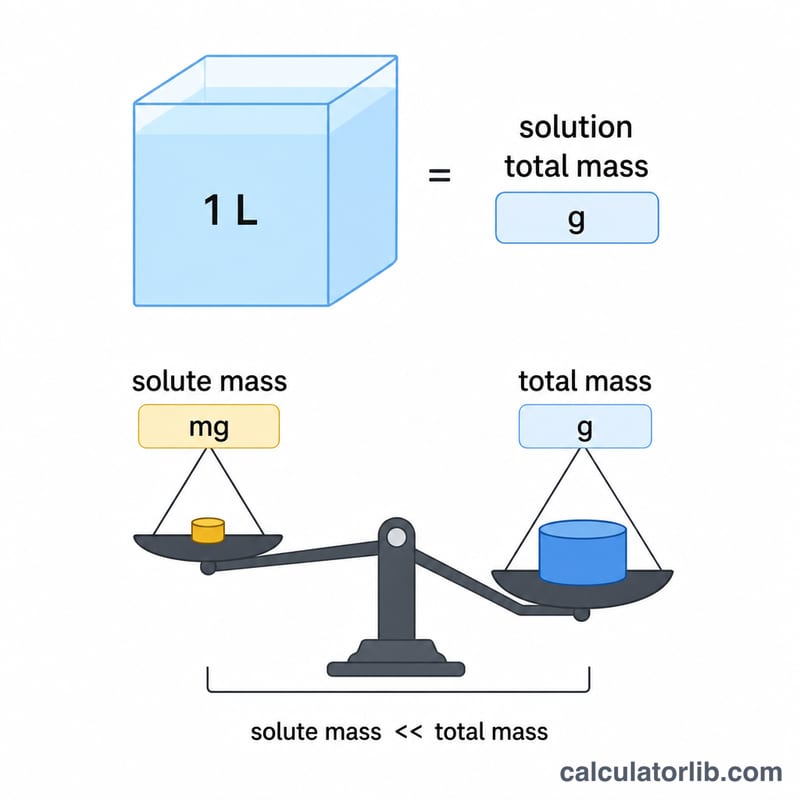
This tool converts a concentration expressed in parts per million (ppm) into molarity (moles of solute per liter of solution, mol/L or M). ppm is a mass ratio — milligrams of solute per kilogram of solution — while molarity is a molar concentration, so converting between them requires the solute's molar mass and the solution's density.
How to use it
Enter three values: the concentration in ppm, the molar mass of your solute in g/mol, and the density of the solution in g/L. For dilute aqueous solutions you can leave the density at the default 1000 g/L (the density of water), in which case 1 ppm equals 1 mg/L. Click calculate to see the molarity and the equivalent millimolarity.
The formula explained
The general relationship is:
$$M = \dfrac{\text{ppm} \times \rho_{g/L}}{1000 \times 1000 \times M_w}$$
Here ppm is mass solute per mass solution. Multiplying by density (g/L) and dividing by 1000 converts ppm to mg per liter; dividing again by 1000 converts mg to grams; and dividing by molar mass converts grams to moles. For dilute water (density 1000 g/L) this simplifies to $$M = \dfrac{\text{ppm}}{1000 \times M_w}$$.
Worked example
Suppose you have 100 ppm of sodium chloride (NaCl, molar mass 58.44 g/mol) in a dilute aqueous solution (density 1000 g/L). $$M = \dfrac{100 \times 1000}{1000 \times 1000 \times 58.44} = \dfrac{100{,}000}{58{,}440{,}000} \approx 0.001711 \text{ mol/L}$$ or about 1.711 mM.
FAQ
Does 1 ppm always equal 1 mg/L? Only when the solution density is 1000 g/L (water). For denser or lighter solutions, ppm × density/1000 gives mg/L.
What molar mass should I use? Use the molar mass of the actual solute species — for salts use the full formula mass (e.g. 58.44 for NaCl).
What if I leave density blank? The calculator defaults to 1000 g/L, appropriate for dilute aqueous solutions.