
What Is the Activity Coefficient?
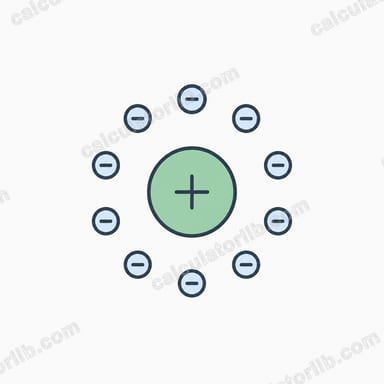
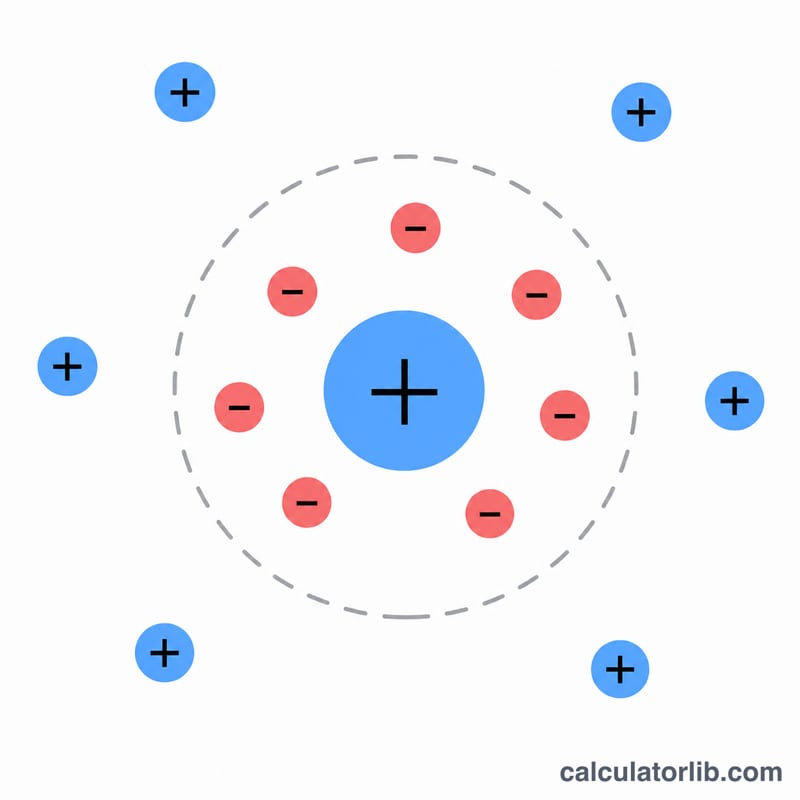
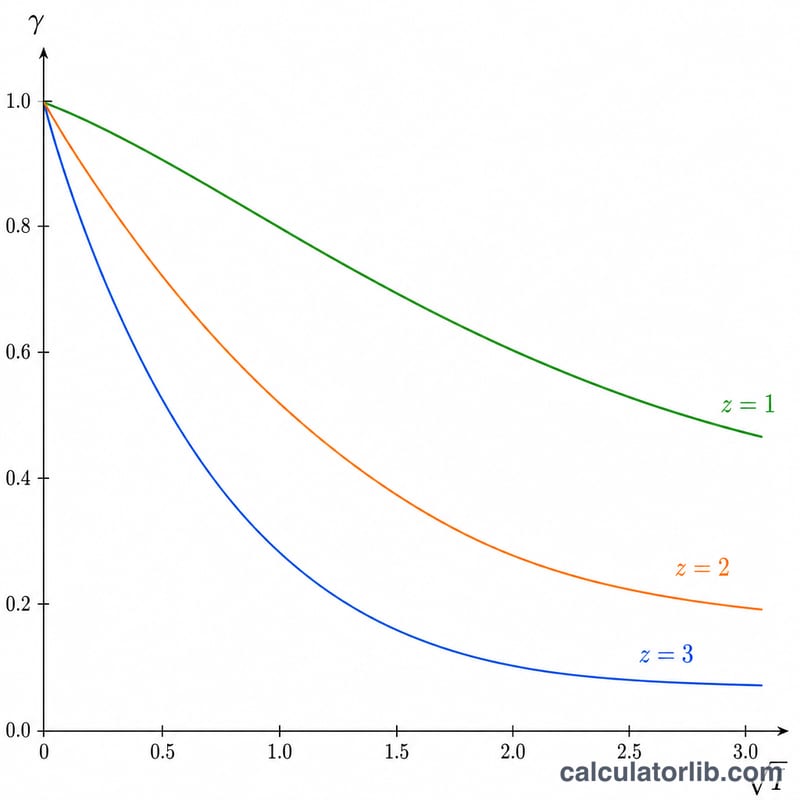
The activity coefficient (γ) corrects the effective concentration of an ion in solution for non-ideal behavior caused by electrostatic interactions with surrounding ions. In an ideal dilute solution γ approaches 1, but as ionic strength rises, ion–ion attractions and repulsions lower the apparent activity. This calculator uses the Debye–Hückel limiting law, valid for very dilute aqueous solutions (typically I < 0.01 mol/L) at 25 °C.
How to Use It
Enter the ion's charge number z (e.g. +1 for Na⁺, −2 for SO₄²⁻ — sign does not matter since it is squared) and the solution's ionic strength I in mol/L. The tool returns log₁₀(γ) and the activity coefficient γ.
The Formula Explained
The limiting law states $$\log_{10}(\gamma) = -0.509 \, z^2 \sqrt{I}$$ The constant 0.509 (mol/L)−1/2 applies to water at 25 °C. Because the charge is squared, multiply-charged ions deviate from ideality far more strongly than singly-charged ones. The ionic strength is \(I = \tfrac{1}{2} \sum (c_i \cdot z_i^2)\) over all ions in solution.
Worked Example
For a doubly charged ion (z = 2) in a solution with I = 0.01 mol/L: $$\log_{10}(\gamma) = -0.509 \cdot (2^2) \cdot \sqrt{0.01} = -0.509 \cdot 4 \cdot 0.1 = -0.2036$$ Then \(\gamma = 10^{-0.2036} \approx 0.6256\). The effective activity is about 63% of the nominal concentration.
Constants Used in the Debye–Hückel Limiting Law
The Debye–Hückel limiting law expresses the single-ion activity coefficient as
$$\log_{10}\gamma = -A\,z^{2}\sqrt{I}$$where \(z\) is the ion charge number, \(I\) is the ionic strength (in mol/L), and \(A\) is the Debye–Hückel constant. For an aqueous solution at 25 °C the standard value is
$$A = 0.509\ (\text{mol/L})^{-1/2}$$
The constant \(A\) is not universal — it depends on the absolute temperature \(T\) and the dielectric (relative permittivity) constant \(\varepsilon_r\) of the solvent, scaling roughly as \(A \propto (\varepsilon_r T)^{-3/2}\). Because the dielectric constant of water falls as temperature rises, \(A\) increases with temperature, as shown below.
| Temperature | \(A\) for water (mol/L)\(^{-1/2}\) |
|---|---|
| 0 °C | ≈ 0.492 |
| 25 °C | 0.509 |
| 50 °C | ≈ 0.534 |
Units note: Since \(I\) carries units of mol/L, the product \(A\sqrt{I}\) is dimensionless and \(A\) carries units of (mol/L)\(^{-1/2}\). The activity coefficient \(\gamma\) itself is dimensionless.
Worked example: For a divalent ion (\(z = 2\)) at an ionic strength of \(I = 0.001\) mol/L in water at 25 °C, \(\log_{10}\gamma = -0.509 \times 2^{2} \times \sqrt{0.001} = -0.0644\), giving \(\gamma = 10^{-0.0644} = \)0.862.
Solvent dependence: In solvents with a lower dielectric constant than water (e.g. methanol, \(\varepsilon_r \approx 33\)), \(A\) is substantially larger, so ion–ion interactions and deviations from ideality become more pronounced. The 0.509 value should therefore only be used for dilute aqueous solutions near room temperature.
FAQ
When is the limiting law accurate? Only at low ionic strength (roughly I < 0.01 mol/L). For higher concentrations, use the extended Debye–Hückel or Davies equations.
Does the sign of z matter? No. Because z is squared, +2 and −2 give identical results.
Why is γ less than 1? Surrounding counter-ions shield each ion, reducing its effective (thermodynamic) concentration below the actual molar concentration.