
What Is the Alligation Method?
Alligation is a classic technique used in pharmacy, chemistry, and compounding to determine how to mix two solutions of known strength to obtain a target concentration that lies between them. Instead of trial and error, alligation gives an exact ratio of the two stock solutions. This calculator works with any consistent unit — percent, mg/mL, molarity, or proof — as long as you use the same unit for all three concentrations.
How to Use This Calculator
Enter the low concentration, the high concentration, and the desired (target) concentration. The target must be between the low and high values. Optionally enter a total amount you want to prepare, and the calculator will split it into how much of each stock solution to use. The result shows the mixing ratio (low : high) and the corresponding amounts.
The Formula Explained
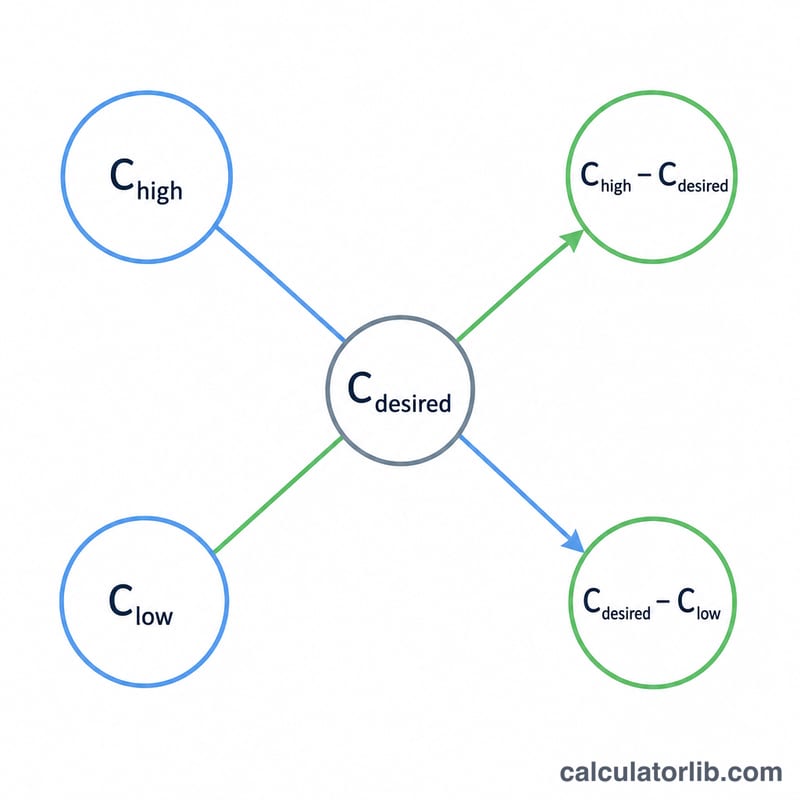
The alligation rule states that the parts of the low-strength solution equal the difference between the high concentration and the desired concentration, while the parts of the high-strength solution equal the difference between the desired and low concentrations:
$$\text{Ratio}_{low:high} = (C_{high} - C_{desired}) : (C_{desired} - C_{low})$$
To convert parts into real amounts, multiply your total batch size by each solution's parts divided by the total number of parts.
Worked Example
Suppose you have a 5% solution and a 20% solution and want 100 mL of a 12% solution. Parts of low = \(20 - 12 = 8\); parts of high = \(12 - 5 = 7\). So the ratio is \(8 : 7\) (15 total parts). Amount of low:
$$A_{low} = 100 \times \frac{8}{15} \approx 53.33 \text{ mL}$$amount of high:
$$A_{high} = 100 \times \frac{7}{15} \approx 46.67 \text{ mL}$$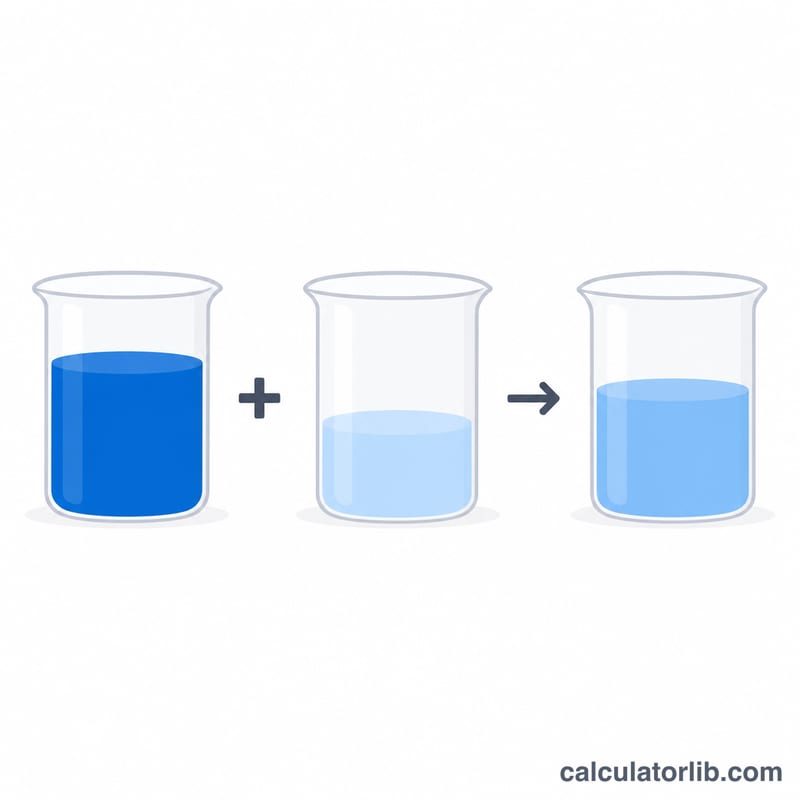
Key Terms & Variables
- Low concentration (clow)
- The strength of the weaker of the two solutions being combined, expressed as % w/v, % v/v, mg/mL, molarity, or any consistent unit. It may be a diluent of 0% (e.g. pure water or saline base).
- High concentration (chigh)
- The strength of the stronger of the two solutions. The desired concentration must lie between the low and high values for a valid mix.
- Desired concentration (cdesired)
- The target strength of the final mixture. It must satisfy \(\text{Low} \le \text{Desired} \le \text{High}\).
- Stock solution
- A concentrated solution kept on hand and diluted as needed. In alligation, the high (and sometimes the low) solution is typically a stock.
- Parts
- Relative, unitless proportions obtained by cross-subtraction: parts of low \(= \text{High} - \text{Desired}\) and parts of high \(= \text{Desired} - \text{Low}\). They define how the batch is split before scaling to actual volumes.
- Mixing ratio
- The parts expressed as a ratio, low : high, usually reduced to its simplest whole-number form (e.g. 3 : 1).
- Alligation alternate
- The method used by this calculator: given two known strengths and a target, it finds the proportion of each component needed to reach that target.
- Alligation medial
- The reverse problem: given known quantities and strengths of several components, it computes the resulting average (weighted mean) concentration of the mixture.
- Batch size (total)
- The total volume (or mass) of finished mixture you want to prepare. The parts/ratio are scaled to this total to give the actual amount of each solution.
FAQ
What if my target equals one of the stock concentrations? Then one "part" becomes zero and you only need that single solution.
Can I use it for three or more solutions? Standard alligation handles two stocks. For three or more, repeat the process in pairs.
Does the unit matter? No — just keep all three concentrations in the same unit and the resulting amounts will match your total's unit.