
What is the dilution factor?
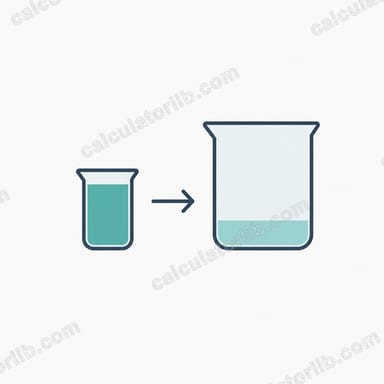
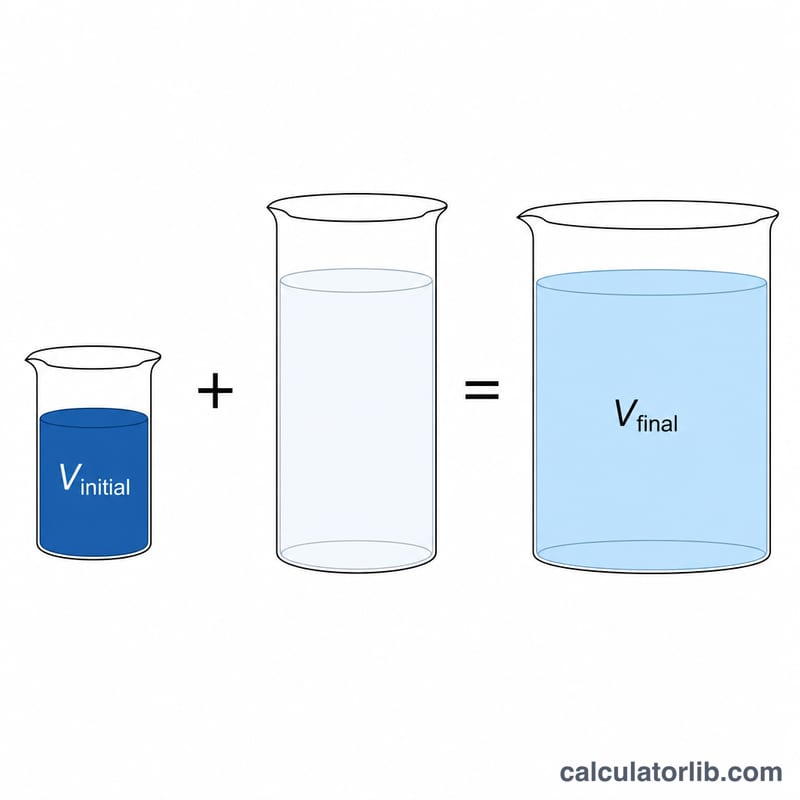
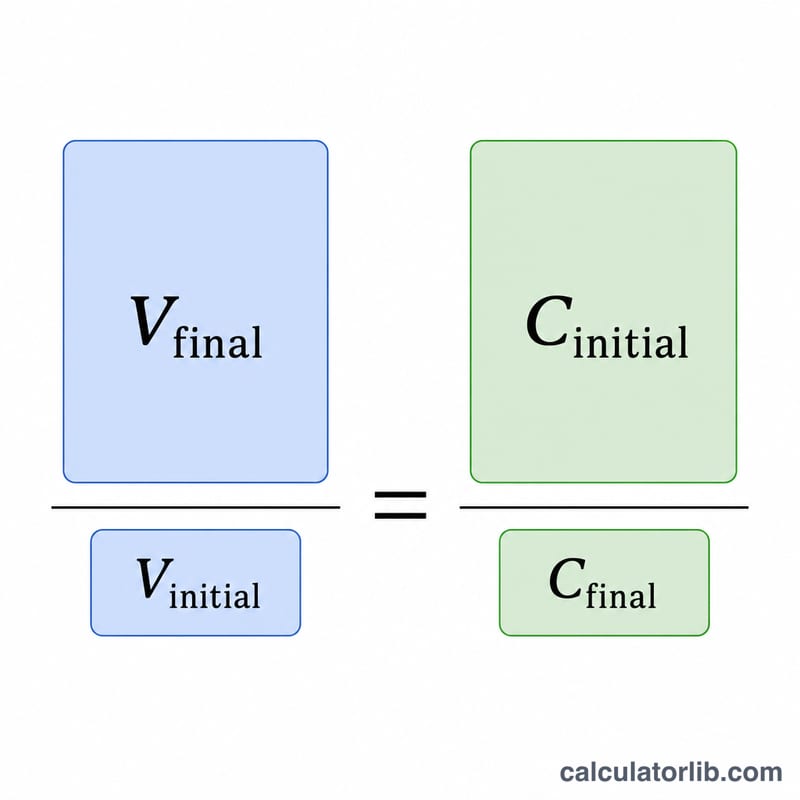
The dilution factor (DF) tells you how many times a sample has been diluted. It equals the final (total) volume divided by the initial sample volume. Because diluting reduces concentration in proportion to the increase in volume, the dilution factor also equals the ratio of the original concentration to the diluted concentration. A dilution factor of 10 (often written 1:10) means one part sample was made up to ten parts total.
How to use this calculator
Enter the initial (sample) volume — the amount of your concentrated stock — and the final (total) volume after adding solvent. Use the same units for both (mL, µL, L). The calculator returns the dilution factor, the equivalent fold dilution, and the volume of diluent (solvent) you need to add to reach the final volume.
The formula explained
The core equation is $$\text{DF} = \frac{V_{\text{final}}}{V_{\text{initial}}}.$$ The volume of solvent required is simply the final volume minus the sample volume. If you know the dilution you want and your stock concentration, you can rearrange to find the diluted concentration: \(C_{\text{final}} = C_{\text{initial}} \div \text{DF}\).
Worked example
You take 2 mL of a stock solution and add buffer until the total volume is 50 mL. The dilution factor is $$50 \div 2 = 25$$ (a 1:25 dilution). You added \(50 - 2 = 48\ \text{mL}\) of diluent. If the stock was 100 mg/mL, the diluted solution is \(100 \div 25 = 4\ \text{mg/mL}\).
FAQ
Is a dilution factor of 10 the same as 1:10? Yes. A DF of 10 means the sample is one tenth of the final volume, written as 1:10.
What units should I use? Any volume unit works, as long as the initial and final volumes use the same unit — the factor is dimensionless.
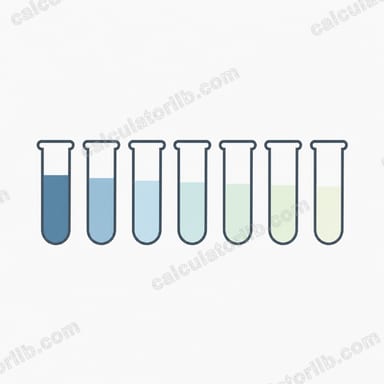
How do I do serial dilutions? Multiply the individual dilution factors. Three successive 1:10 steps give a total DF of \(10 \times 10 \times 10 = 1000\).