
What is a serial dilution?
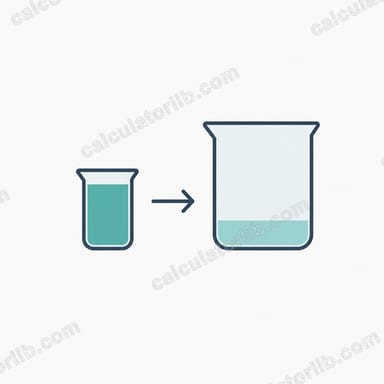
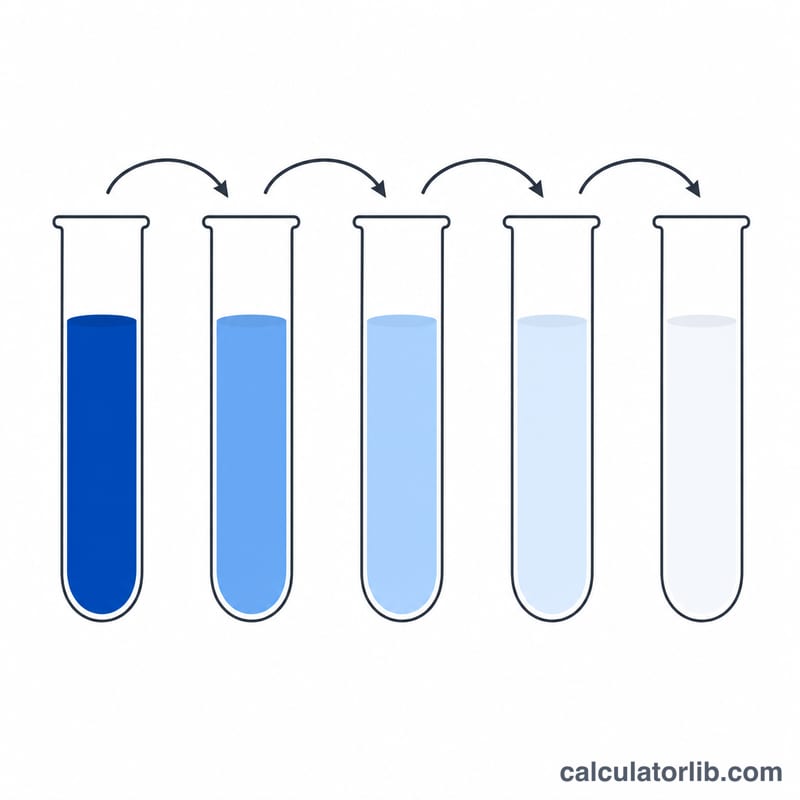
A serial dilution is a stepwise dilution of a substance in solution, where each step uses the same dilution factor as the previous one. Serial dilutions are widely used in chemistry, microbiology, pharmacology, and immunoassays to produce very low concentrations accurately, since diluting a large amount in one step is impractical and imprecise.
How to use this calculator
Enter three values: the initial concentration C₀ (in any unit such as M, mg/mL, or CFU/mL), the dilution factor applied at each step (for example 10 for a 1:10 dilution), and the number of dilution steps n. The calculator returns the final concentration Cₙ plus the total dilution factor across all steps.
The formula explained
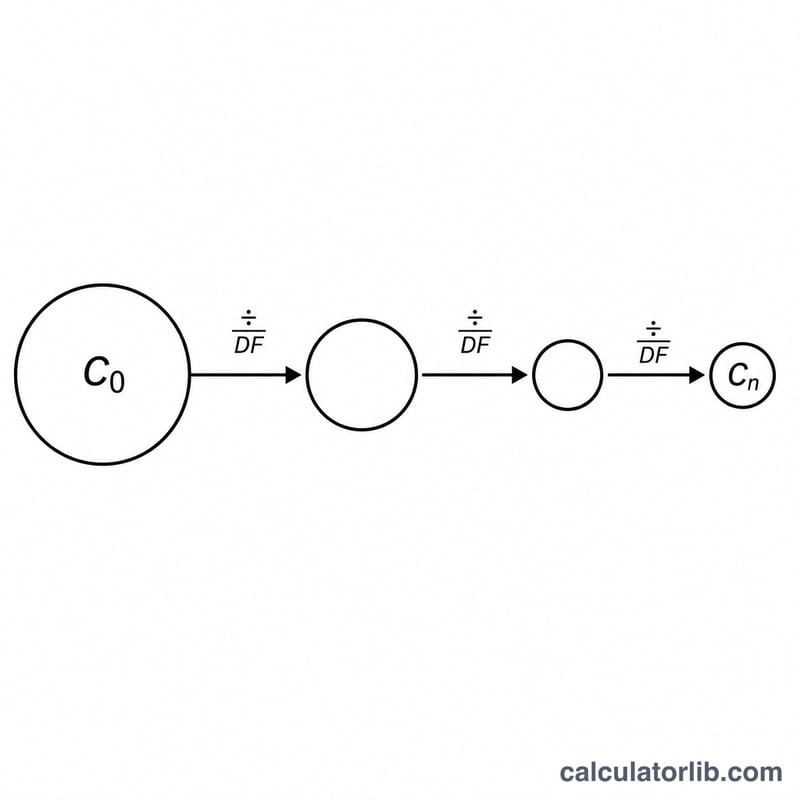
Each dilution step divides the concentration by the dilution factor (DF). After one step the concentration is \(C_0/\text{DF}\), after two steps \(C_0/\text{DF}^2\), and after n steps:
$$C_n = \dfrac{C_0}{\text{DF}^{n}}$$
The total or overall dilution factor is simply \((\text{DF})^n\), telling you how many times more dilute the final solution is compared with the starting stock.
Worked example
Suppose you start with a stock at \(C_0 = 100\ \text{mg/mL}\) and perform a 1:10 (DF = 10) serial dilution five times (n = 5). The total dilution factor is \(10^5 = 100{,}000\), so the final concentration is $$\frac{100}{100{,}000} = 0.001\ \text{mg/mL}\ (1\ \mu\text{g/mL}).$$
FAQ
What does a 1:10 dilution mean? It means one part sample plus nine parts diluent, giving a dilution factor of 10 (the sample is now one-tenth as concentrated).
Can the dilution factor be a decimal? Yes — any value of 1 or greater works. A factor of 1 means no dilution.
What units should I use? Use any concentration unit you like; the final result is reported in the same unit as C₀, since the ratio cancels the units.