
What this calculator does
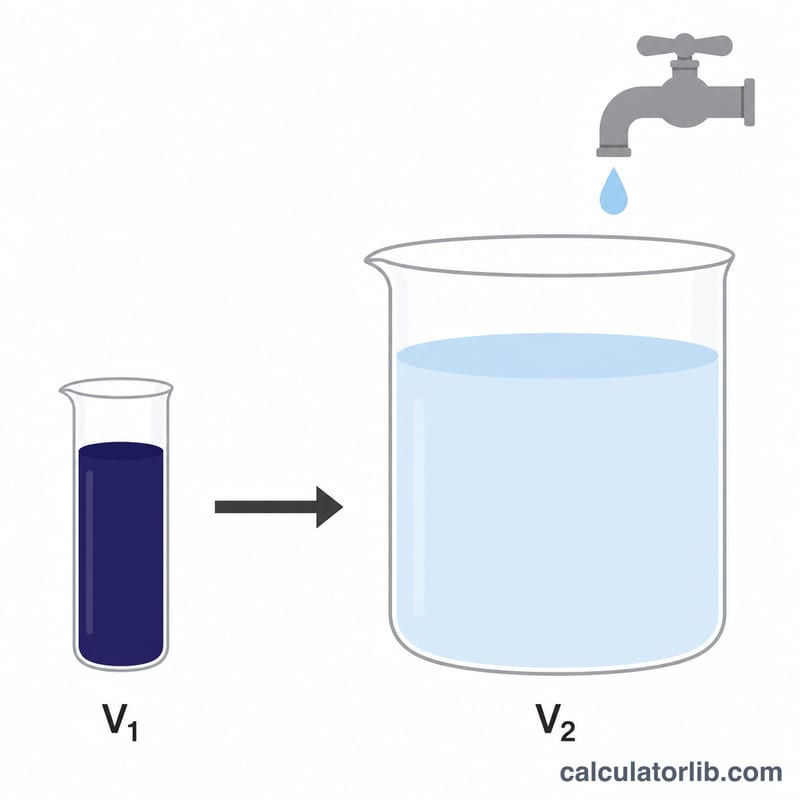
This tool tells you how much concentrate (stock solution, undiluted liquid) you need to make a desired total volume of diluted solution, plus how much water to add. It works for everyday dilutions of detergents, disinfectants, pesticides, liquid fertilizers, lab reagents, and even diluting drinks. It is a universal arithmetic tool with no country-specific rules.
How to use it
Enter the total volume of diluted solution you want to make (in mL). Then choose a specification method. In concentration mode, enter the concentration of your stock solution and the concentration you want in the final solution (both in %). In fold mode, just enter the dilution ratio, e.g. 50 for a 1:50 (50-fold) dilution. Pick how many decimal places to round the answer to and read off the required concentrate volume and the water to add.
The formula explained
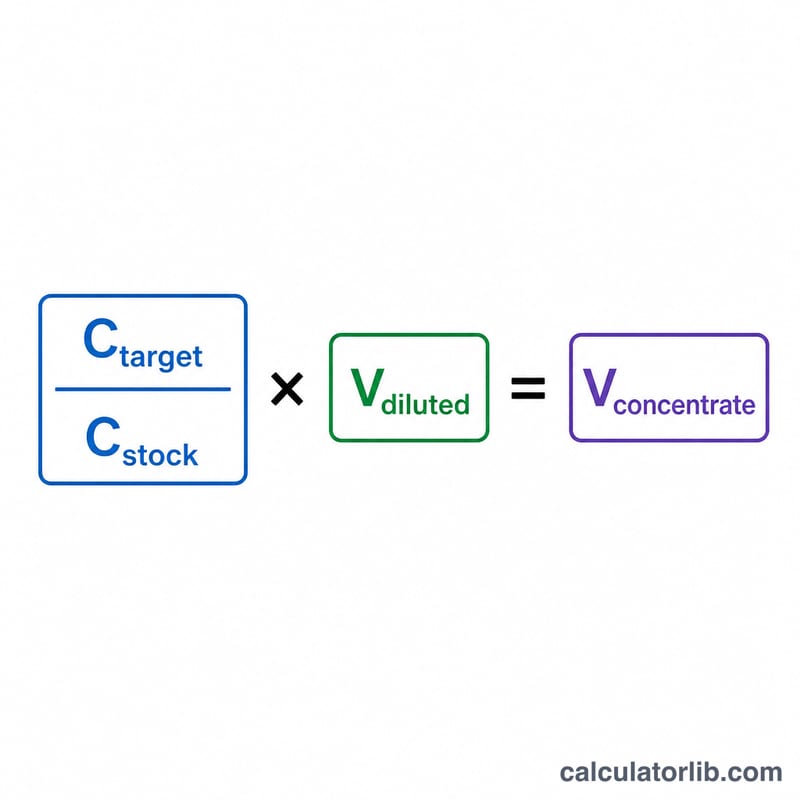
By concentration, the required concentrate is $$V_{c} = \frac{\text{Diluted Conc. (\%)}}{\text{Stock Conc. (\%)}} \times \text{Diluted Volume (mL)}$$ Because percent appears in both the top and bottom of the fraction it cancels, so the result comes out directly in mL. By fold, the required concentrate is simply $$V_{c} = \frac{\text{Diluted Volume (mL)}}{\text{Dilution Ratio (fold)}}$$ In both cases the water to add is \(\text{Diluted Volume} - V_{c}\). The two modes are consistent: a dilution fold of \(N\) is the same as targeting a concentration of \(\text{stock}/N\).
Worked example
To make 3000 mL of a 0.1% solution from a 5% stock: $$\text{concentrate} = \frac{0.1}{5} \times 3000 = 0.02 \times 3000 = 60 \text{ mL}$$ and \(\text{water} = 3000 - 60 = \mathbf{2940}\) mL. The same answer comes from fold mode with a 50-fold dilution: \(3000 / 50 = 60\) mL.
FAQ
Why is the answer the same in both modes? A 5% stock taken to 0.1% is a 50-fold dilution (\(5 / 0.1 = 50\)), so both methods give 60 mL.
Can the target be more concentrated than the stock? No. You cannot increase concentration by adding water, so the target concentration must be less than or equal to the stock concentration.
Is this exact? It is a simple volume-based (v/v) approximation that ignores volume contraction or expansion on mixing and density differences. It is fine for routine household and garden dilutions; for precise lab work account for these effects. No responsibility is assumed for results.