
What This Calculator Does
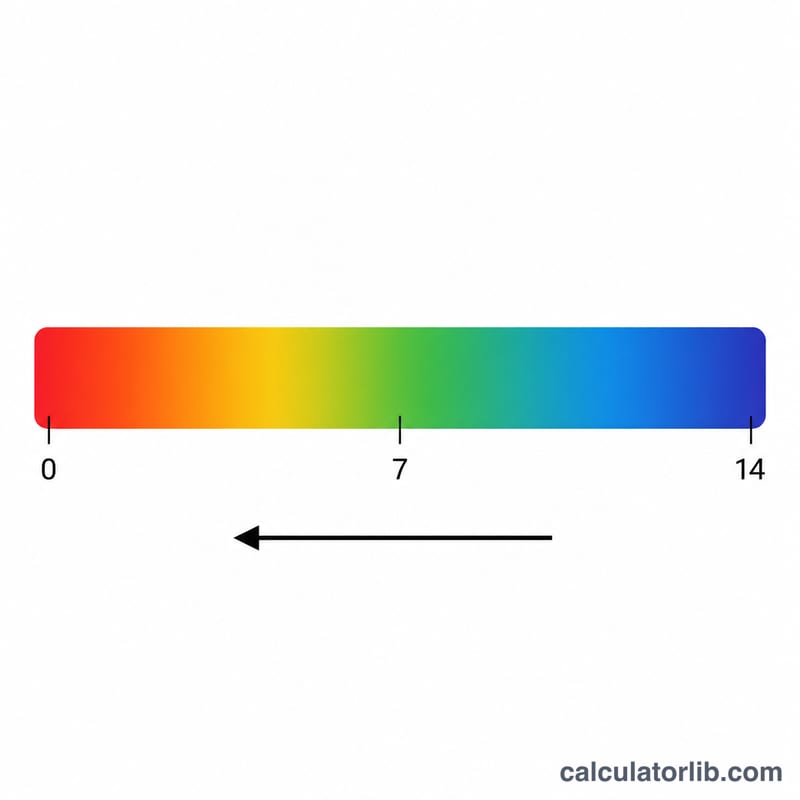
This tool finds the pH of a strong acid or strong base after it has been diluted. Strong acids (HCl, HNO3, H2SO4 as a first approximation) and strong bases (NaOH, KOH) dissociate completely in water, so their hydrogen- or hydroxide-ion concentration equals the molar concentration of the dissolved solute. Diluting the solution lowers that concentration and pushes the pH toward 7.
How To Use It
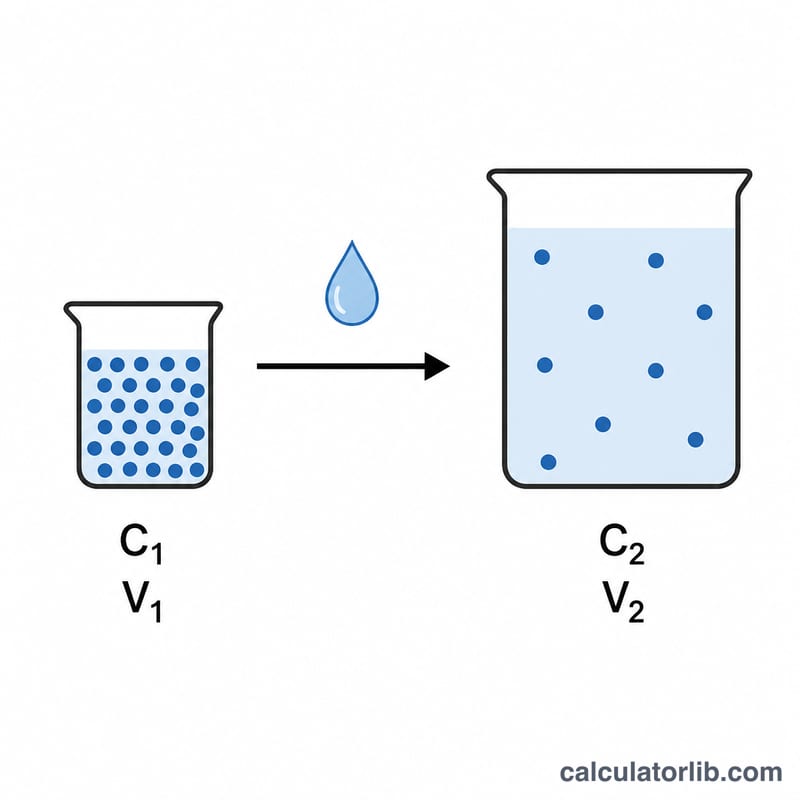
Choose whether the solution is a strong acid or strong base. Enter the initial molar concentration C1 (mol/L), the initial volume V1, and the final volume V2 after adding solvent. V1 and V2 must share the same unit. The calculator returns the diluted concentration C2, the resulting pH, and the corresponding pOH.
The Formula Explained
Dilution conserves the number of moles of solute, giving the classic relationship \(C_1 \cdot V_1 = C_2 \cdot V_2\), so \(C_2 = C_1 \cdot V_1 / V_2\). For a strong monoprotic acid, \([\text{H}^+] = C_2\) and $$\text{pH} = -\log_{10}(C_2)$$ For a strong base, \([\text{OH}^-] = C_2\), so \(\text{pOH} = -\log_{10}(C_2)\) and \(\text{pH} = 14 - \text{pOH}\) (at 25 degrees C, where the water ion-product pKw = 14).
Worked Example
Take 10 mL of 0.1 mol/L HCl and dilute to 100 mL. $$C_2 = \frac{0.1 \times 10}{100} = 0.01 \text{ mol/L}$$ $$\text{pH} = -\log_{10}(0.01) = 2$$ The acid that started at pH 1 is now at pH 2 after a ten-fold dilution.
FAQ
Does this work for weak acids? No. Weak acids and bases only partially dissociate, so their pH requires the acid dissociation constant Ka and an equilibrium calculation.
Why does the pH approach 7 with heavy dilution? As concentration falls, the contribution from water self-ionization becomes significant. This simple model assumes the solute dominates; at extremely low concentrations real pH limits near 7.
What temperature is assumed? 25 degrees C, where pKw = 14, used to convert between pH and pOH.