
What this calculator does
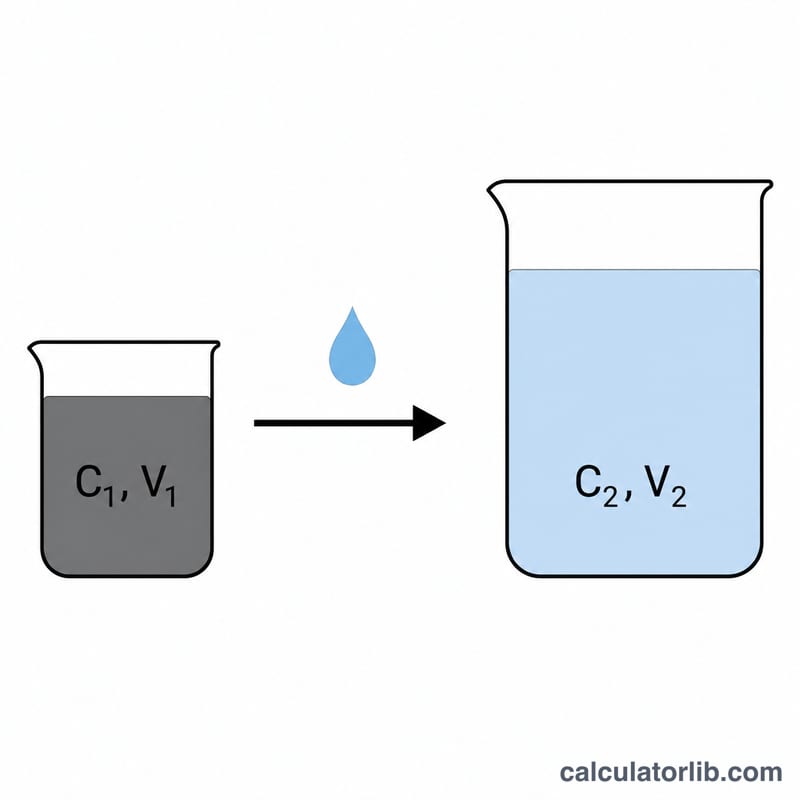
This tool solves the dilution equation for the final volume V2. Given a stock solution of concentration C1 and volume V1, it tells you the total volume you must reach so that the diluted solution has your desired final concentration C2. It also reports how much extra solvent you need to add. This is a universal chemistry relationship and applies anywhere — labs, cooking, gardening, and aquarium dosing.
How to use it
Enter the initial concentration (C1), the initial volume (V1), and the target concentration (C2) you want after diluting. Use any consistent units: C1 and C2 must share the same concentration unit (M, %, mg/mL, ppm), while V1 and V2 share the same volume unit (mL, L, gallons). The result V2 is the final total volume; the difference V2 − V1 is the solvent to add.
The formula explained
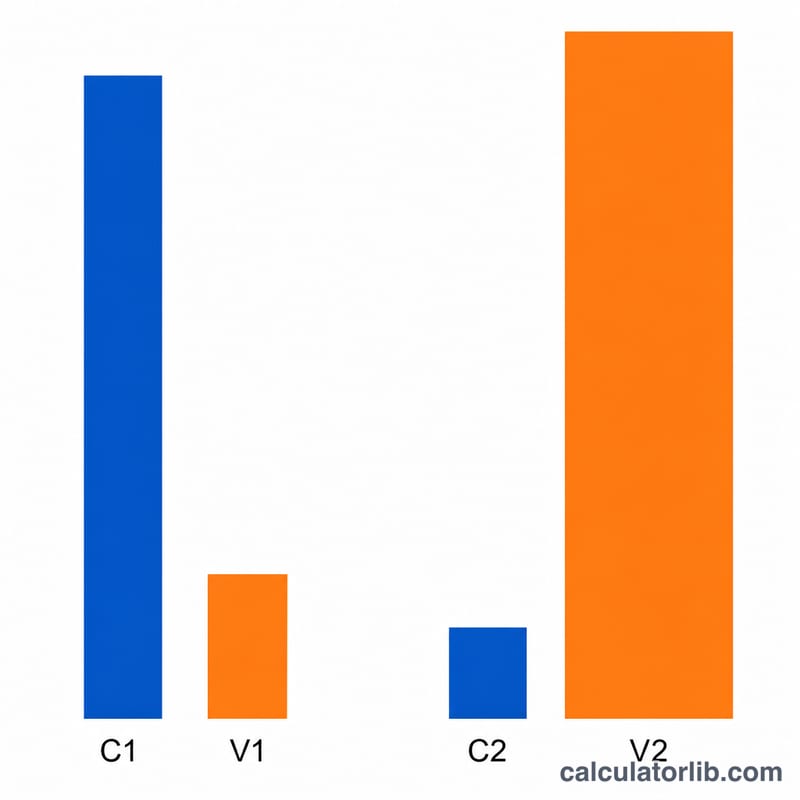
The conservation of solute means the amount of dissolved substance does not change during dilution: \(\text{C1}\cdot\text{V1} = \text{C2}\cdot\text{V2}\). Rearranging for the unknown final volume gives $$V_2 = \frac{\text{C1} \times \text{V1}}{\text{C2}}$$ Because C2 is in the denominator, a smaller target concentration produces a larger final volume, which matches intuition: more dilution needs more liquid.
Worked example
You have 5 mL of a 10 M stock and want a final concentration of 2 M. Then $$V_2 = \frac{10 \times 5}{2} = \frac{50}{2} = 25\ \text{mL}$$ Since you started with 5 mL, you add \(25 - 5 = 20\ \text{mL}\) of solvent.
FAQ
Do the units need to match? Yes — C1 and C2 must use the same concentration unit, and V2 comes out in the same volume unit as V1.
Can I dilute to a higher concentration? No. Dilution only lowers concentration. If C2 is greater than C1 the equation returns a volume smaller than V1, which is not physically a dilution.
What if C2 is zero? Division by zero is undefined, so a target of 0 is not valid — the calculator guards against it and returns 0.