
What is the Octal to Binary Converter?
This tool converts a number written in octal (base 8) into its binary (base 2) equivalent. Octal uses the digits 0 through 7, while binary uses only 0 and 1. Because 8 is exactly 2³, every single octal digit corresponds to a fixed group of three binary bits, which makes the conversion fast, exact, and reversible.
How to use it
Type any valid octal number (digits 0-7 only) into the input box and submit. The converter expands each digit into three bits, joins them, removes unnecessary leading zeros, and also shows the decimal value for reference. If you enter a digit of 8 or 9, the input is flagged as invalid because those digits do not exist in base 8.
The formula explained
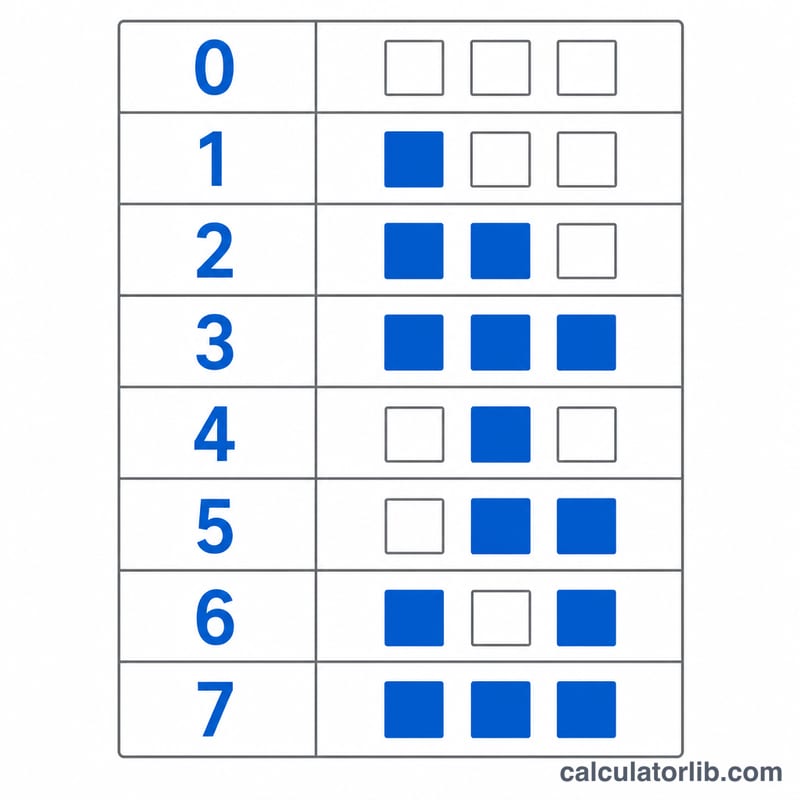
Each octal digit d is rewritten as a 3-bit binary string using the mapping: 0→000, 1→001, 2→010, 3→011, 4→100, 5→101, 6→110, 7→111. The bit groups are then concatenated in order.
$$\text{Binary}_2 = \underset{i}{\Big\Vert}\; \operatorname{bin}_3\!\left(\text{Octal digit}_i\right)$$Mathematically, a digit equals \(4b_2 + 2b_1 + b_0\), where each \(b_i\) is 0 or 1.
Worked example
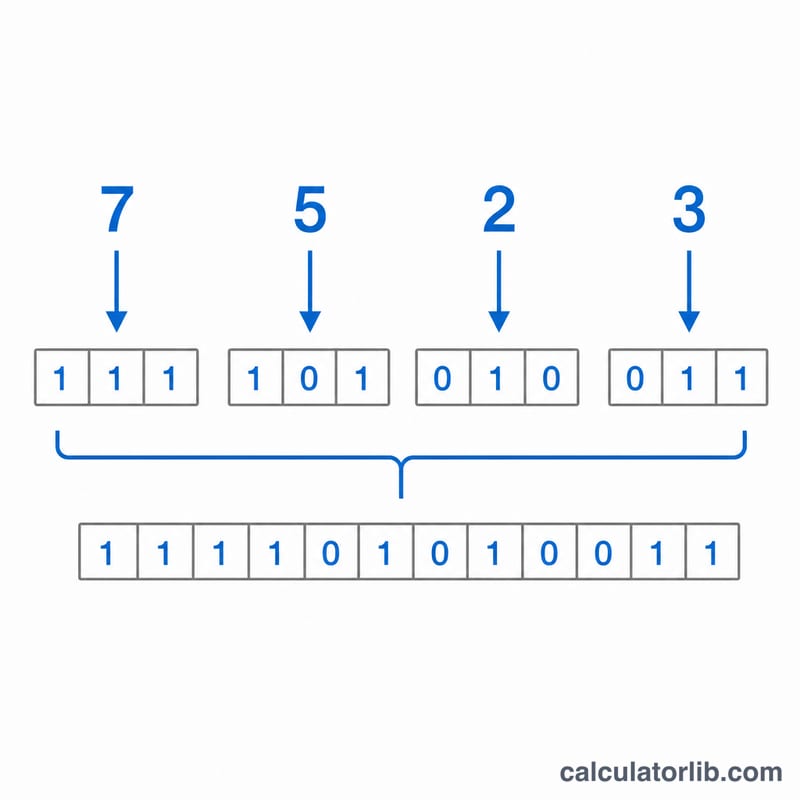
Convert octal 725:
7 → 111, 2 → 010, 5 → 101. Concatenated: 111010101. As a check, $$725_8 = 7\times64 + 2\times8 + 5 = 448 + 16 + 5 = 469$$ in decimal, and \(111010101_2 = 469\). The results match.
FAQ
Why exactly three bits per digit? Because \(2^3 = 8\), every octal digit (0-7) fits perfectly in three binary bits with no overlap.
Do leading zeros matter? Internally each digit becomes three bits, but the final binary value strips leading zeros (except a single 0), matching standard binary notation.
Can I convert numbers with a fractional part? This converter handles whole octal numbers. For fractions, each digit after the point also maps to three bits, grouped to the right of the binary point.