
What is the Ideal Gas Law Temperature Calculator?
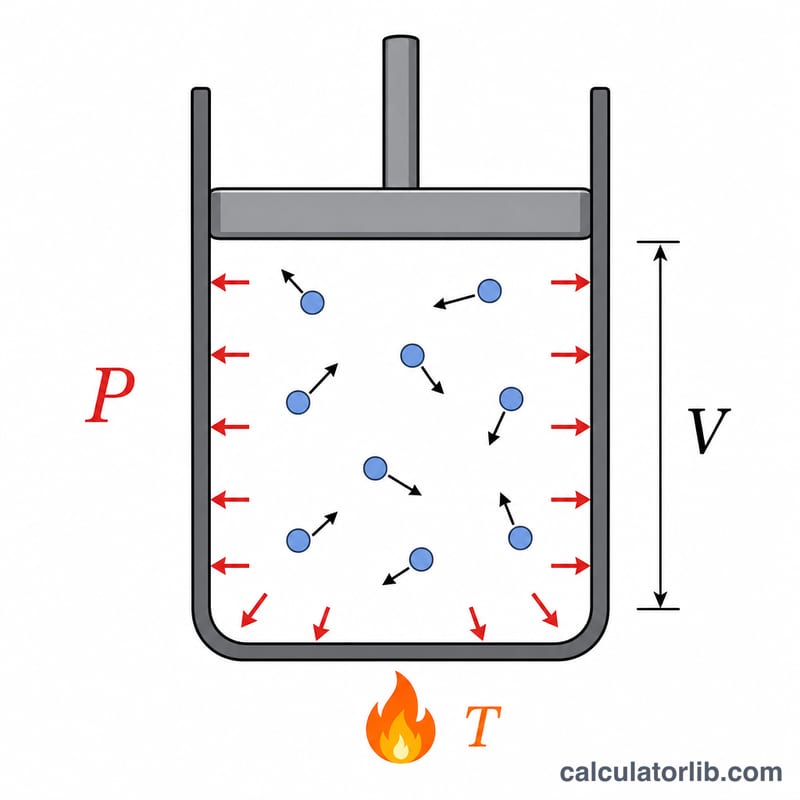
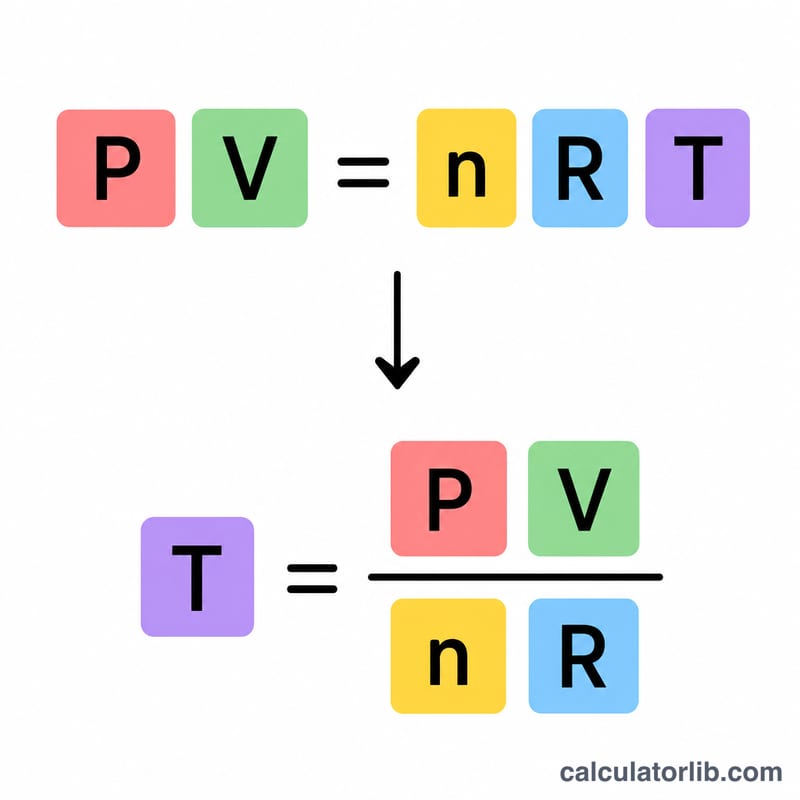
This calculator uses the ideal gas law, \(PV = nRT\), to solve for the absolute temperature of a gas. When you know the pressure, volume, and the amount of substance (in moles), you can rearrange the equation to find the temperature: \(T = PV / (nR)\). The universal gas constant R is fixed at 8.314 J/(mol·K), so the inputs must be in SI units — pressure in pascals (Pa) and volume in cubic metres (m³) — to produce a temperature in kelvin.
How to use it
Enter the gas pressure in pascals, the volume in cubic metres, and the amount of gas in moles. The calculator returns the absolute temperature in kelvin and also converts it to degrees Celsius and Fahrenheit for convenience. If your data is in other units, convert first: 1 atm ≈ 101,325 Pa, 1 L = 0.001 m³.
The formula explained
The ideal gas law links the four state variables of an ideal gas. Solving for temperature gives $$T = \frac{\text{Pressure (Pa)} \times \text{Volume (m}^3\text{)}}{\text{Amount (mol)} \times R}$$ Pressure times volume represents the total work-equivalent energy of the gas, and dividing by the product of moles and the gas constant scales it to an absolute temperature. The result is always in kelvin, where 0 K is absolute zero.
Worked example
Suppose 1 mole of gas occupies 0.0224 m³ at standard atmospheric pressure of 101,325 Pa. Then $$T = \frac{101{,}325 \times 0.0224}{1 \times 8.314} = \frac{2{,}269.68}{8.314} \approx 272.99 \text{ K}$$ or about −0.16 °C — close to standard temperature, as expected for the molar volume at STP.
FAQ
What units should I use? Use SI units: pascals for pressure and cubic metres for volume, so the answer comes out in kelvin.
What value of R does it use? The calculator uses \(R = 8.314\) J/(mol·K), the SI value of the universal gas constant.
Why is my temperature negative in Celsius? Kelvin is an absolute scale; subtracting 273.15 can yield a negative Celsius value for cold gases — that is normal.