
What It Does
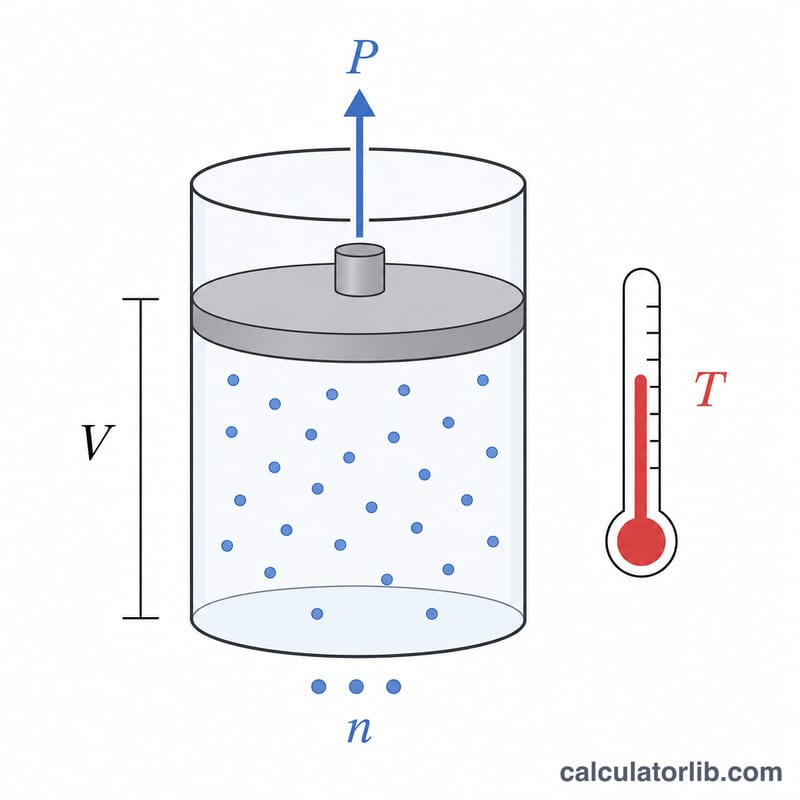
The Ideal Gas Temperature Calculator rearranges the ideal gas law, \(PV = nRT\), to solve for temperature: \(T = PV/(nR)\). Given the pressure, volume, amount of substance, and the universal gas constant, it returns the absolute temperature of the gas in kelvin, along with the equivalent in degrees Celsius. This is a universal physics/chemistry tool with no jurisdiction restrictions.
How to Use It
Enter the four inputs in consistent SI units: pressure P in pascals (Pa), volume V in cubic metres (m³), amount n in moles (mol), and the gas constant R in joules per mole per kelvin (J/mol·K). The default R is 8.314 J/mol·K. The calculator multiplies P by V, divides by n × R, and displays the temperature instantly.
The Formula Explained
The ideal gas law states \(PV = nRT\). Solving for T isolates temperature on one side:
$$T = \frac{P \cdot V}{n \cdot R}$$Pressure and volume in the numerator raise temperature, while more moles of gas or a larger gas constant lower the calculated temperature for the same P and V. The result is an absolute temperature, so a negative kelvin value indicates physically impossible inputs.
Worked Example
One mole of an ideal gas occupies 0.0224 m³ at 101325 Pa, with R = 8.314 J/mol·K. Then
$$T = \frac{101325 \times 0.0224}{1 \times 8.314} = \frac{2269.68}{8.314} \approx 272.99 \text{ K}$$which is about −0.16 °C — close to standard temperature, confirming the molar volume at standard conditions.
FAQ
What units should I use? Use SI units (Pa, m³, mol) so the answer comes out in kelvin. Mixing units (e.g. litres with pascals) gives wrong results.
What value of R should I enter? Use 8.314 J/mol·K for SI units. If you work in litre-atmospheres, use 0.08206 with pressure in atm and volume in L.
Why is my temperature negative? Kelvin cannot be negative for a real gas; check that your pressure, volume, and moles are all positive and physically reasonable.