
What the Gas Line Calculator Does
This calculator helps homeowners, plumbers and HVAC installers in the United States estimate the correct gas pipe diameter and flow rate for a natural gas line. Sizing matters: a pipe that is too small starves appliances of fuel, while an oversized line wastes material and money. By entering your total load, run length and supply pressure, the tool matches your demand against standard pipe capacity tables and returns a recommended nominal pipe size in inches plus an estimated flow rate.
The Three Inputs
- Total BTU – the combined input rating of every appliance the line will feed (furnace, water heater, range, dryer, etc.).
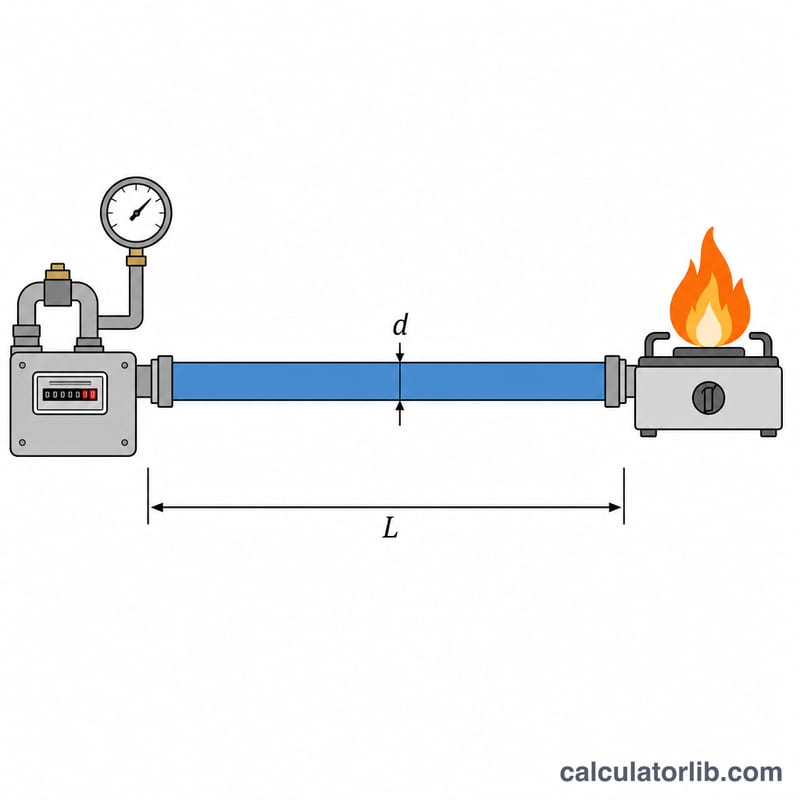
- Pipe Length (feet) – the developed length of the gas run from the meter or regulator to the appliance.
- Pressure (inches water column) – the supply pressure. Typical residential low-pressure systems run around 0.5 inch w.c.; the tool selects a different capacity table for higher pressures.
How the Calculation Works
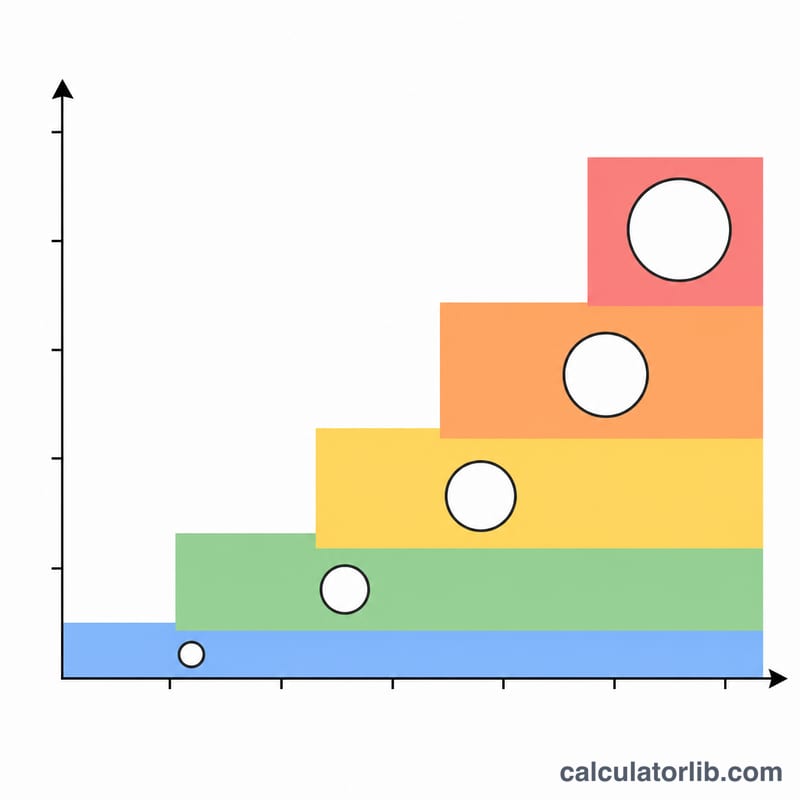
The tool first picks a capacity table based on your pressure: under 0.75, under 1.5, under 2.5, under 3.5, under 4.5, or 4.5 and above inches of water column. Within that table it scans standard pipe sizes — 0.5", 0.75", 1", 1.25", 1.5" and 2" — and returns the first size whose rated capacity meets or exceeds your total BTU. If no listed size is large enough, it returns the 2" pipe.
The estimated flow rate is calculated simply as:
- $$\text{Flow Rate (CFH)} = \frac{\text{Total BTU}}{1000}$$
This converts the heat load into approximate cubic feet of natural gas per hour, since one cubic foot delivers roughly 1,000 BTU.
Worked Example
Suppose you have a total load of 150,000 BTU, a run of 40 feet, and a supply pressure of 0.5 inch w.c. The pressure under 0.75 selects the first capacity row. Scanning across it, the 0.5", 0.75" and 1" sizes fall short, but the 1.25" pipe (rated 1,390) still does not cover 150,000... so the tool returns the largest size, 2 inches. The estimated flow rate is $$150{,}000 \div 1{,}000 = 150 \text{ CFH}$$
Frequently Asked Questions
Does the calculator account for pipe length in the result? Pipe length is collected as an input, but the size recommendation is driven by your total BTU and pressure against the capacity table. For very long runs, always verify against a full sizing chart, as longer runs reduce capacity.
What if I don't know my pressure? Standard residential natural gas is delivered at about 0.5 inch w.c. after the regulator, which uses the first table. Use higher values only if you have a verified higher-pressure system.
Is this a substitute for code compliance? No. Use this tool for planning estimates only. Final sizing must follow local codes and the National Fuel Gas Code (NFPA 54), and be confirmed by a licensed professional.