
What Is the Specific Gas Constant?
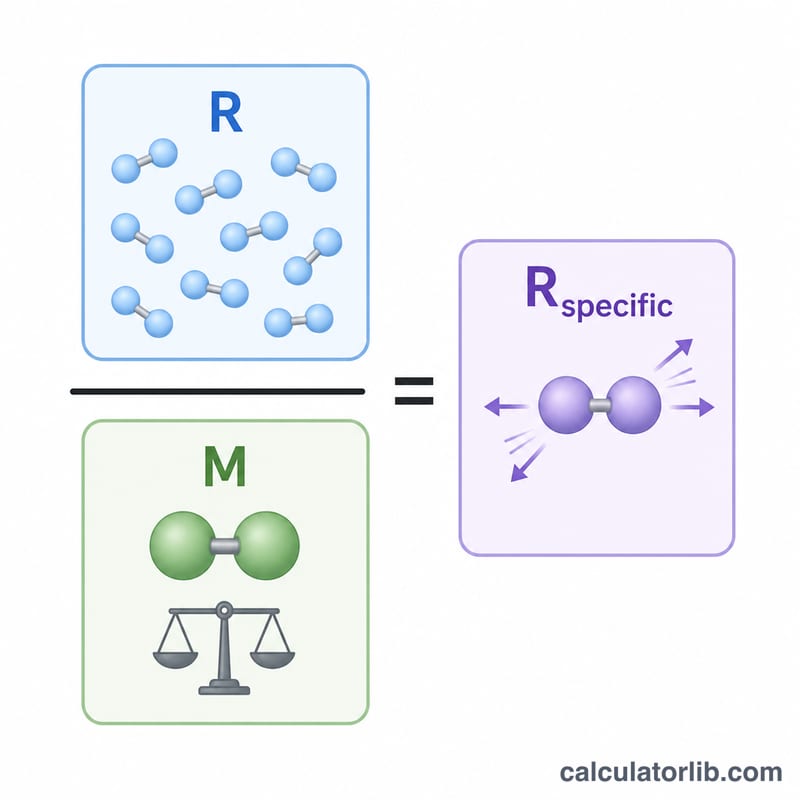
The specific gas constant (also called the individual gas constant), denoted Rspecific, is the universal gas constant R divided by the molar mass M of a particular gas. While the universal gas constant (8.314 J/mol·K) is the same for all ideal gases, the specific gas constant is unique to each substance and is expressed per unit mass, in joules per kilogram per kelvin, J/(kg·K). It appears in the mass-based form of the ideal gas law, \(pV = mR_{\text{specific}}T\).
How to Use This Calculator
Enter the molar mass of your gas in grams per mole (g/mol). The calculator converts it to kg/mol and divides the universal gas constant by it. For example, dry air has a molar mass of about 28.97 g/mol, oxygen (O₂) is 32 g/mol, and water vapor (H₂O) is 18.015 g/mol.
The Formula Explained
The relationship is simply
$$R_{\text{specific}} = \frac{R}{M}$$Because \(R\) is in J/(mol·K) and we want a per-kilogram result, the molar mass must be in kg/mol — so a value entered in g/mol is divided by 1000 first. Explicitly:
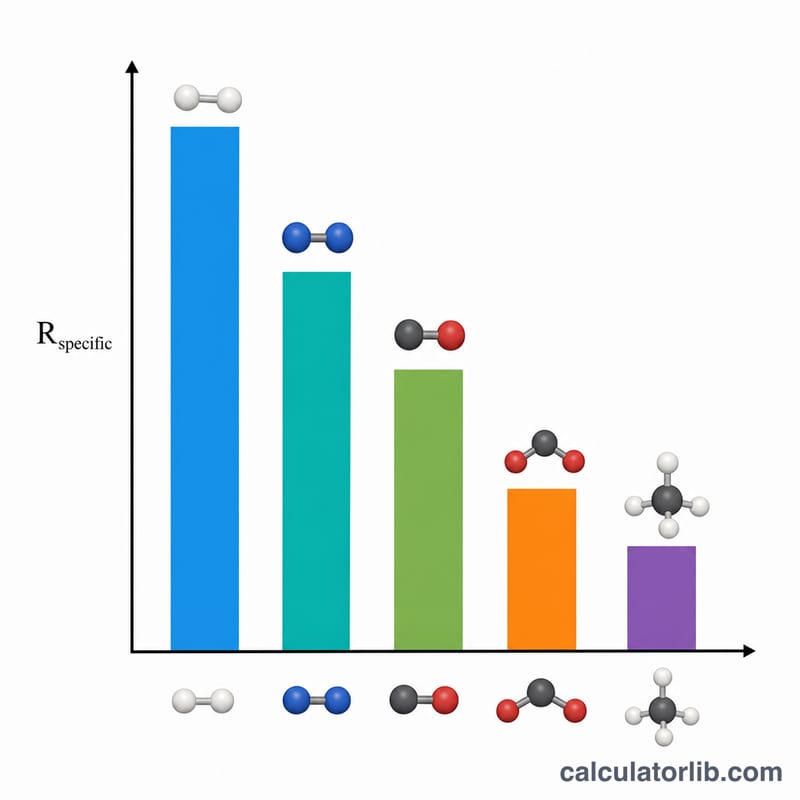
$$R_{\text{specific}} = \frac{8.314}{\text{Molar Mass (g/mol)} / 1000}$$The larger the molar mass, the smaller the specific gas constant, since heavier molecules carry more mass per mole.
Worked Example
For dry air with \(M = 28.97\) g/mol: convert to 0.02897 kg/mol, then
$$R_{\text{specific}} = \frac{8.314}{0.02897} \approx 287.0 \ \text{J/(kg}\cdot\text{K)}$$This matches the standard textbook value of about 287 J/(kg·K) for air.
FAQ
What is the specific gas constant for air? Approximately 287 J/(kg·K), using a molar mass near 28.97 g/mol.
Why is it different from the universal gas constant? The universal constant is per mole and identical for all ideal gases; the specific constant is per kilogram and depends on each gas's molar mass.
What units should I enter? Enter molar mass in g/mol (the common chemistry unit). The result is reported in J/(kg·K).