
What Is Specific Rotation?
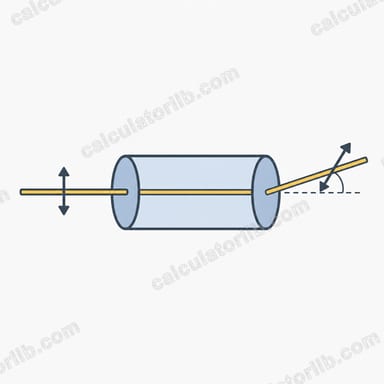
Specific rotation, written as \([\alpha]\), is a standardized, intensive property of a chiral (optically active) substance. It expresses how much a solution rotates plane-polarized light, normalized to a 1 decimeter path length and a concentration of 1 gram per milliliter. Because raw observed rotation depends on tube length and concentration, chemists report specific rotation so values can be compared across labs and used to identify compounds or measure purity.
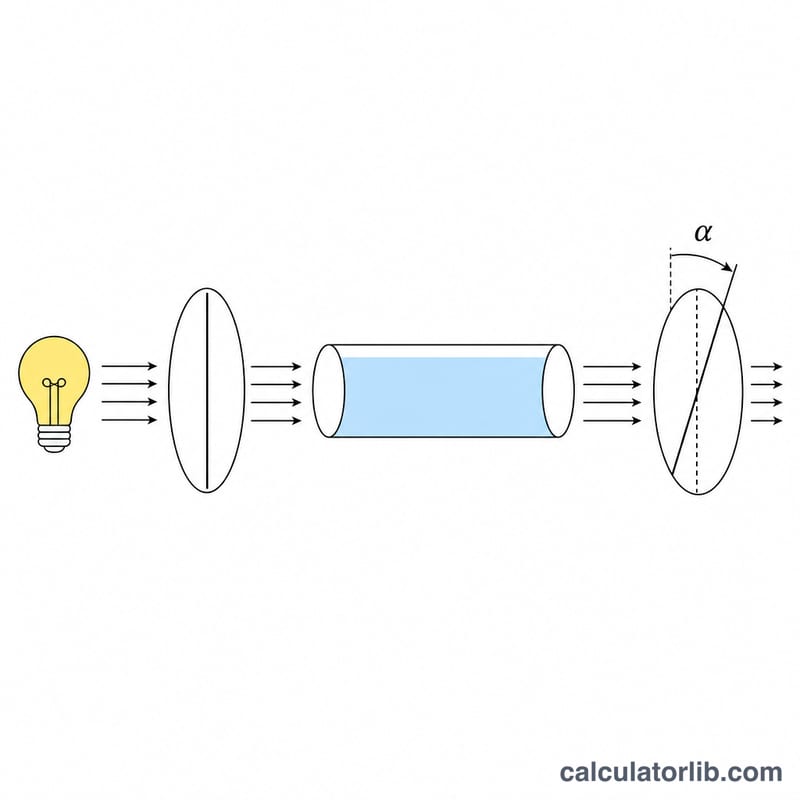
How to Use This Calculator
Enter three values: the observed rotation \(\alpha\) (in degrees, measured with a polarimeter), the path length \(l\) (the sample tube length in decimeters, dm), and the concentration \(c\) (in grams per milliliter, g/mL). Press calculate to get \([\alpha]\). A positive result means the substance is dextrorotatory (rotates light clockwise, +); a negative result means it is levorotatory (counterclockwise, −).
The Formula Explained
The equation is $$[\alpha] = \frac{\text{Observed Rotation }\alpha}{\text{Path Length }l \cdot \text{Concentration }c}$$ Here \(\alpha\) is the measured optical rotation, \(l\) is the path length in dm, and \(c\) is concentration in g/mL. Note the units: if your tube is 100 mm, that is 1 dm; if concentration is given in g/100 mL (a common convention), convert to g/mL first. Specific rotation is also temperature- and wavelength-dependent, usually reported as \([\alpha]^{20}_{D}\) for 20 °C using the sodium D line (589 nm).
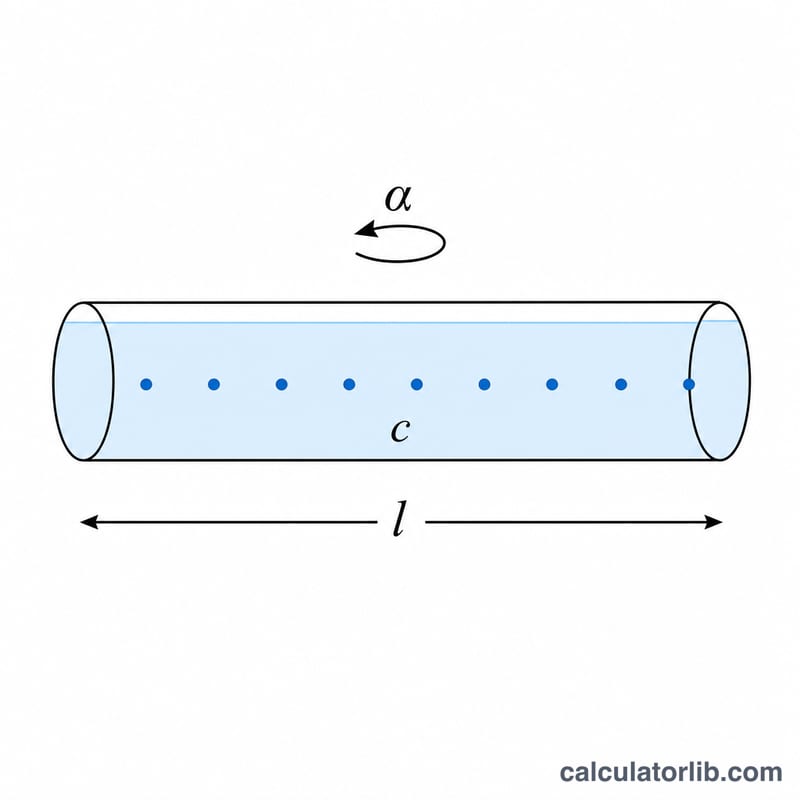
Worked Example
Suppose a polarimeter reads an observed rotation of \(\alpha = 1.5°\), using a 1.0 dm tube and a solution of 0.1 g/mL. Then $$[\alpha] = \frac{1.5}{1.0 \times 0.1} = \frac{1.5}{0.1} = 15$$ The specific rotation is \(+15 \ °\cdot\text{mL}\cdot\text{g}^{-1}\cdot\text{dm}^{-1}\).
FAQ
What units does concentration use? This tool uses g/mL. If you have g/100 mL, divide by 100 first.
Why divide by path length in dm, not cm? The historical convention defines specific rotation per decimeter, so a standard 100 mm tube equals 1 dm.
What does a negative value mean? A negative \([\alpha]\) indicates a levorotatory compound that rotates polarized light counterclockwise.