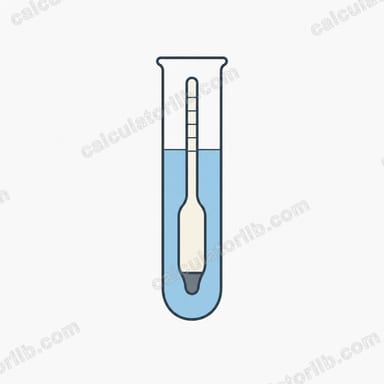

What is the Specific Gravity to Density Calculator?
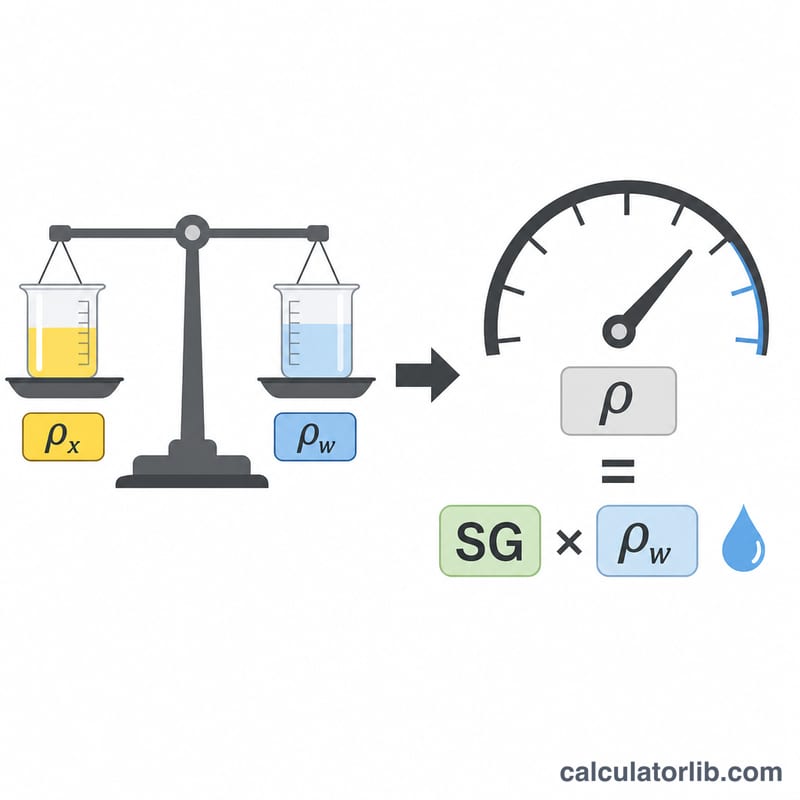
Specific gravity (SG) is a dimensionless ratio that compares the density of a substance to the density of a reference fluid, almost always water. Because it has no units, SG alone does not tell you mass per unit volume — you need to multiply it by the reference fluid density to recover an actual density. This calculator does that conversion instantly, returning density in kilograms per cubic metre, grams per cubic centimetre and grams per litre.
How to use it
Enter the specific gravity of your material and the reference water density (the default is 1000 kg/m³, the value for pure water near 4 °C). The calculator multiplies the two values and displays the resulting density in three common units. Adjust the reference density if your standard is defined at a different temperature.
The formula explained
The relationship is simply $$\rho = \text{SG} \times \text{Water Density (kg/m}^3\text{)}$$ Since specific gravity is density divided by water density, multiplying it back by water density cancels the ratio and leaves the true density. With \(\rho_{water} = 1000\) kg/m³, an SG of 1 gives 1000 kg/m³ (1 g/cm³), exactly the density of water.
Worked example
Seawater has a typical specific gravity of about 1.025. Multiplying by the reference density of 1000 kg/m³ gives $$1.025 \times 1000 = 1025 \text{ kg/m}^3,$$ which equals 1.025 g/cm³ or 1025 g/L. That small density increase over fresh water is why objects float more easily in the ocean.
FAQ
Is specific gravity the same as density? No. Specific gravity is unitless; density has units of mass per volume. They share the same numeric value only when the reference density is 1 g/cm³.
Why does water density matter? SG is defined relative to a reference fluid. Using the correct reference density (which varies slightly with temperature) ensures an accurate density result.
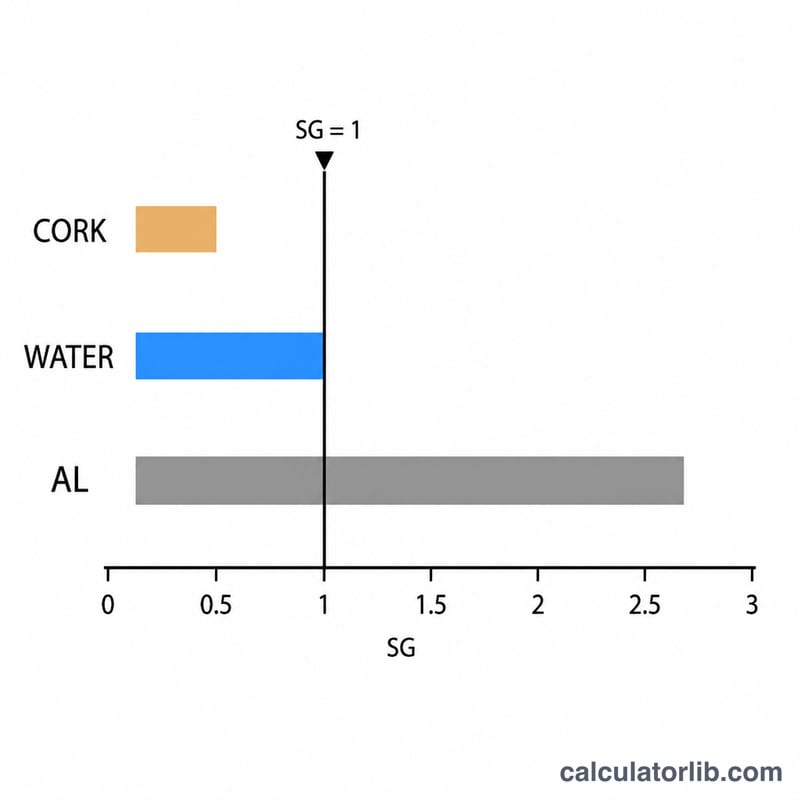
Can SG be less than 1? Yes. Materials lighter than water, such as oils or ethanol, have SG below 1 and therefore a density below 1000 kg/m³.