
What It Is
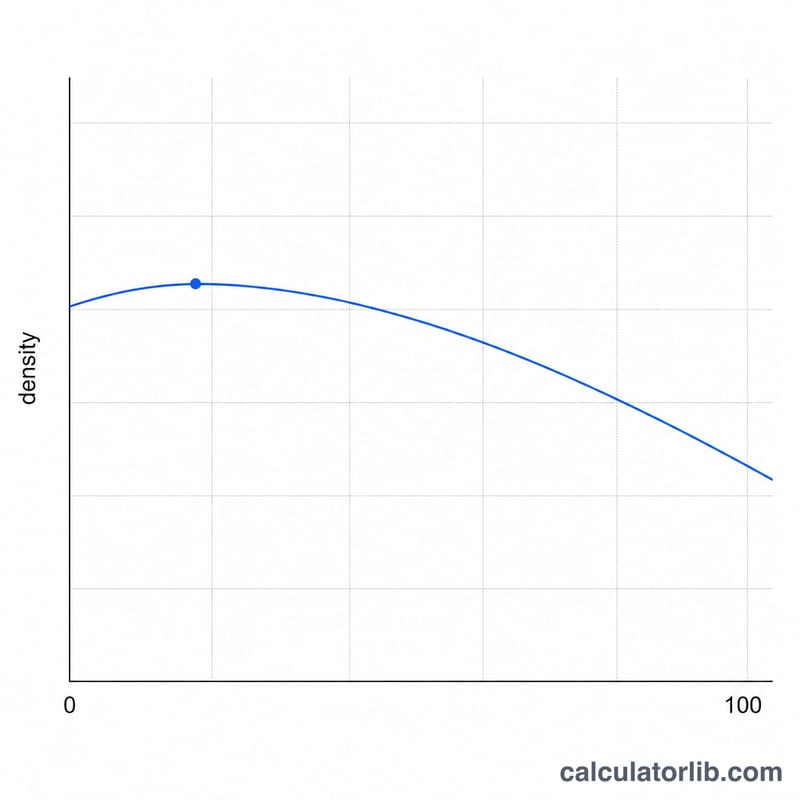
This calculator estimates the density of liquid water as a function of temperature using a well-known empirical polynomial valid from 0 °C to 100 °C at standard atmospheric pressure. Water density is not constant: it peaks near 4 °C and decreases as water warms, which is why ice floats and why lakes stratify by temperature.
How to Use It
Enter the water temperature in degrees Celsius (0–100). The calculator returns the density in kilograms per cubic metre (kg/m³) and also in grams per cubic centimetre (g/cm³). Use it for lab work, engineering, aquariums, brewing, or physics homework.
The Formula
The density is computed from:
$$\rho = 1000\left(1 - \frac{\text{T} + 288.9414}{508929.2\left(\text{T} + 68.12963\right)}\left(\text{T} - 3.9863\right)^2\right)$$where \(\text{T}\) is temperature in °C and \(\rho\) is in kg/m³. The term \((\text{T} - 3.9863)^2\) ensures the maximum density occurs at about 3.9863 °C, matching the real physical behaviour of water.
Worked Example
For \(\text{T} = 100\) °C: \((\text{T} + 288.9414) = 388.9414\); denominator \(= 508929.2 \times (100 + 68.12963) = 508929.2 \times 168.12963 \approx 85{,}565{,}000\); \((\text{T} - 3.9863)^2 = 96.0137^2 \approx 9218.63\). So $$\rho \approx 1000 \times \left(1 - \frac{388.9414}{85{,}565{,}000} \times 9218.63\right) \approx 1000 \times (1 - 0.041903) \approx 958.10 \text{ kg/m}^3.$$ Near boiling, water is noticeably less dense than the ~999.97 kg/m³ it reaches near 4 °C.
FAQ
At what temperature is water densest? About 3.99 °C, where density is roughly 999.97 kg/m³.
Does this account for pressure? No — it assumes standard atmospheric pressure and pure liquid water.
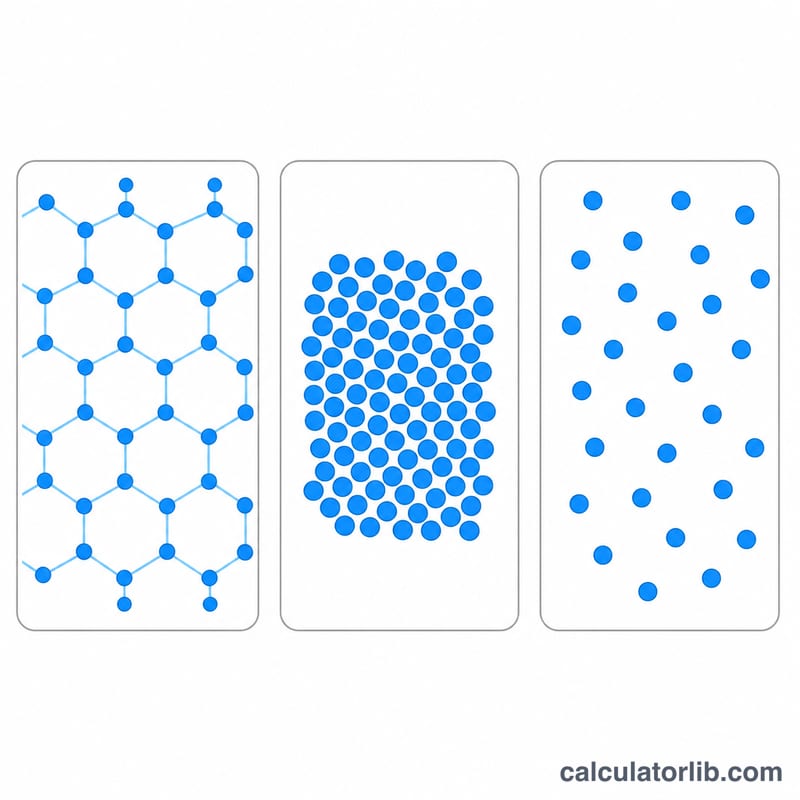
Why does density drop above 4 °C? Thermal expansion: warmer molecules move apart, increasing volume and lowering density.