

What Is Density?
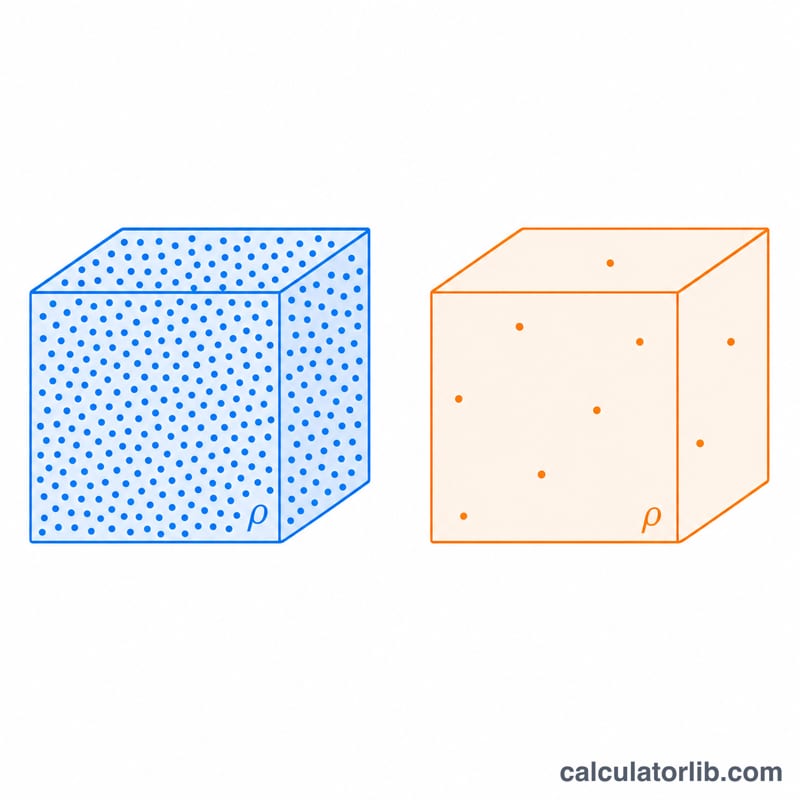
Density (ρ, the Greek letter rho) measures how much mass is packed into a given volume of a substance. It is one of the most fundamental properties in physics, chemistry, and engineering. A material with high density, such as lead, has a lot of mass concentrated in a small space, while a low-density material, such as cork, takes up a lot of space for relatively little mass. This calculator uses the universal relationship \(\rho = m / V\), valid for any substance anywhere.
How to Use the Calculator
Enter the mass of your object in kilograms and its volume in cubic metres. Click calculate and you will see the density in kilograms per cubic metre (kg/m³), the SI standard unit, along with a handy conversion to grams per cubic centimetre (g/cm³), which is common in chemistry and material science. If your measurements are in other units, convert them first (for example, 1 litre = 0.001 m³, and 1 gram = 0.001 kg).
The Formula Explained
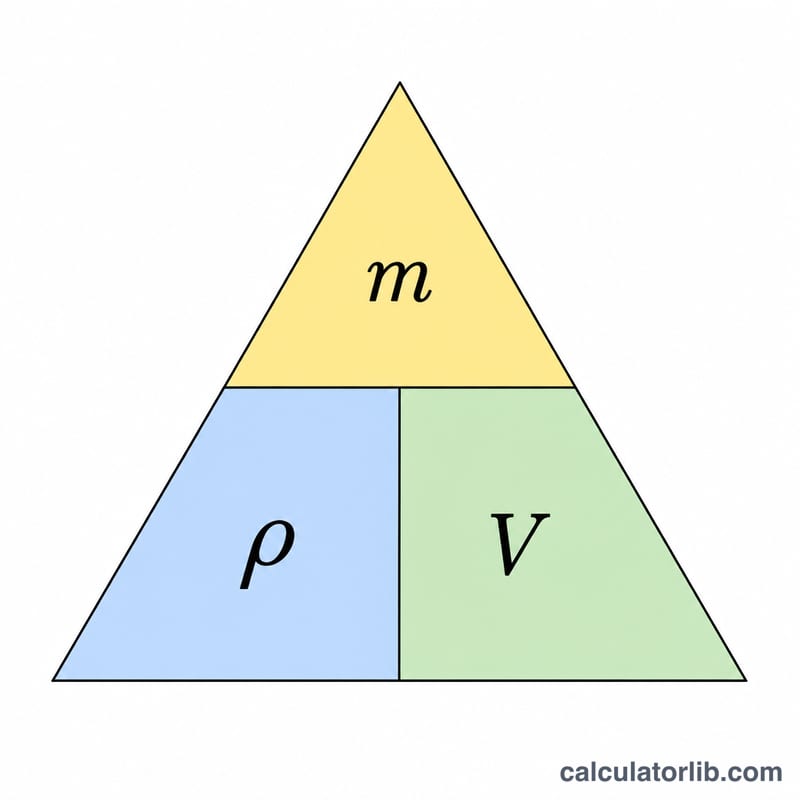
The equation $$\rho = \frac{\text{Mass (kg)}}{\text{Volume (m}^3\text{)}}$$ states that density is the ratio of mass to volume. If you double the mass while keeping the volume the same, the density doubles. If you increase the volume while holding mass constant, density falls. The SI unit is kg/m³; to convert to g/cm³, divide by 1000.
Worked Example
Suppose a metal block has a mass of 10 kg and a volume of 2 m³. Then $$\rho = 10 / 2 = 5 \text{ kg/m}^3,$$ which equals 0.005 g/cm³. For a denser comparison, a 19.3 kg block occupying 0.001 m³ gives 19,300 kg/m³ — the density of pure gold.
FAQ
What is the density of water? About 1000 kg/m³ (1 g/cm³) at 4°C, which is why this value is often used as a reference.
Why does density matter? It determines whether an object floats or sinks, helps identify materials, and is essential in buoyancy and fluid-mechanics calculations.
Can I use any units? The formula works with any consistent units, but this tool expects kilograms and cubic metres and reports kg/m³ and g/cm³.