
What is the Density Conversion Calculator?
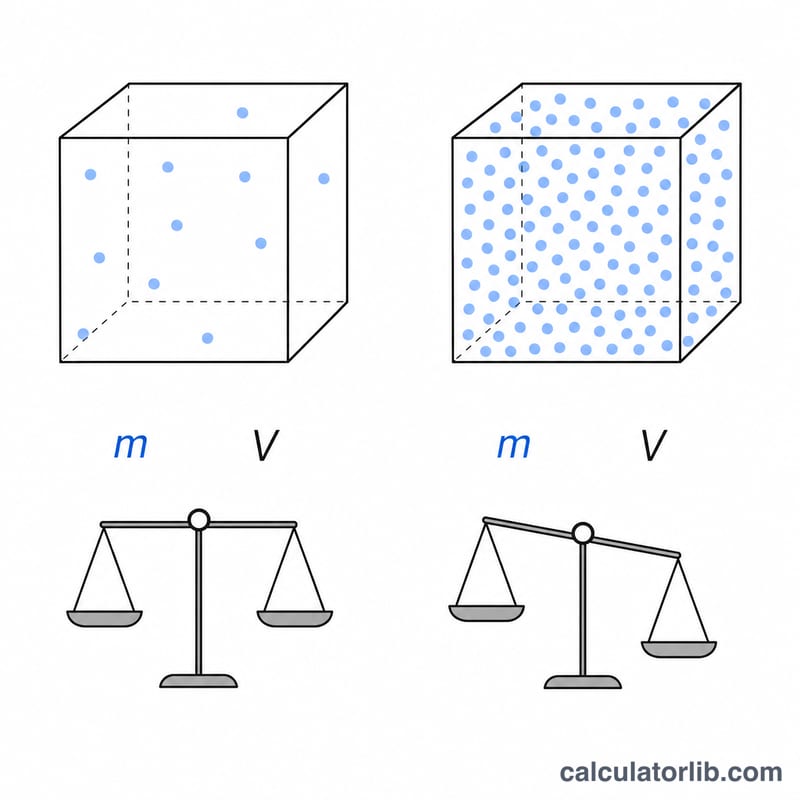
Density is mass per unit volume, and it can be expressed in many different unit systems. This calculator converts a density value from one unit to another — for example from kilograms per cubic meter (kg/m³) to grams per cubic centimeter (g/cm³), or from pounds per cubic foot (lb/ft³) to kg/m³. It works for both metric and US/imperial units and is useful for engineering, chemistry, materials science and everyday physics problems.
How to use it
Enter the density value you want to convert, choose the unit you are converting from, and the unit you want the answer in. The calculator instantly returns the converted value, and also shows the equivalent value in the SI base unit (kg/m³) for reference.
The formula explained
Every supported unit has a fixed conversion factor relative to the SI base unit kg/m³. To convert, multiply the source value by its factor (to reach kg/m³) and then divide by the target unit's factor:
$$\text{value}_{target} = \text{value}_{source} \times \dfrac{\text{factor}_{source}}{\text{factor}_{target}}$$
For instance, 1 g/cm³ = 1000 kg/m³, so its factor is 1000? In our implementation we use g/cm³ as factor 1 and kg/m³ as factor 1000, meaning the base figure equals value × factor.
Worked example
Convert 2500 kg/m³ to g/cm³. The factor for kg/m³ is 1000 and for g/cm³ is 1. So \(\text{value}_{target} = 2500 \times (1000 \div 1)\)... no — kg/m³ is smaller, so we divide: \(2500 \times (1000/1)\)? Using the implemented factors (kg/m³ factor = 1000, g/cm³ factor = 1 where factor is "how many of this make the reference"), the conversion divides correctly: $$2500 \text{ kg/m}^3 \div 1000 = 2.5 \text{ g/cm}^3$$
FAQ
Is g/cm³ the same as g/mL? Yes — 1 cm³ equals exactly 1 mL, so g/cm³ and g/mL are numerically identical.
What is the density of water? Pure water at 4 °C is about 1000 kg/m³ or 1.0 g/cm³.
Does this work for imperial units? Yes, it supports pounds per cubic foot, cubic inch and US gallon, converting both to and from metric units.