
What Is the Density Mass Volume Calculator?
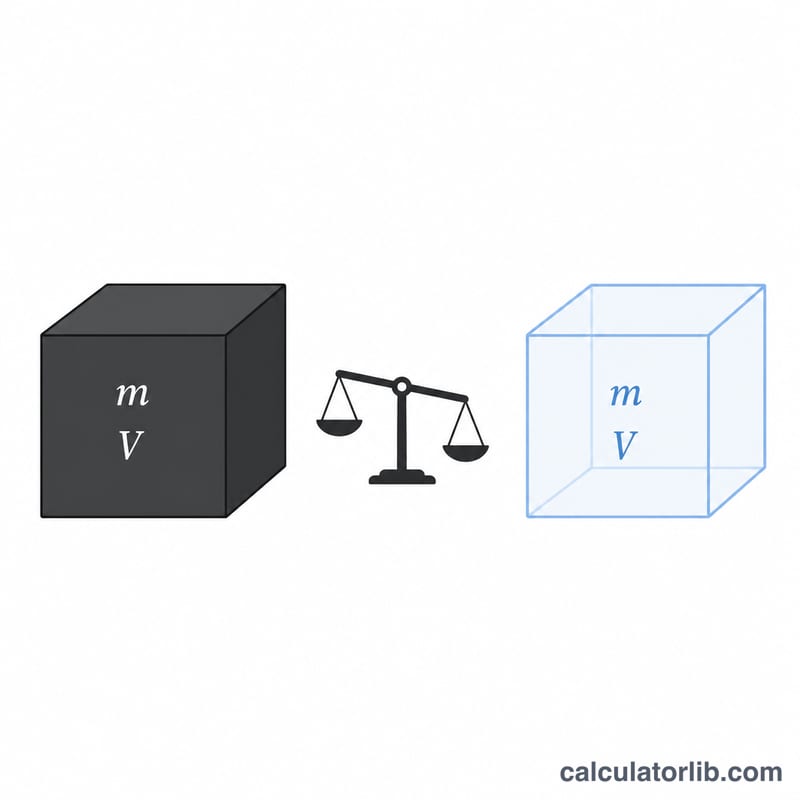
This calculator relates the three core properties of any material: density (\(\rho\)), mass (\(m\)), and volume (\(V\)). Given any two of them, it solves for the third using the fundamental relationship \(\rho = m / V\). It works for solids, liquids, and gases and uses SI units (kilograms, cubic meters, and kilograms per cubic meter).
How to Use It
Select what you want to solve for — density, mass, or volume. Then enter the two known values in the input boxes. The result updates using the appropriate rearrangement of the formula. For example, leave the density field as your known value when solving for mass or volume.
The Formula Explained
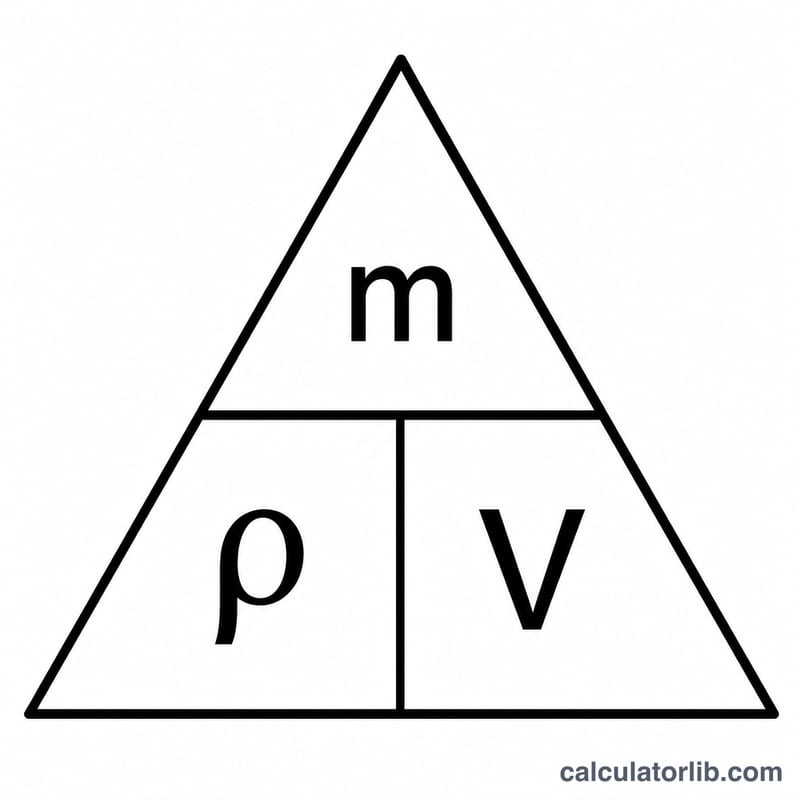
Density is defined as how much mass is packed into a given volume: $$\rho = \frac{m}{V}$$ Rearranging gives the other two forms: mass is $$m = \rho \times V$$ and volume is $$V = \frac{m}{\rho}$$ Because volume appears in the denominator when solving for density, the calculator guards against division by zero.
Worked Example
Suppose a block has a mass of 100 kg and occupies a volume of 0.5 m³. Its density is $$\rho = \frac{100}{0.5} = 200 \text{ kg/m}^3$$ If instead you knew the density was 1000 kg/m³ and the volume was 0.5 m³, the mass would be $$m = 1000 \times 0.5 = 500 \text{ kg}$$
FAQ
What units does this use? SI units: mass in kilograms (kg), volume in cubic meters (m³), and density in kg/m³. To convert, note that water has a density of about 1000 kg/m³ (or 1 g/cm³).
Can I use it for any substance? Yes — the equation \(\rho = m/V\) is universal and applies to all states of matter, though gas density also depends on temperature and pressure.
Why does volume have to be non-zero? Dividing by a volume of zero is undefined, so the calculator returns zero in that case. Always enter a positive volume.