
What This Calculator Does
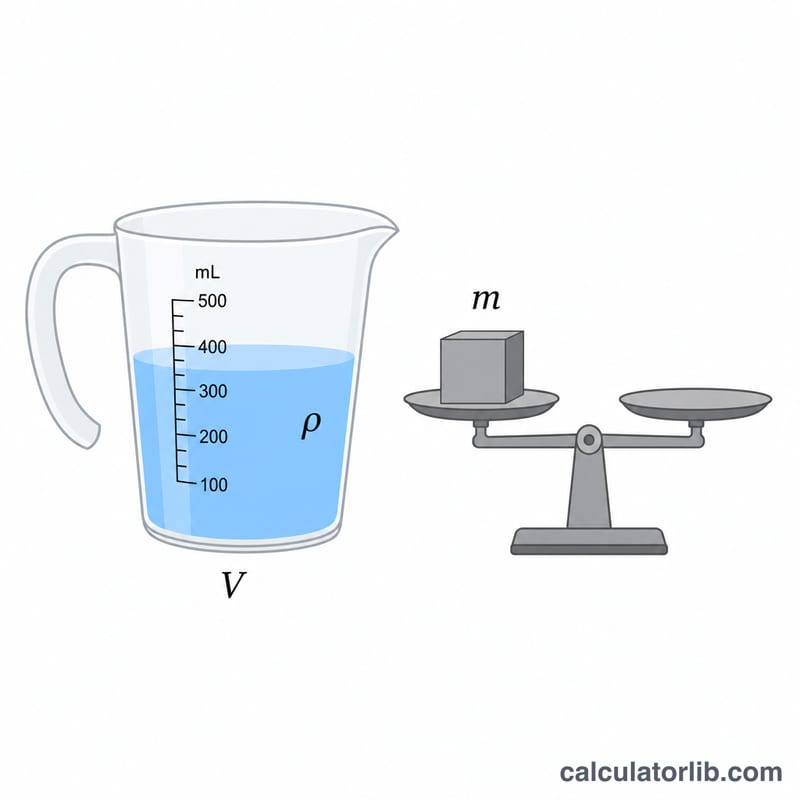
This tool works with the fundamental physics relationship between density, mass and volume: \(\rho = m / V\). Given any two of the three quantities, it solves for the third. It is useful for chemistry labs, physics homework, engineering, cooking conversions and material science. Units are grams (g) for mass, cubic centimetres (cm³) for volume and grams per cubic centimetre (g/cm³) for density, but the math holds for any consistent unit system.
How To Use It
Choose what you want to solve for: density, mass or volume. Then enter the two values you already know and leave the unknown field blank. Click calculate and the result appears in the highlighted box, along with all three values for reference.
The Formula Explained
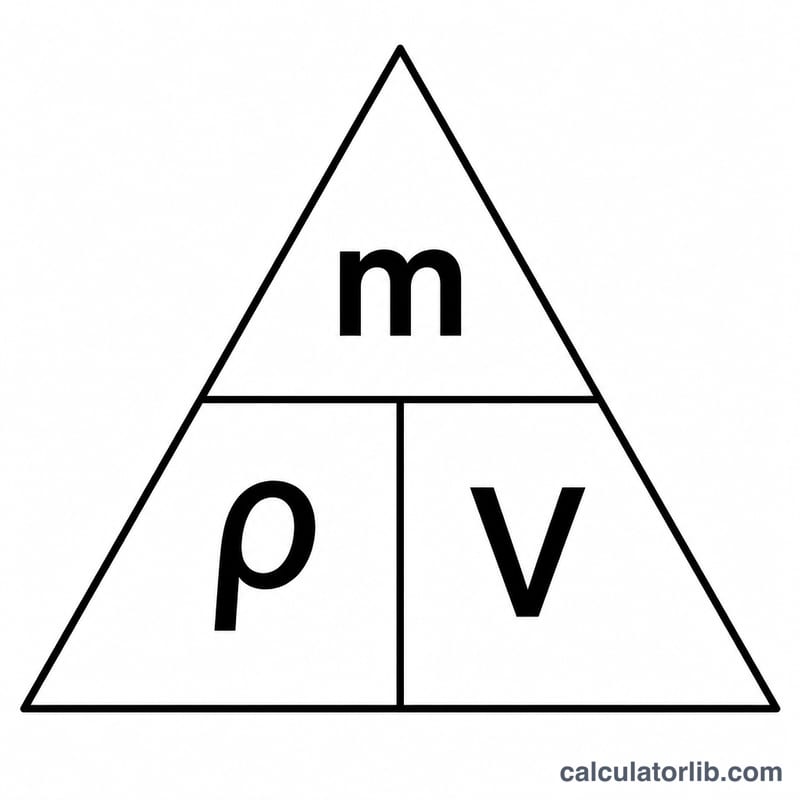
Density measures how much mass is packed into a given volume. The base equation is $$\rho = \frac{m}{V}$$ Rearranging algebraically gives the other two forms: mass \(m = \rho \times V\), and volume \(V = m / \rho\). Doubling the mass while keeping volume fixed doubles the density; doubling the volume while keeping mass fixed halves it.
Worked Example
Suppose an object has a mass of 100 g and a volume of 50 cm³. Its density is $$\rho = \frac{100}{50} = 2 \text{ g/cm}^3$$ If instead you knew the density was 2 g/cm³ and the volume was 50 cm³, the mass would be \(2 \times 50 = 100\) g.
FAQ
What units should I use? The defaults are grams, cubic centimetres and g/cm³. You can use any units as long as they are consistent — for example kg, m³ and kg/m³.
Why is water important here? Pure water has a density of about 1 g/cm³, so it is a handy reference point: anything denser sinks in water and anything less dense floats.
What if I leave volume as zero? Division by zero is undefined, so the calculator guards against it and returns 0 when volume or density is zero.