What This Square Root Calculator Does
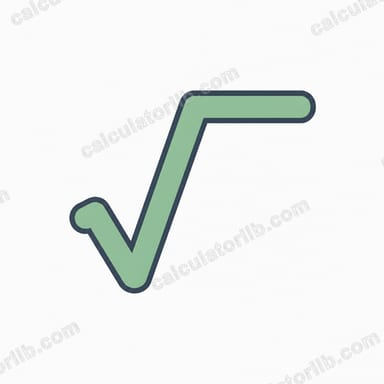
This calculator finds the square root (√x) of any number you enter. The square root of a number is the value that, when multiplied by itself, gives you the original number. For example, the square root of 25 is 5, because 5 × 5 = 25. This tool returns the principal (positive) square root, which is the standard answer used in everyday math, homework checks, and quick calculations.

How to Use It
There is a single input field:
- Enter a number: Type the number whose square root you want to find. This can be a whole number (like 144), a decimal (like 2.25), or any positive value.
Once you enter your number, the calculator instantly computes and displays the square root. You don't need to round, estimate, or look anything up.
The Formula
The calculation uses the standard square root function:
result = √x
Internally, the tool converts your text input into a numeric value and applies the square root operation directly. Your original number and the calculated root are both returned so you can confirm the result. Note that because it returns the principal root, the answer is always zero or positive. If you enter a negative number, a square root is not defined for real numbers.
Worked Example
Suppose you enter 81:
- Input number: 81
- Calculation: √81
- Result: 9 (because 9 × 9 = 81)
For a non-perfect square like 10, the calculator returns 3.1622776…, since 3.1622776 × 3.1622776 ≈ 10. This is where the tool is especially handy — perfect squares are easy to recognise, but irrational roots are tedious to work out by hand.
Key Terms and Definitions
| Term | Meaning |
|---|---|
| Radicand | The number written under the radical sign — the value whose root is being taken. In \(\sqrt{49}\), the radicand is 49. |
| Radical sign (√) | The symbol \(\sqrt{\ }\) denoting a root. The horizontal bar (vinculum) shows exactly which expression is inside, so \(\sqrt{9+16}=5\) while \(\sqrt{9}+16=19\). |
| Principal square root | The non-negative root. Every positive number has two square roots (\(7\) and \(-7\) both square to 49), but \(\sqrt{49}\) means only \(+7\). This is the value the calculator returns; equations such as \(n^2 = 49\) have both solutions, written \(n = \pm 7\). |
| Perfect square | An integer whose square root is also an integer: 1, 4, 9, 16, 25, 36, 49, 64, 81, 100, 121, 144, … Recognising these makes bracketing and simplifying much faster. |
| Irrational number | A number that cannot be written as a ratio of two integers; its decimal never terminates and never repeats. The square root of any positive integer that is not a perfect square is irrational — \(\sqrt{2} \approx 1.41421356\), \(\sqrt{3} \approx 1.73205081\). Calculator output is therefore a rounded approximation, not an exact value. |
| Square (n²) | The inverse operation: \(n^2 = n \times n\). Squaring undoes a square root for non-negative inputs, which is why \((\sqrt{x})^2 = x\) for \(x \ge 0\) and why squaring is the standard way to check a root. |
| Index | The small number that says which root is meant, written \(\sqrt[n]{x}\). For a square root the index is 2 and is left off by convention; a cube root has index 3, written \(\sqrt[3]{x}\) (\(\sqrt[3]{27}=3\)). |
| Imaginary unit (i) | Defined by \(i^2 = -1\). No real number squared gives a negative result, so \(\sqrt{-9}\) has no real value; in the complex numbers it equals \(3i\), because \((3i)^2 = 9i^2 = -9\). A square-root tool restricted to real numbers will reject or flag negative inputs. |
| Surd / radical form | An exact expression left under the radical, such as \(5\sqrt{3}\) rather than 8.66025. Radical form carries no rounding error and is standard in algebra, trigonometry and exact geometry answers. |
Frequently Asked Questions
Can I calculate the square root of a decimal? Yes. Enter values like 0.25 (result 0.5) or 6.25 (result 2.5). Decimals are fully supported.
Why does it only show the positive root? Every positive number technically has two square roots — one positive and one negative (for example, both 4 and −4 squared give 16). This calculator returns the principal root, which is the positive one, as that is the convention in most schoolwork and applications.
What happens if I enter a negative number? Real square roots are only defined for zero and positive numbers, so a negative input has no real result. Enter a positive number for a meaningful answer.