
What Is the Even Permutations Calculator?
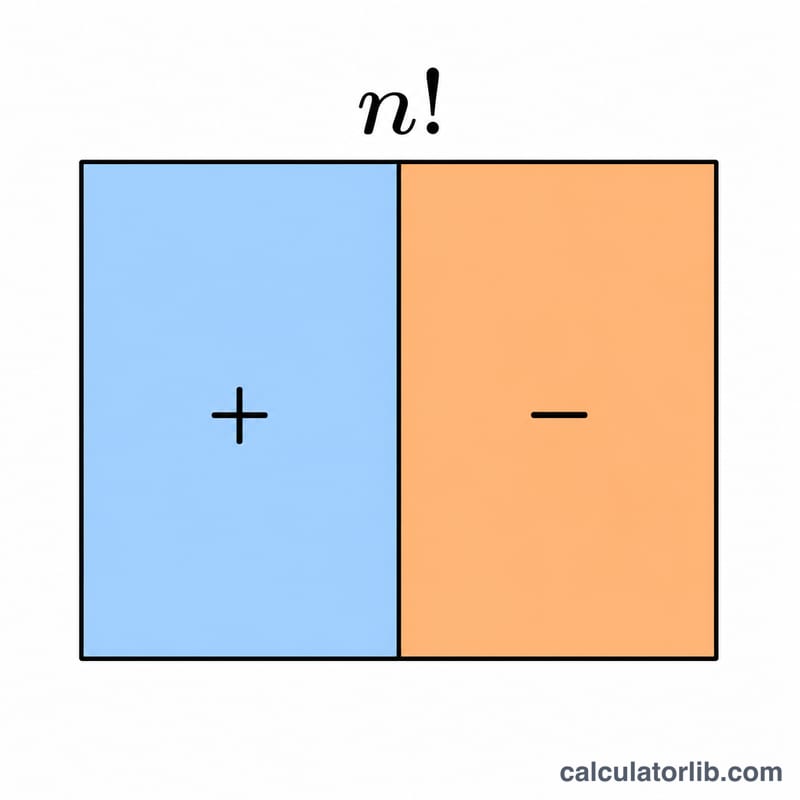
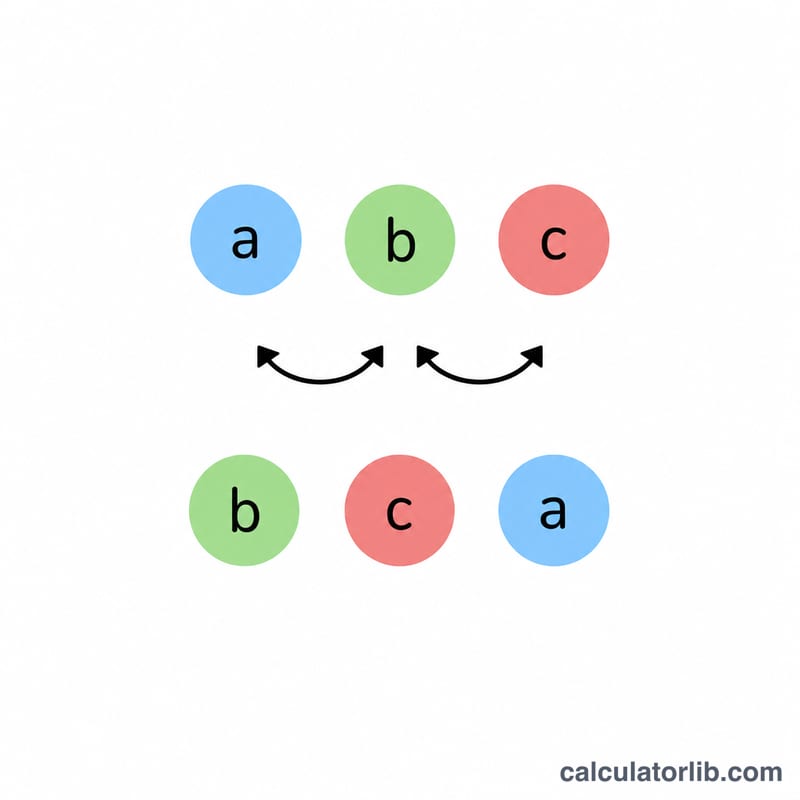
The Even Permutations Calculator tells you how many even permutations exist for a set of n distinct elements. In group theory, a permutation is "even" if it can be written as a product of an even number of transpositions (swaps of two elements), and "odd" if it needs an odd number. For any set with two or more elements, exactly half of all permutations are even and half are odd. This tool computes that count instantly, alongside the total and odd permutation counts for context.
How to Use It
The calculator has a single input field:
- Number of elements (n) — enter a positive whole number representing the size of your set. Values must be 100,000 or less.
After you submit, the tool returns the total permutations (\(n!\)), the number of even permutations, and the number of odd permutations. If you enter a non-positive number, a value above 100,000, or something that is not an integer, you'll get a clear error message instead.
The Formula Explained
The number of even permutations is:
$$E_n = \frac{n!}{2}$$
Here n! (n factorial) is the product of all integers from 1 up to n, which equals the total number of ways to arrange n distinct elements. Because the even and odd permutations split the symmetric group exactly in half, dividing the total by 2 gives the even count. The calculator also computes the odd permutations as \(n! - (n!/2)\), which is the same value — confirming the equal split. Internally it uses BigInteger arithmetic, so it handles very large factorials without overflow.
Worked Example
Suppose n = 4. The total permutations are \(4! = 4 \times 3 \times 2 \times 1 = 24\). The even permutations are:
$$\frac{24}{2} = 12$$
So a set of 4 elements has 12 even permutations and 12 odd permutations. These 12 even permutations form the alternating group A₄. For n = 5, \(5! = 120\), so there are 60 even permutations (the group A₅).
Frequently Asked Questions
Why is the answer always exactly half of n!? For any n ≥ 2, multiplying by a single transposition turns every even permutation into a distinct odd one and vice versa, creating a perfect one-to-one pairing. That guarantees equal counts.
What about n = 1? With one element there is only the identity permutation, which is even. The formula \(n!/2 = 1/2\) rounds down to 0 in integer arithmetic, so be aware that the n = 1 case is a special edge case in pure mathematics.
Is there a maximum input? Yes. To keep calculations fast and stable, the input must be a positive integer of 100,000 or less.