
What Is the Odd Permutations Calculator?
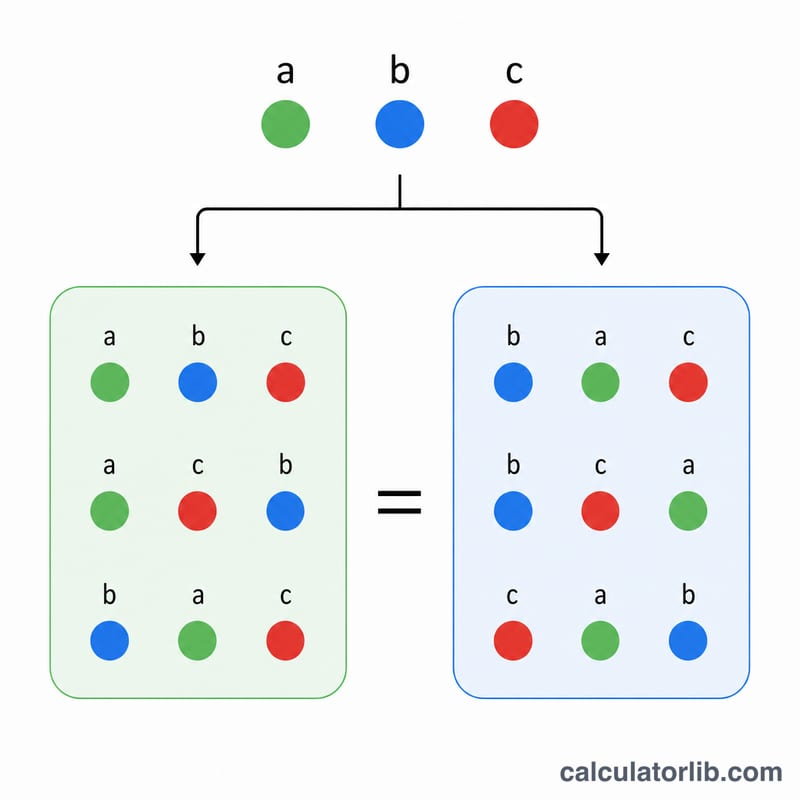
In group theory and combinatorics, every permutation of a set is classified as either even or odd, depending on whether it can be written as an even or odd number of transpositions (swaps of two elements). This calculator tells you how many odd permutations exist for a set of n distinct elements. You simply enter one value — the number of elements (n) — and it returns the count of odd permutations, along with the total number of permutations and the count of even permutations for context.
The Formula
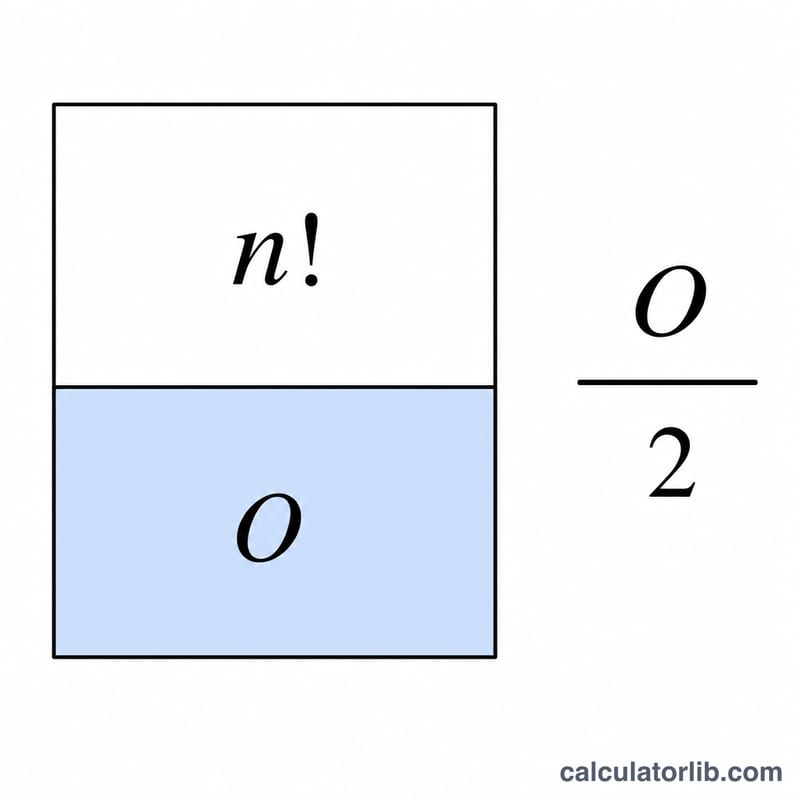
For any set of n distinct elements (with n ≥ 2), exactly half of all permutations are odd and half are even. The total number of permutations is n!, so the number of odd permutations is:
Odd permutations = n! / 2
- Total permutations = n! (all possible orderings)
- Odd permutations = n! / 2
- Even permutations = n! − (n! / 2) = n! / 2
The calculator accepts positive integers from 1 up to 1,000 and uses big-integer arithmetic, so it handles extremely large factorial results without overflow.
How to Use It
- Enter the number of elements n in the input field (for example, 5).
- Submit to see the odd permutation count instantly.
- The result also displays the total and even permutation counts so you can verify the 50/50 split.
Note: the input must be a positive whole number of 1,000 or less. Negative numbers, zero, decimals, or non-numeric text will return an error.
Worked Example
Suppose n = 5. First find the total permutations: 5! = 5 × 4 × 3 × 2 × 1 = 120. Then divide by 2:
Odd permutations = 120 / 2 = 60
The even permutations also equal 120 − 60 = 60. So a set of 5 elements has 60 odd and 60 even permutations.
Frequently Asked Questions
Why is the answer always exactly half of n!? For n ≥ 2, the set of even permutations forms the alternating group, which always has exactly half the elements of the full symmetric group. The other half are odd.
What about n = 1? A single element has only one permutation (the identity), which is even. The formula 1! / 2 = 0 reflects that there are no odd permutations when n = 1.
Why is the maximum input 1,000? Factorials grow astronomically fast. Capping n at 1,000 keeps calculations practical while still covering well beyond any everyday combinatorics problem.