
What the Wavelength Calculator does
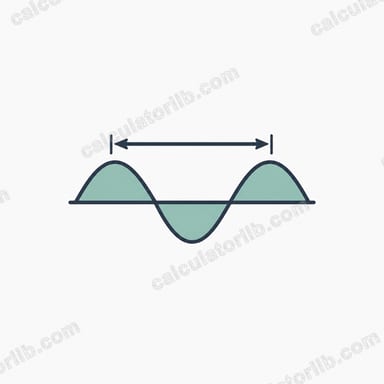
This Wavelength Calculator solves the fundamental wave equation that links wavelength, wave speed (velocity) and frequency. Whether you are studying sound, light, radio signals or water waves, the tool lets you enter the two values you know and instantly calculates the third. It works in standard SI units: wavelength in metres (m), velocity in metres per second (m/s) and frequency in Hertz (Hz).
The inputs you provide
- Calculation – choose what you want to find: Solve for Wavelength, Solve for Velocity, or Solve for Frequency.
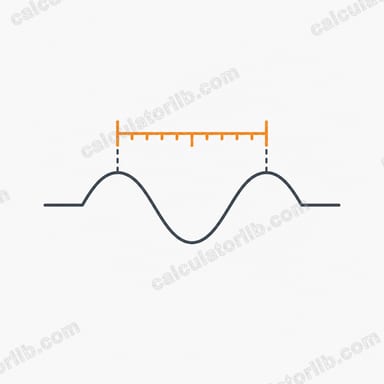
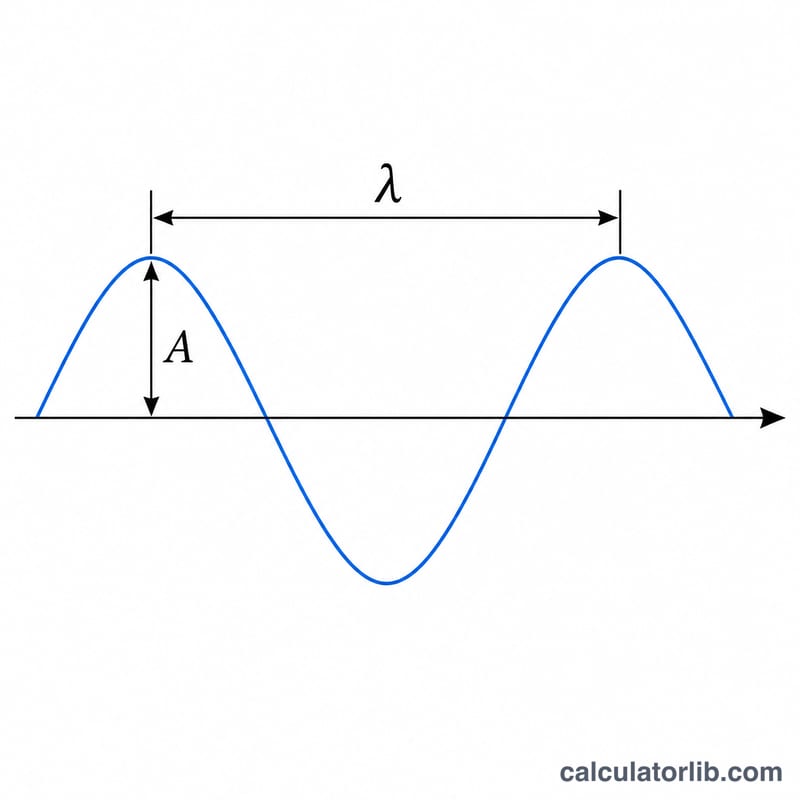
- Wavelength (m) – the distance between successive wave crests, in metres.
- Velocity (m/s) – the speed at which the wave travels.
- Frequency (Hz) – the number of wave cycles passing a point each second.
You only fill in the two fields relevant to your chosen calculation; the remaining field is what the calculator returns. Scientific notation (for example 3e8) is accepted for very large or small numbers.
The formula
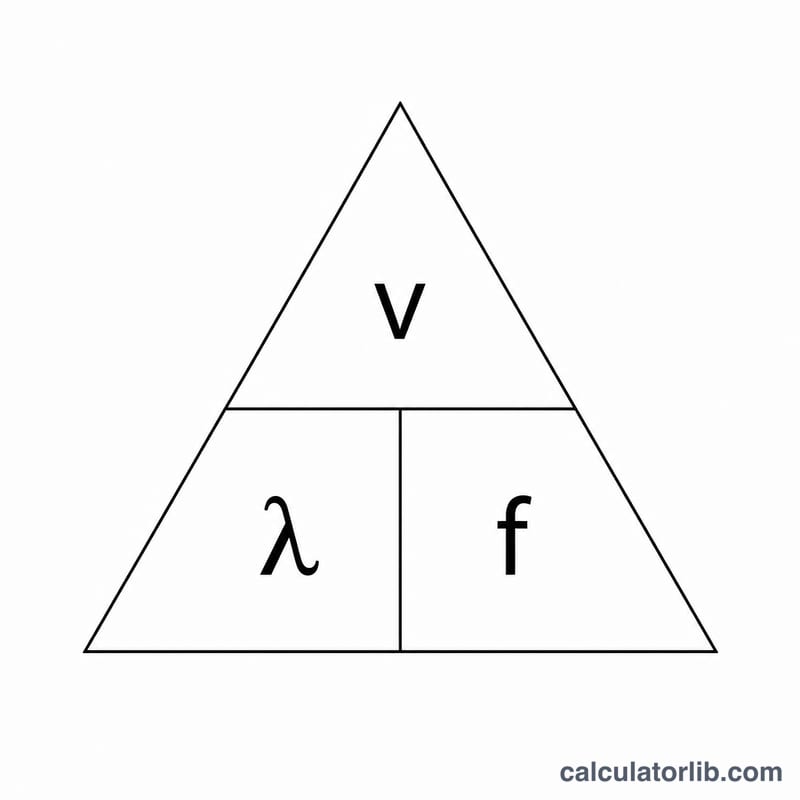
All three options are rearrangements of the same relationship:
- Wavelength: \(\lambda = v / f\)
- Velocity: \(v = \lambda \times f\)
- Frequency: \(f = v / \lambda\)
The calculator simply applies the version that matches your selected "Calculation" mode.
Worked example
Suppose you have a radio wave travelling at the speed of light, \(v = 3 \times 10^{8}\) m/s, with a frequency of 100,000,000 Hz (100 MHz). Select Solve for Wavelength and enter the velocity and frequency. The calculator computes:
$$\lambda = v / f = 300{,}000{,}000 \div 100{,}000{,}000 = 3 \text{ metres.}$$So a 100 MHz FM radio signal has a wavelength of 3 metres. Reverse it: enter \(\lambda = 3\) m and \(f = 100{,}000{,}000\) Hz, select Solve for Velocity, and you get \(v = 3 \times 10^{8}\) m/s.
Frequently asked questions
What units should I use? Always use metres for wavelength, metres per second for velocity and Hertz for frequency. Convert kilohertz or megahertz to Hertz first (1 MHz = 1,000,000 Hz).
What velocity do I use for light? For electromagnetic waves in a vacuum, use 299,792,458 m/s (often rounded to \(3 \times 10^{8}\) m/s). For sound in air at room temperature, use about 343 m/s.
Why did I get a divide error or zero? When solving for wavelength or frequency, the value you divide by must not be zero — make sure the frequency or wavelength field contains a valid non-zero number.