What this calculator does
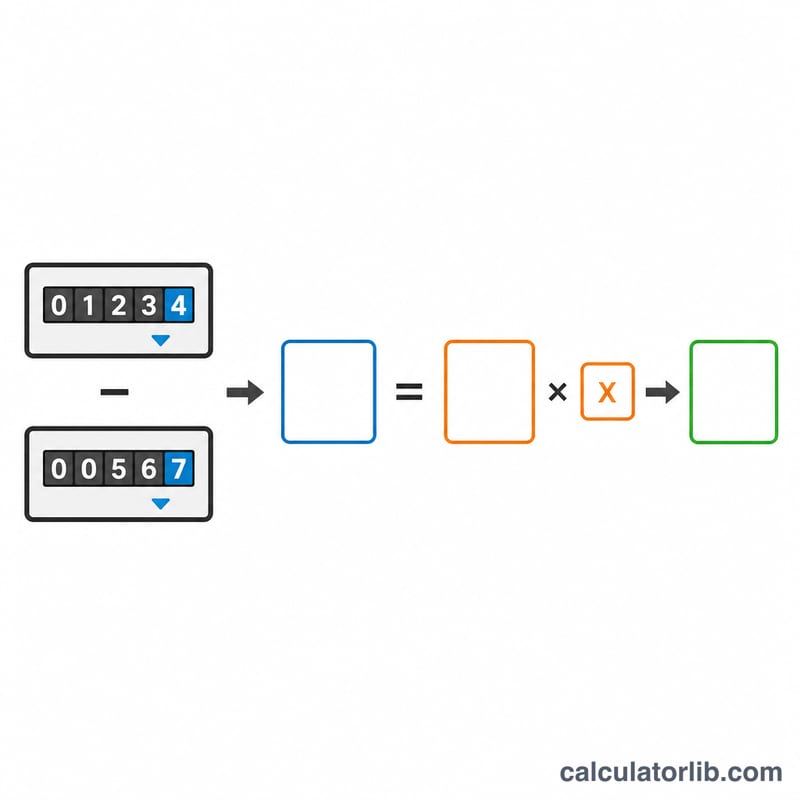
The Meter Reading kWh Calculator tells you exactly how much electricity you have used between two readings of your meter. Utilities bill in kilowatt-hours (kWh), and every electricity meter records a cumulative total. By subtracting the previous reading from the current reading, and applying any meter multiplier, you get the energy consumed during that period.
How to use it
Read your meter now and enter that number as the Current meter reading. Enter the figure from your last bill or last manual reading as the Previous meter reading. Most domestic meters have a multiplier of 1, but some transformer-rated or commercial meters multiply the dial value (for example by 10, 40 or 100) — check the multiplier printed on the meter or your bill. Optionally add a price per kWh to estimate the cost of that usage.
The formula explained
The core equation is simply
$$\text{kWh used} = \left(\text{Current reading} - \text{Previous reading}\right) \times \text{multiplier}$$The reading difference is the raw number of register units consumed; the multiplier converts those register units into true kilowatt-hours. Cost is then the kWh figure multiplied by your unit rate.
Worked example
Suppose the meter now reads 5,420 and last month it read 5,000, with a multiplier of 1 and a rate of 0.30 per kWh. Usage = \((5{,}420 - 5{,}000) \times 1 = 420\) kWh. Cost = \(420 \times 0.30 = 126\). If the same meter had a multiplier of 10, usage would be \((420) \times 10 = 4{,}200\) kWh.
Typical Household Appliance and Usage Reference (kWh)
Energy in kilowatt-hours is power multiplied by time: \(\text{kWh} = \text{kW} \times \text{hours}\), and \(\text{kW} = \text{W} \div 1000\). A 2,000 W heater running for 3 hours uses \(2 \times 3 = 6\) kWh. The values below are approximate typical figures. Real ratings vary by model, age, settings and how often thermostat-controlled devices cycle on and off. Monthly figures assume 30 days.
| Appliance | Typical power (W) | Example use per day | Approx. kWh per day | Approx. kWh per month |
|---|---|---|---|---|
| LED bulb | 10 W | 5 hours | 0.05 | 1.5 |
| Laptop | 50 W | 6 hours | 0.3 | 9 |
| Television | 100 W | 4 hours | 0.4 | 12 |
| Refrigerator (running 24 h, cycling) | about 100-150 W rated, cycles on and off | 24 hours | about 1-2 | about 30-60 |
| Washing machine | about 500 W average | 1 hour | 0.5 | 15 |
| Electric kettle | 2,000-3,000 W | 12 minutes (0.2 h) at 2,500 W | 0.5 | 15 |
| Electric oven | about 2,000 W | 1 hour | 2 | 60 |
| Tumble dryer | about 3,000 W | 1 hour | 3 | 90 |
| Portable electric heater | 1,500 W | 4 hours | 6 | 180 |
| Air conditioner | 1,000-3,000 W (example 1,500 W) | 6 hours | 9 | 270 |
| EV home charger | about 7,000 W (7 kW) | 2 hours | 14 | 420 |
To estimate cost, multiply kWh by your unit rate. For example, 9 kWh at 0.15 per kWh costs \(9 \times 0.15 = 1.35\) per day in your currency.
How to Calculate kWh Between Meter Readings by Hand
- Record both readings with the date and time. Write down the previous reading (from your last bill or note) and the current reading, each with its date.
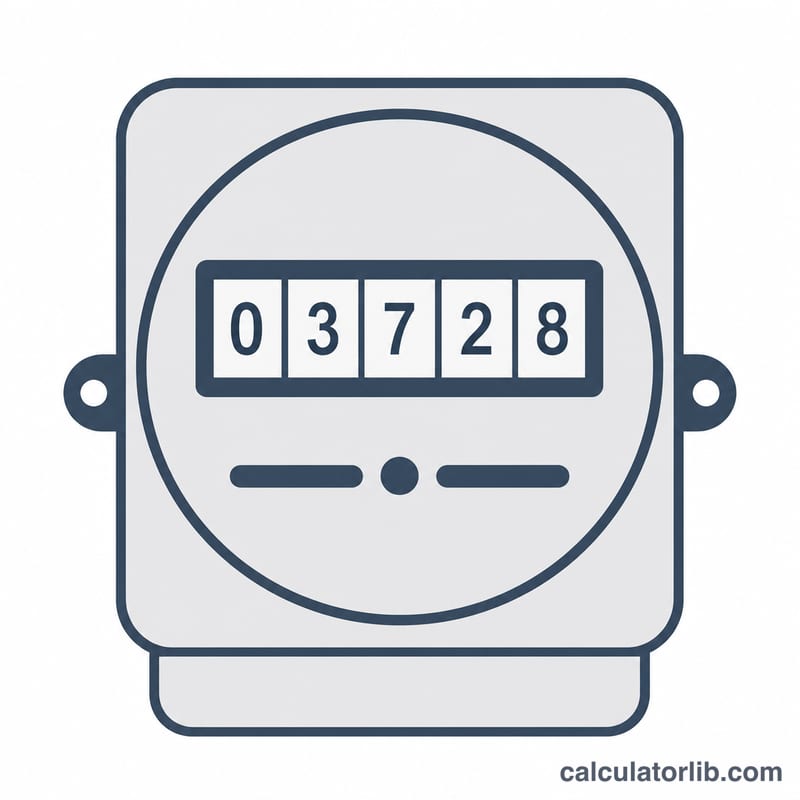
- Read the digits left to right. On a digital or dial-style register, take the whole-number digits only. Ignore any red digit or digits after a decimal point, as these show fractions of a kWh. Note any leading zeros.
- Subtract previous from current. \(\text{Usage (register units)} = \text{Current} - \text{Previous}\).
- Handle rollover. If the current reading is lower than the previous one, the meter has passed its maximum and reset to zero. Add the meter's capacity (100,000 for a 5-digit meter) to the current reading before subtracting. For example, previous 99,850 and current 00,430 gives \((430 + 100000) - 99850 = 580\) kWh.
- Apply the meter multiplier. Most home meters have a multiplier of 1. Meters connected through current transformers (CTs) may have a multiplier such as 10, 40 or 80 printed on the meter or bill. \(\text{kWh} = (\text{Current} - \text{Previous}) \times \text{Multiplier}\).
- Multiply by the unit rate. \(\text{Cost} = \text{kWh} \times \text{Rate}\). Standing charges, taxes and tiered rates are not included in this simple estimate.
- Optional: find the daily average. Divide kWh by the number of days between the two readings, \(\text{kWh per day} = \text{kWh} \div \text{days}\).
Worked example: previous reading 45,120, current reading 45,820, multiplier 1, rate 0.15 per kWh.
\(\text{Usage} = (45820 - 45120) \times 1 = 700\) kWh
\(\text{Cost} = 700 \times 0.15 = 105.00\), so the estimated energy cost is 105.00 in your currency.
If those readings were 30 days apart, the daily average is \(700 \div 30 \approx 23.3\) kWh per day.
Meter Reading Terms Explained
- kWh (kilowatt-hour)
- The unit of electrical energy that suppliers bill. One kWh is the energy used by a 1 kW load running for one hour.
- kW vs. kWh
- kW is power, the rate at which energy is being used at a moment. kWh is energy, the total used over time. A 3 kW heater is a power rating; running it for 2 hours consumes 6 kWh.
- Meter register
- The display or set of dials that shows the cumulative energy recorded by the meter. It only counts upward and is never reset in normal use.
- Meter multiplier / CT ratio
- A factor by which the register difference must be multiplied to get true usage. It is used when the meter measures through current transformers (CTs), common on larger commercial or industrial supplies. Household meters typically use a multiplier of 1.
- Rollover
- When the register passes its highest value (such as 99,999) and returns to zero. The usage calculation must then add the meter's capacity to the new reading.
- Billing period
- The span between two meter readings (actual or estimated) covered by one bill, often a month or a quarter.
- Unit rate
- The price per kWh. It may be a flat rate, tiered, or vary by time of day, depending on your supplier and tariff.
- Standing charge
- A fixed daily or monthly fee charged regardless of how much electricity you use. It is common in some countries (for example the UK) and is not included in a simple kWh × rate estimate.
- Analog, digital and smart meters
- Analog meters show usage on rotating dials, which are read from the dials one at a time, usually left to right. Digital meters show the total on an LCD or mechanical-style counter. Smart meters are digital meters that also send readings to the supplier automatically and often show usage in near real time, though you can still compare two register readings by hand.
FAQ
What if my current reading is lower than the previous one? A meter can roll over after reaching its maximum (e.g. from 99999 back to 0). This calculator clamps negative differences to zero, so re-check your numbers or add the rollover amount manually.
What is the multiplier? It is a factor printed on the meter that scales the displayed register to actual kWh. Standard household meters use 1.
Does this work for gas or water? The same subtraction logic applies, but those meters measure volume (cubic metres or feet) and need a separate conversion to energy, so use a dedicated calculator for accurate gas billing.