
What Is the 18650 Battery Pack Calculator?
This tool sizes a lithium-ion battery pack built from 18650 cells arranged in a series-parallel (S×P) configuration. Enter how many cells are wired in series, how many in parallel, the nominal voltage of a single cell and its capacity in milliamp-hours, and the calculator returns the total pack voltage, capacity in amp-hours, total cell count and stored energy in watt-hours.
How to Use It
Set the series (S) count — these stack to raise voltage. Set the parallel (P) count — these stack to raise capacity. A typical 18650 has a nominal voltage of \(3.7\,\text{V}\) and a capacity of \(2500\!-\!3500\,\text{mAh}\). The result instantly updates the four key pack specs.
The Formula Explained
With \(S\) = cells in series, \(P\) = cells in parallel, \(V_{cell}\) = nominal cell voltage and \(C_{cell}\) = cell capacity, the pack values are:
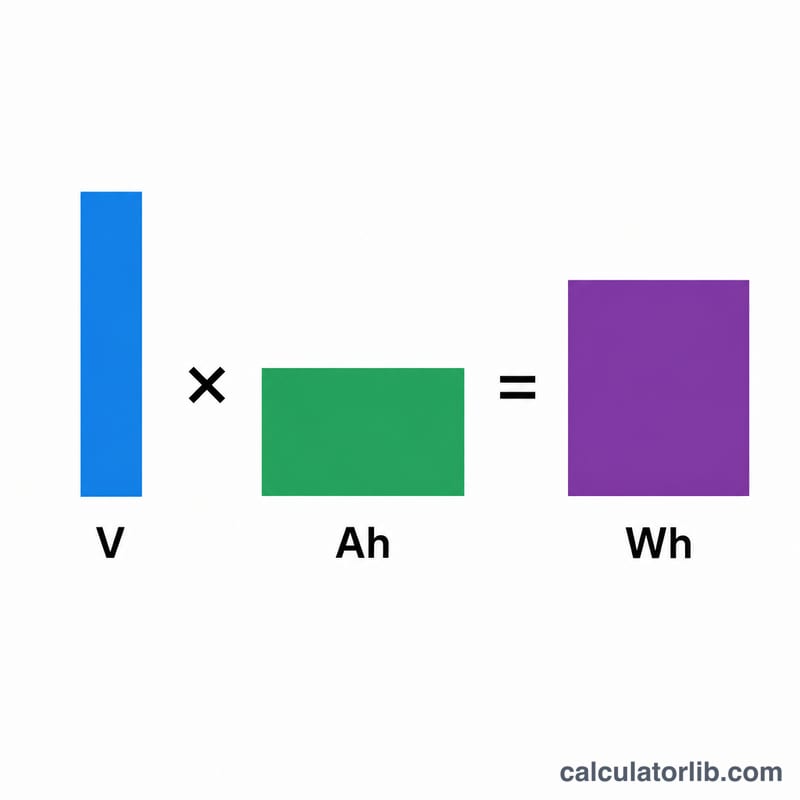
$$V_{pack} = S \times V_{cell}, \qquad C_{pack} = P \times C_{cell}$$Energy in watt-hours is voltage multiplied by capacity in amp-hours:
$$E = V_{pack} \times \frac{P \times C_{cell}}{1000}$$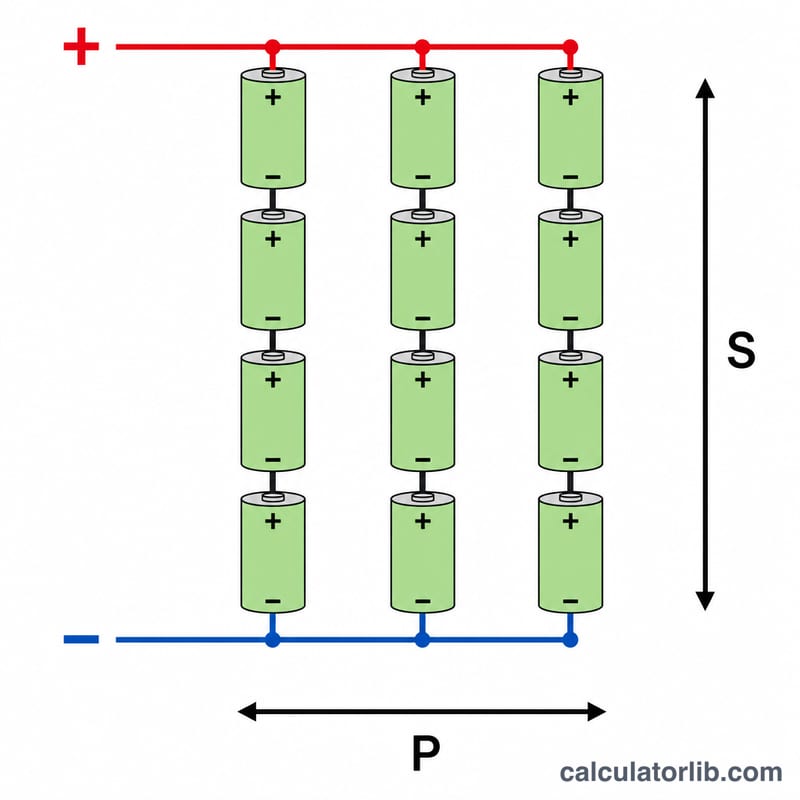
Worked Example
A 10S4P pack of \(3.7\,\text{V}\), \(3000\,\text{mAh}\) cells:
$$V_{pack} = 10 \times 3.7 = 37\,\text{V}$$$$C_{pack} = \frac{4 \times 3000}{1000} = 12\,\text{Ah}$$$$E = 37 \times 12 = 444\,\text{Wh}$$The pack uses \(10 \times 4 = 40\) cells total.
Common 18650 Pack Configurations Compared
The table below compares popular series-parallel (SxP) configurations using a representative baseline cell of 3.7 V nominal and 3000 mAh (3.0 Ah). Pack voltage is the number of series cells times cell voltage; pack capacity (Ah) is the number of parallel groups times cell capacity; energy in watt-hours is the product of the two.
| Config (SxP) | Cell count | Pack voltage (V) | Capacity (Ah) | Energy (Wh) | Typical use |
|---|---|---|---|---|---|
| 3S2P | 6 | 11.1 | 6.0 | 66.6 | Small portable devices, lights |
| 7S2P | 14 | 25.9 | 6.0 | 155.4 | Laptop / 24 V tool packs |
| 10S4P | 40 | 37.0 | 12.0 | 444 | 36 V e-bike battery |
| 13S5P | 65 | 48.1 | 15.0 | 721.5 | 48 V e-bike / e-scooter |
| 14S10P | 140 | 51.8 | 30.0 | 1554 | High-capacity power wall / EV module |
A 36 V e-bike pack rated at 444 Wh can be cross-checked as amp-hours: 444 Wh ÷ 37 V = 12 Ah, matching the 4P group capacity above.
Typical 18650 Cell Specifications
18650 cells (18 mm diameter × 65 mm length) come in many chemistries and capacities. Lithium-ion (NMC/NCA) cells have a nominal voltage near 3.6–3.7 V and charge to about 4.2 V, while lithium iron phosphate (LiFePO4) cells are nominally 3.2 V and charge to about 3.65 V. Higher-capacity cells generally support lower continuous discharge currents, while high-drain cells trade capacity for current.
| Cell type / class | Chemistry | Nominal voltage (V) | Charge voltage (V) | Typical capacity (mAh) | Typical continuous discharge |
|---|---|---|---|---|---|
| High-capacity Li-ion | NMC / NCA | 3.6–3.7 | 4.2 | 3000–3500 | Low: ~5–10 A |
| Balanced Li-ion | NMC | 3.6–3.7 | 4.2 | 2500–3000 | Moderate: ~10–20 A |
| High-drain Li-ion | NMC / NCA | 3.6–3.7 | 4.2 | 2000–2600 | High: ~20–30 A |
| LiFePO4 | LiFePO4 | 3.2 | 3.65 | 1100–1800 | Moderate–high, very stable |
Example energy of a single 3.7 V / 3000 mAh cell: 3.7 V × 3 Ah = 11.1 Wh. Always use the cell manufacturer's datasheet for exact ratings, as discharge current and capacity vary by model.
Key Terms Explained
- Series (S)
- Cells connected end-to-end so their voltages add while capacity stays the same. A 10S group of 3.7 V cells gives 37 V at single-cell capacity.
- Parallel (P)
- Cells connected side-by-side (same polarity) so their capacities add while voltage stays the same. A 4P group of 3000 mAh cells gives 12000 mAh (12 Ah) at single-cell voltage.
- Nominal voltage
- The representative average voltage of a cell during discharge (typically 3.6–3.7 V for Li-ion, 3.2 V for LiFePO4), used for sizing packs even though actual voltage ranges from full charge (~4.2 V) to cutoff (~2.5–3.0 V).
- Capacity (mAh / Ah)
- The charge a cell can deliver. Milliamp-hours (mAh) ÷ 1000 = amp-hours (Ah). A 3000 mAh cell holds 3.0 Ah.
- Watt-hour (Wh)
- The energy stored, equal to voltage × amp-hours. Wh is the fairest way to compare packs of different voltages: \(E_{\text{Wh}} = V \times \text{Ah}\).
- BMS (Battery Management System)
- Electronics that protect a pack by balancing series cells and guarding against over-charge, over-discharge, over-current and over-temperature. The BMS must match the pack's series count (e.g. a "13S BMS").
- C-rate
- Current relative to capacity. 1C is the current that fully discharges the pack in one hour; a 12 Ah pack at 1C draws 12 A, at 2C draws 24 A.
- SxP notation
- Shorthand for pack layout: the number before "S" is series cells (sets voltage), the number before "P" is parallel cells per group (sets capacity). Total cells = S × P. For example, 13S5P = 65 cells.
FAQ
Does series or parallel raise voltage? Series wiring raises voltage; parallel wiring raises capacity (and current capability).
What voltage should I use? Use the nominal voltage (usually \(3.6\)–\(3.7\,\text{V}\)) for energy estimates. Fully charged cells reach about \(4.2\,\text{V}\).
Why watt-hours? Watt-hours measure total stored energy and let you compare packs of different voltages fairly.