What Is the Hip Roof Shingle Calculator?
A hip roof slopes downward on all four sides, so its total surface area is larger than the building footprint. This calculator estimates the sloped roof area, the number of roofing squares (one square = 100 sq ft), and the number of asphalt shingle bundles you need to buy. Because shingles are sold by the bundle (typically 3 bundles per square), planning by bundle prevents both shortages and costly over-ordering.

How to Use It
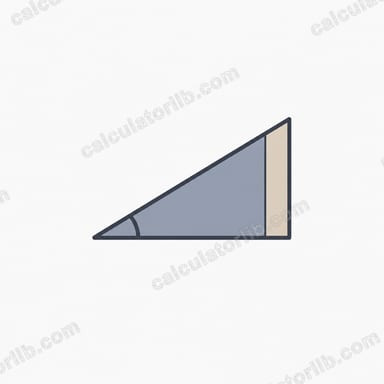
Enter the building footprint length and width in feet, the roof pitch as rise per 12 inches of run (e.g. a 6/12 roof rises 6 inches per foot), and a waste factor percentage. A 10% waste factor is common; complex hip roofs with many hips and valleys may need 12-15%.
The Formula Explained
The flat footprint is converted to true sloped area using the pitch multiplier, where \(L\) = length, \(W\) = width, and \(P\) = rise per 12:
$$A = L \times W \times \frac{\sqrt{P^2 + 144}}{12}$$Adding waste \(w\) (as a decimal) and converting to bundles at 3 per square:
$$B = \left\lceil \frac{A (1 + w)}{100} \times 3 \right\rceil$$
Worked Example
For a 40 ft × 30 ft building with a 6/12 pitch and 10% waste:
$$A = 40 \times 30 \times \frac{\sqrt{6^2 + 144}}{12} = 1200 \times 1.1180 = 1341.64\,\text{sq ft}$$With waste: \(1341.64 \times 1.10 = 1475.81\) sq ft = \(14.76\) squares.
$$B = \lceil 14.76 \times 3 \rceil = \lceil 44.27 \rceil = 45\,\text{bundles}$$Roof Pitch Multiplier Lookup Table
Pitch is written as rise over a 12-inch run (US roofing convention). The multiplier converts a flat footprint area into sloped roof surface area. It is calculated as \(\sqrt{P^2+144}/12\), and the angle is \(\arctan(P/12)\).
| Pitch (rise/12) | Multiplier | Approx. angle |
|---|---|---|
| 2/12 | 1.0138 | 9.5° |
| 3/12 | 1.0308 | 14.0° |
| 4/12 | 1.0541 | 18.4° |
| 5/12 | 1.0833 | 22.6° |
| 6/12 | 1.1180 | 26.6° |
| 7/12 | 1.1577 | 30.3° |
| 8/12 | 1.2019 | 33.7° |
| 9/12 | 1.2500 | 36.9° |
| 10/12 | 1.3017 | 39.8° |
| 12/12 | 1.4142 | 45.0° |
Example: for a 6/12 pitch, \(\sqrt{6^2+144}/12 = \sqrt{180}/12 = 13.4164/12 = 1.1180\). A hip roof has the same total surface area as a gable roof of equal pitch over the same footprint, so this multiplier applies directly.
Bundle Estimates for Common Hip Roof Sizes
These estimates use the calculator's formula: sloped area = length × width × multiplier, then waste is added, then 3 bundles per square (1 square = 100 sq ft). They assume the footprint dimensions only, with no eave overhang added, and standard 3-bundle-per-square shingles. Add overhang to your length and width if you want it covered.
| Footprint (ft) | Pitch | Waste | Sloped area (sq ft) | Squares with waste | Bundles (rounded up) |
|---|---|---|---|---|---|
| 30 × 24 | 4/12 | 10% | 758.9 | 8.35 | 26 |
| 40 × 30 | 6/12 | 10% | 1,341.6 | 14.76 | 45 |
| 50 × 36 | 8/12 | 12% | 2,163.3 | 24.23 | 73 |
| 60 × 40 | 10/12 | 15% | 3,124.1 | 35.93 | 108 |
Worked example (40 × 30 ft, 6/12, 10% waste): $$1{,}200 \times 1.1180 = 1{,}341.6\text{ sq ft}$$ $$1{,}341.6 \times 1.10 = 1{,}475.8\text{ sq ft} = 14.76\text{ squares}$$ $$14.76 \times 3 = 44.3 \;\Rightarrow\; 45\text{ bundles}$$
Ordering Tips for Hip Roof Shingles
- Round up to whole bundles. Shingles are sold by the bundle, so always round the result up, never down.
- Match waste to complexity. A simple hip roof often needs about 10%. Use 12–15% for many hips, valleys, dormers, or chimneys, because cuts at hips and valleys create offcuts.
- Buy hip and ridge cap separately. Estimate it from the total linear feet of hips plus ridges. One bundle of cap shingles typically covers roughly 20–35 linear feet, depending on the product. Check the package. Hip roofs have more cap length than gable roofs of the same size.
- Account for starter strips and underlayment. Starter courses along eaves and rakes are usually a separate product. Underlayment, drip edge, and flashing are also ordered separately from the shingle count.
- Check the manufacturer's bundles per square. Three bundles per square is common for standard architectural and 3-tab shingles in the US, but some heavier or specialty products use 4 or 5. Adjust the count if your product differs.
- Measure overhangs. This estimate uses the dimensions you enter. If your eaves overhang the walls, add the overhang to the length and width.
- Keep a spare bundle. Extra bundles from the same production lot help match color for future repairs.
This is general planning information. Confirm quantities and local code requirements with your roofing supplier or contractor.
FAQ
Does the footprint method work for hip roofs? Yes. Whether a roof is gable or hip, the total sloped area over a rectangular footprint is the same — the pitch multiplier accounts for the slope on all sides.
How many shingles in a bundle? Standard 3-tab and architectural shingles come 3 bundles per 100 sq ft square; heavier shingles may need 4 or 5 bundles per square.
Should I add extra for hips and ridges? Hip and ridge caps are usually bought separately. Increase the waste factor to 12-15% on roofs with many hips, valleys, and dormers.