
What Is a Gambrel Roof Calculator?
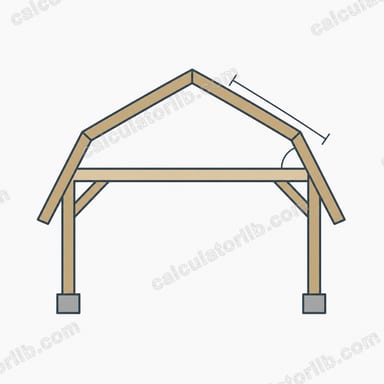
A gambrel roof — often called a barn roof — has two distinct slopes on each side: a steep lower slope and a shallower upper slope that meet at a ridge. This double-pitch design maximizes headroom in attics and lofts. This calculator works out the rafter lengths for both sections, the total vertical rise, and the combined rafter length per side, using nothing more than the roof span, the upper section width, and the two slope angles.
How to Use It
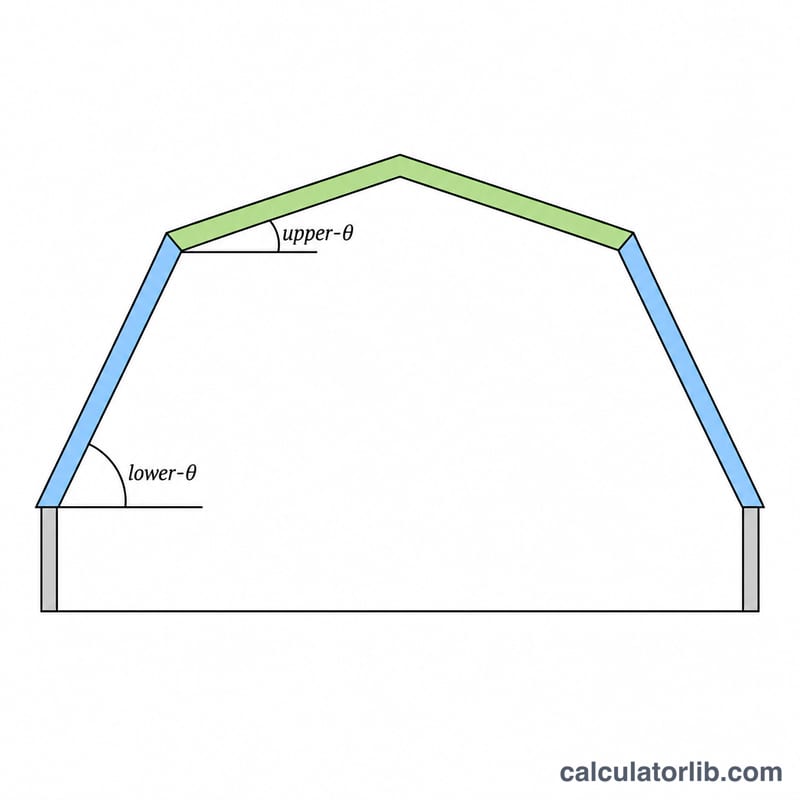
Enter the total span (the full width the roof covers), the upper section width (the horizontal distance between the two ridge-side break points), and the lower and upper slope angles measured from the horizontal. The tool returns each rafter length, the roof's total rise, and the sum of both rafters on one side so you can estimate lumber.
The Formula Explained
Each rafter is the hypotenuse of a right triangle. The lower section has a horizontal run of \(w/2 - t/2\), so its rafter length is that run divided by the cosine of the lower angle. The upper section runs \(t/2\) horizontally, giving \((t/2)/\cos\theta_U\). The vertical rise of each section equals its run times the tangent of its angle; adding them gives the total roof height.
$$H = \left(\frac{W - T}{2}\right)\tan\theta_L + \left(\frac{T}{2}\right)\tan\theta_U$$$$L = \frac{\dfrac{\text{Width} - \text{Upper Width}}{2}}{\cos\text{Lower Angle}} + \frac{\dfrac{\text{Upper Width}}{2}}{\cos\text{Upper Angle}}$$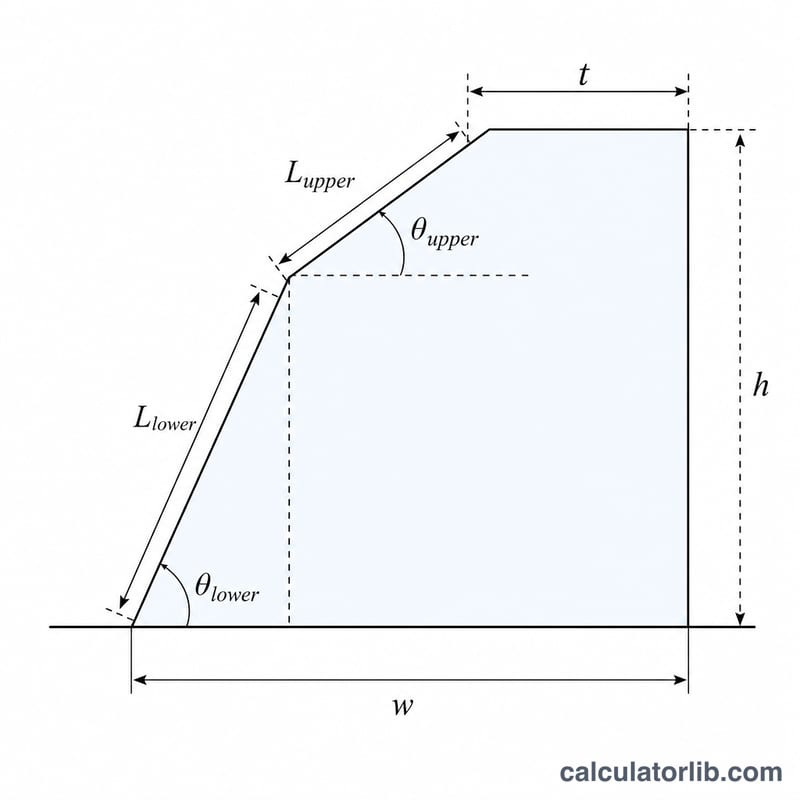
Worked Example
For a 30 ft span, 16 ft upper width, a 70° lower slope and a 30° upper slope: lower run = 15 − 8 = 7 ft, so lower rafter = 7 / cos 70° ≈ 20.47 ft. Upper rafter = 8 / cos 30° ≈ 9.24 ft. Total rise = 7·tan 70° + 8·tan 30° ≈ 19.23 + 4.62 = 23.85 ft.
$$\text{lower run} = 15 - 8 = 7 \text{ ft}$$$$\text{lower rafter} = \frac{7}{\cos 70°} \approx 20.47 \text{ ft}$$$$\text{upper rafter} = \frac{8}{\cos 30°} \approx 9.24 \text{ ft}$$$$\text{total rise} = 7\cdot\tan 70° + 8\cdot\tan 30° \approx 19.23 + 4.62 = 23.85 \text{ ft}$$FAQ
What angles should I use? Traditional gambrel roofs use roughly 60–75° for the lower slope and 25–35° for the upper slope, but you can enter any values your design calls for.
Is the result for one side? Yes — rafter lengths are per side. A symmetric gambrel uses the same lengths on the opposite side.
Does this include overhang? No. Add your desired eave overhang to the lower rafter length separately.