
What Is a Roof Truss Calculator?
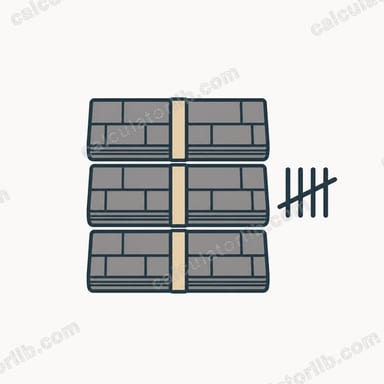
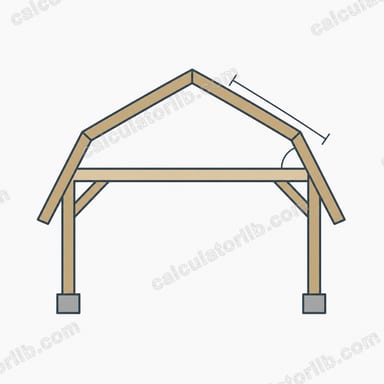
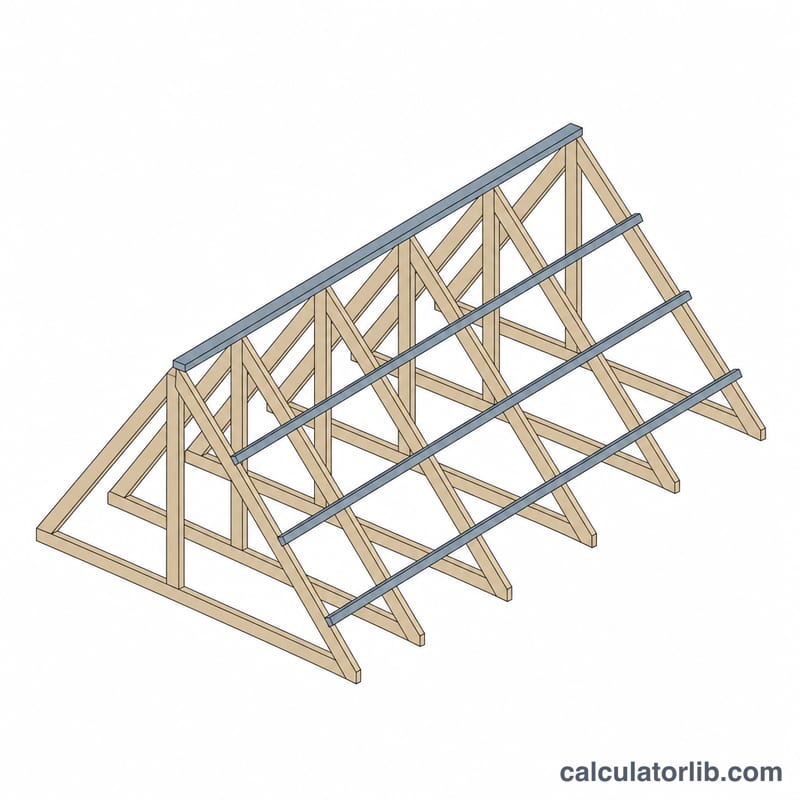
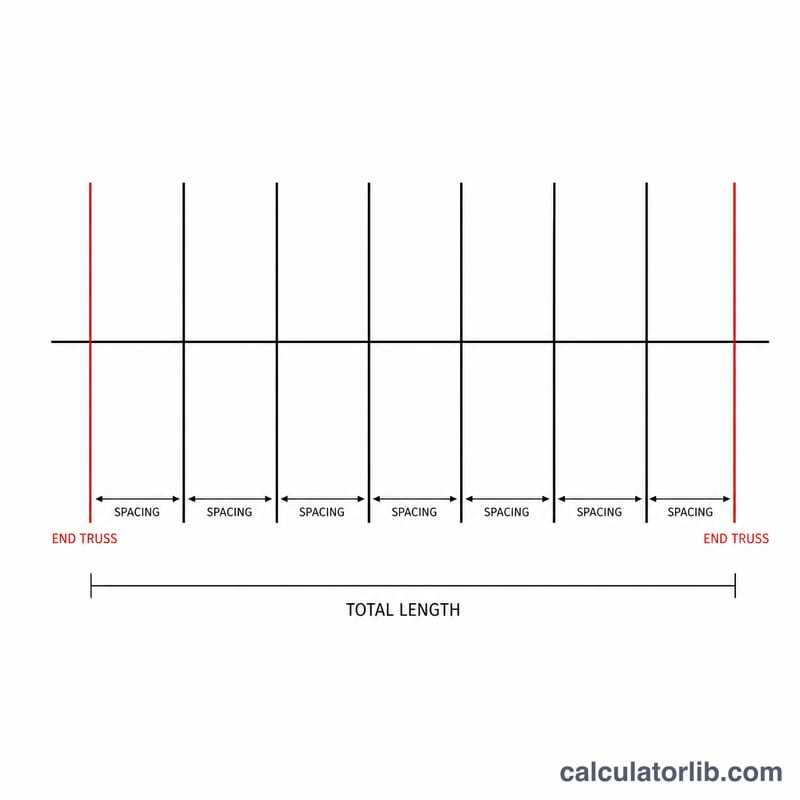
A roof truss calculator estimates how many prefabricated roof trusses you need to frame a roof of a given length. Trusses are installed at a regular on-center spacing along the building, and this tool counts the trusses required including one at each end.
How to Use It
Enter the roof length (the distance the trusses span across, in feet) and the truss spacing (the on-center distance between trusses — commonly 2 ft / 24 in). The calculator divides length by spacing, rounds up to a whole number of bays, then adds one because trusses sit at both ends of every bay.
The Formula Explained
The core equation is $$\text{Trusses} = \left\lceil \frac{\text{Roof Length (ft)}}{\text{Truss Spacing (ft)}} \right\rceil + 1$$ Dividing length by spacing gives the number of gaps (bays). Rounding up ensures the last partial bay still gets a truss. Adding 1 accounts for the fence-post effect: if you have N gaps, you need N+1 posts (trusses) to bound them.
Worked Example
For a 40 ft roof with trusses spaced 2 ft on center: \(40 \div 2 = 20\) bays. Adding 1 gives 21 trusses. If the roof were 41 ft, \(\left\lceil 41 \div 2 \right\rceil = 21\) bays, so you would need 22 trusses.
FAQ
Does this include gable-end trusses? Yes — the +1 ensures a truss sits at each end of the roof.
What spacing should I use? 24 inches (2 ft) on center is standard for residential roofs, but 16 in (1.33 ft) is used for heavier loads. Always confirm with your structural engineer and local building code.
Is this an exact material order? No. It is a planning estimate. Final counts should follow stamped truss-manufacturer layout drawings and account for hips, valleys, and overhangs.