
What Is the Fire Flow Calculator?
The Fire Flow Calculator estimates the amount of water, in gallons per minute (GPM), needed to control or extinguish a structure fire. It combines two widely taught fireground formulas: the Iowa Rate-of-Flow formula and the National Fire Academy (NFA) formula. These quick mental-math tools help incident commanders size up a fire and decide how many lines and how much supply are required.
How to Use It
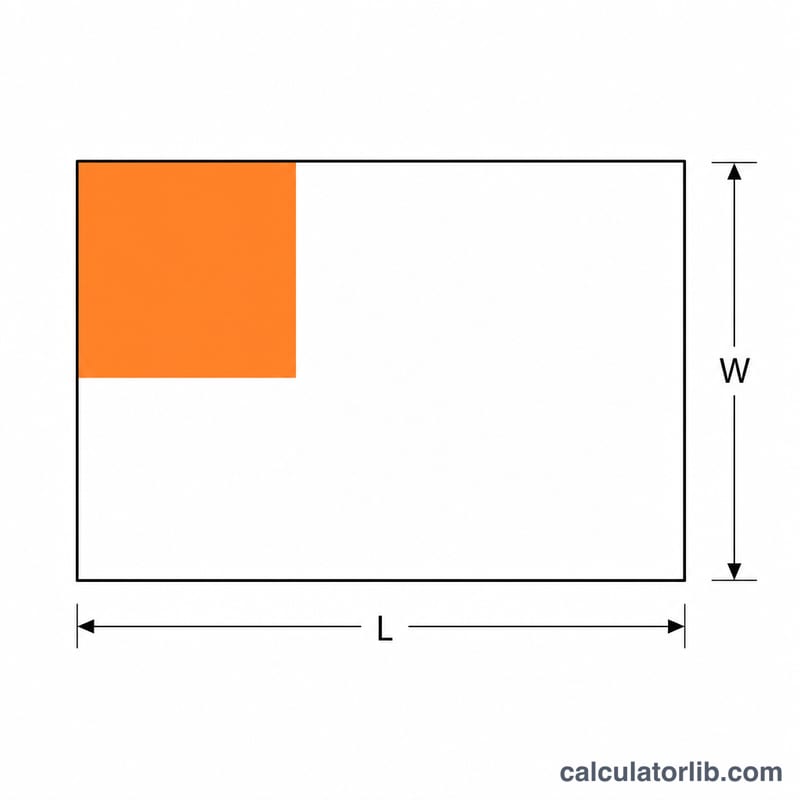
Enter the building's length and width in feet, then enter the estimated percentage of the area involved in fire. The calculator multiplies length by width to get the area, divides by 3, and—for the Iowa value—scales by the percent involved. The result is your target flow rate in GPM.
The Formula Explained
The base value \((L \times W) / 3\) represents the National Fire Academy needed fire flow for a fully involved area. The Iowa formula refines this by applying the fraction of the area actually burning:
$$\text{Fire Flow (GPM)} = \frac{\text{Length (ft)} \times \text{Width (ft)}}{3} \times \frac{\text{Percent Involved (\%)}}{100}$$Dividing by 3 is an empirically derived constant that correlates floor area with the water needed for knockdown.
Worked Example
A building measures 50 ft × 30 ft and is 50% involved. Area = 1,500 sq ft. NFA flow:
$$1{,}500 \div 3 = 500 \text{ GPM}$$(for 100% involvement). Iowa flow:
$$500 \times 0.50 = \mathbf{250 \text{ GPM}}$$
FAQ
Is this for a single floor or the whole building? The area entered should represent the involved compartment or floor. For multi-story fully involved structures, calculate per floor and add.
Why divide by 3? It is an empirical constant in both the Iowa and NFA formulas that converts area (or volume) into an approximate required flow.
Should I add water for exposures? Yes—the NFA method commonly adds about 25% of the base flow for each exposed building. These figures are training estimates, not a substitute for department SOPs.