
What is the Beam Deflection Calculator?
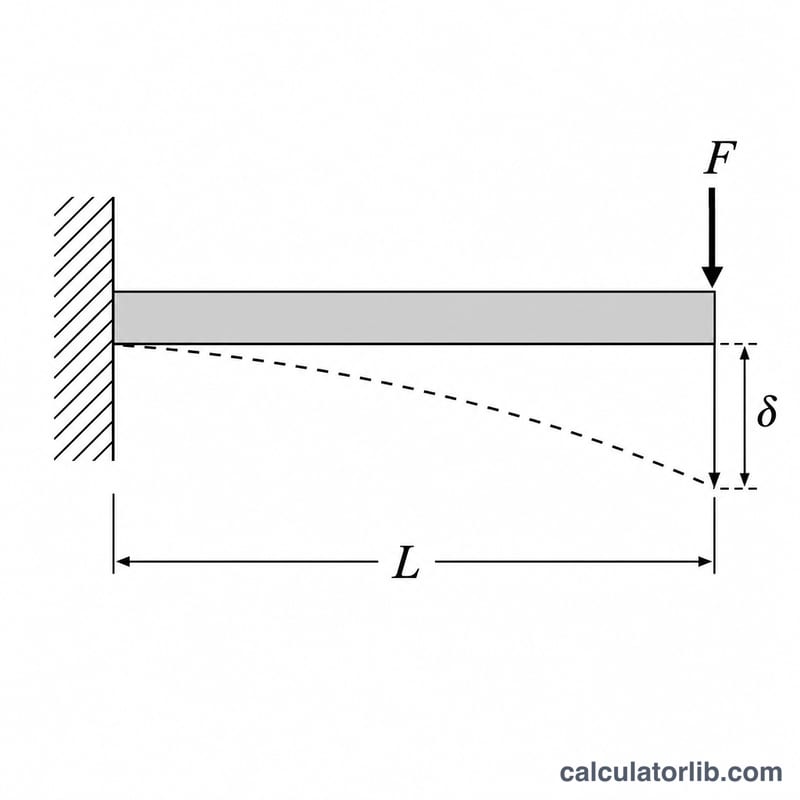
This tool computes the maximum deflection at the free end of a cantilever beam carrying a concentrated point load at its tip. A cantilever is a beam fixed rigidly at one end and free at the other — think of a balcony, diving board, or bracket. Under load the free end droops by a predictable amount governed by the load, the beam's length, and its stiffness. The result applies universally (SI units) to any linearly elastic material.
How to use it
Enter the point load F in newtons (N) applied at the free end, the beam length L in metres, the material's Young's modulus E in pascals (Pa), and the cross-section's second moment of area I in m⁴. The calculator returns the tip deflection in both millimetres and metres.
The formula explained
The governing equation is:
$$\delta = \frac{F \cdot L^{3}}{3 \cdot E \cdot I}$$
Deflection grows with the cube of length, so doubling a cantilever's length increases its droop eightfold. Stiffness comes from the product \(E \cdot I\): stiffer materials (high \(E\)) and beefier cross-sections (high \(I\)) resist bending. The factor 3 in the denominator is specific to a cantilever with a single end point load.
Worked example
A steel cantilever (\(E = 200\ \text{GPa} = 2\times10^{11}\ \text{Pa}\)), length \(L = 2\ \text{m}\), with \(I = 1\times10^{-7}\ \text{m}^4\), carries \(F = 1000\ \text{N}\) at the tip. Then $$\delta = \frac{1000 \times 2^{3}}{3 \times 2\times10^{11} \times 1\times10^{-7}} = \frac{8000}{60000} = 0.1333\ \text{m} \approx 133.3\ \text{mm}.$$
Typical Young's Modulus Values
Young's modulus \(E\) measures a material's stiffness — its resistance to elastic deformation under axial stress. In the cantilever deflection formula, a higher \(E\) produces a smaller deflection. Values below are nominal engineering figures; real material properties vary with grade, temperature, moisture, and direction of loading (timber and composites are strongly anisotropic).
| Material | \(E\) (GPa) | \(E\) (Pa) |
|---|---|---|
| Structural steel | ~200 | \(2.0\times10^{11}\) |
| Aluminium alloy | ~69 | \(6.9\times10^{10}\) |
| Concrete (normal-weight) | ~30 | \(3.0\times10^{10}\) |
| Glass-reinforced plastic (GRP/fibreglass) | ~17–35 | \(1.7\text{–}3.5\times10^{10}\) |
| Oak / structural timber (along grain) | ~11 | \(1.1\times10^{10}\) |
Note: These are nominal mean values for guidance only. For design work, use the modulus specified for the exact material grade and standard (e.g. EN, ASTM) you are working to. To convert GPa to Pa, multiply by \(10^9\) (\(1\ \text{GPa} = 10^9\ \text{Pa}\)).
Definitions & Glossary
- Point load \(F\) — a force assumed to act at a single point, here at the free end of the cantilever. SI unit: newton (N).
- Length \(L\) — the span of the cantilever measured from the fixed support to the point where the load is applied (the free end). SI unit: metre (m).
- Young's modulus \(E\) — the elastic (stiffness) modulus of the beam material, the ratio of axial stress to axial strain in the linear range. SI unit: pascal (Pa); often quoted in GPa.
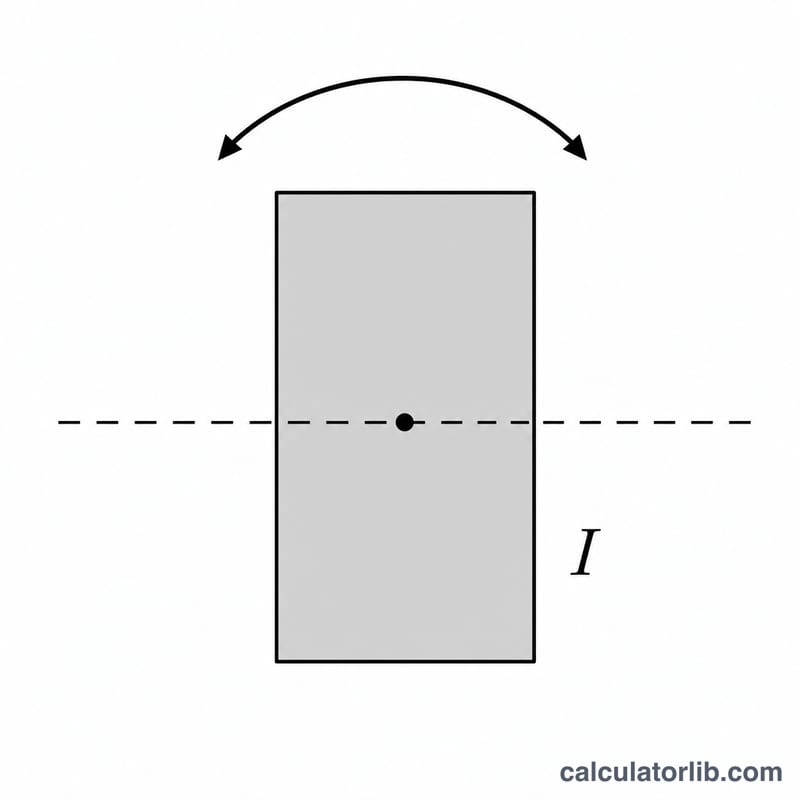
- Second moment of area \(I\) — a geometric property of the cross-section describing its resistance to bending about the neutral axis; depends only on shape and dimensions. SI unit: \(\text{m}^4\).
- Cantilever — a beam rigidly fixed (built in) at one end and unsupported at the other, so all support reactions occur at the fixed end.
- Deflection \(\delta\) — the vertical displacement of the beam from its undeformed position; for an end-loaded cantilever it is maximum at the free end and equals \(FL^3/(3EI)\). SI unit: metre (m).
- Fixed (built-in) end — the support that resists both translation and rotation, providing a reaction force and a reaction moment; the beam slope is zero there.
- Free end — the unsupported end of the cantilever, where the point load is applied and where deflection is greatest.
- Linear-elastic assumption — the analysis assumes the material obeys Hooke's law (stress proportional to strain), deflections are small, and the beam returns to its original shape when unloaded; results are invalid once the material yields or deflections become large.
FAQ
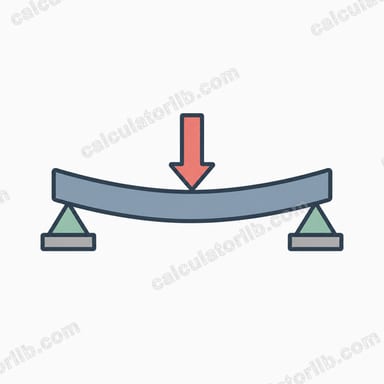
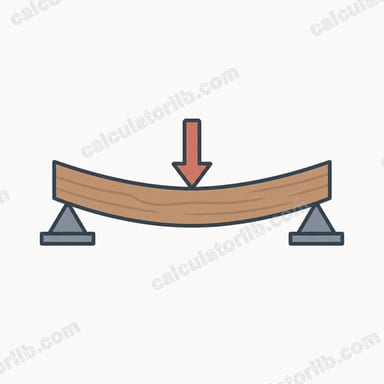
Does this work for a simply supported beam? No — that case uses a different constant (e.g. \(F \cdot L^{3}/48EI\) for a central load). This calculator is specifically for an end-loaded cantilever.
What units should I use? Keep everything in SI: newtons, metres, pascals, and m⁴ for inertia. The output is then in metres (also shown in mm).
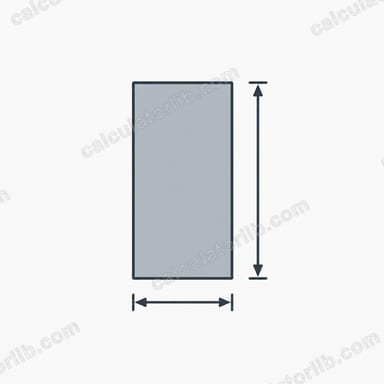
How do I find I? For a solid rectangle of width b and height h, \(I = b \cdot h^{3}/12\). For a circular section of diameter d, \(I = \pi \cdot d^{4}/64\).