
What Is Laser Beam Divergence?
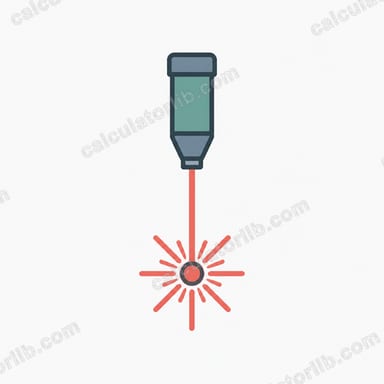
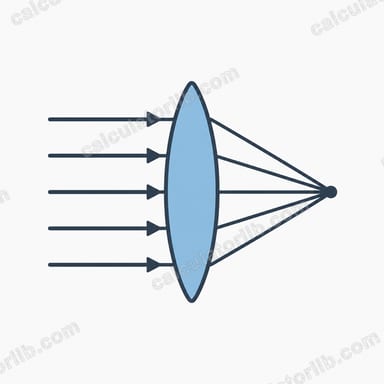
Laser beam divergence measures how much a laser beam spreads out as it travels away from the source. Even highly collimated lasers expand gradually due to diffraction. Divergence is usually expressed as a full angle in milliradians (mrad). A smaller divergence means a tighter, more focused beam over long distances — important for rangefinders, lidar, free-space communication, and laser cutting.
How to Use This Calculator
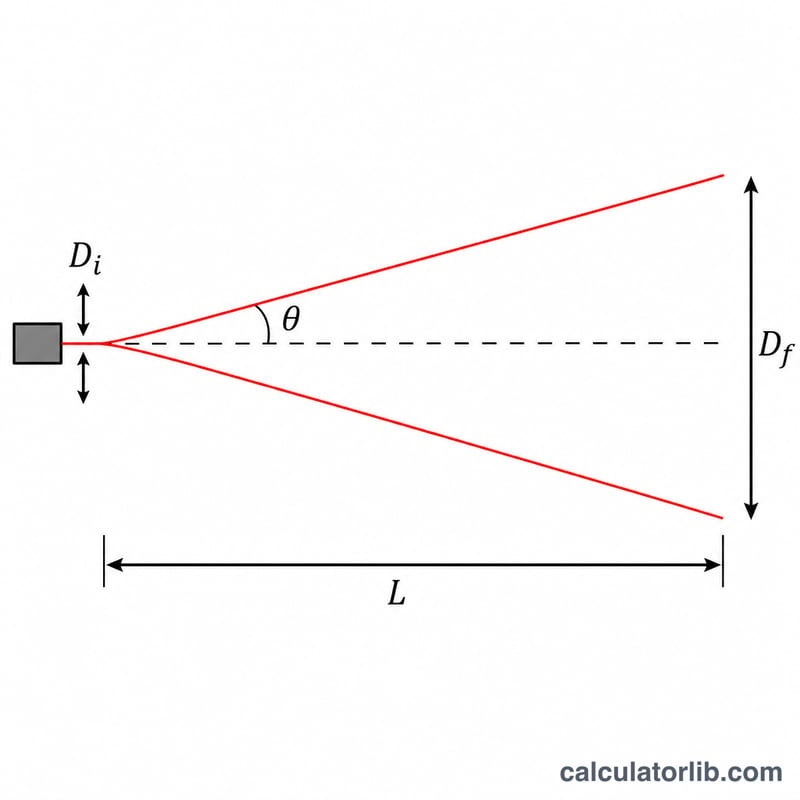
Measure the beam diameter at two points along its path. Enter the initial diameter \(\text{D}_i\) (near the source), the final diameter \(\text{D}_f\) (farther away), both in millimeters, and the distance \(\text{L}\) between the two measurement points in meters. The calculator returns the full-angle divergence in milliradians, radians, and degrees, plus the half-angle value.
The Formula Explained
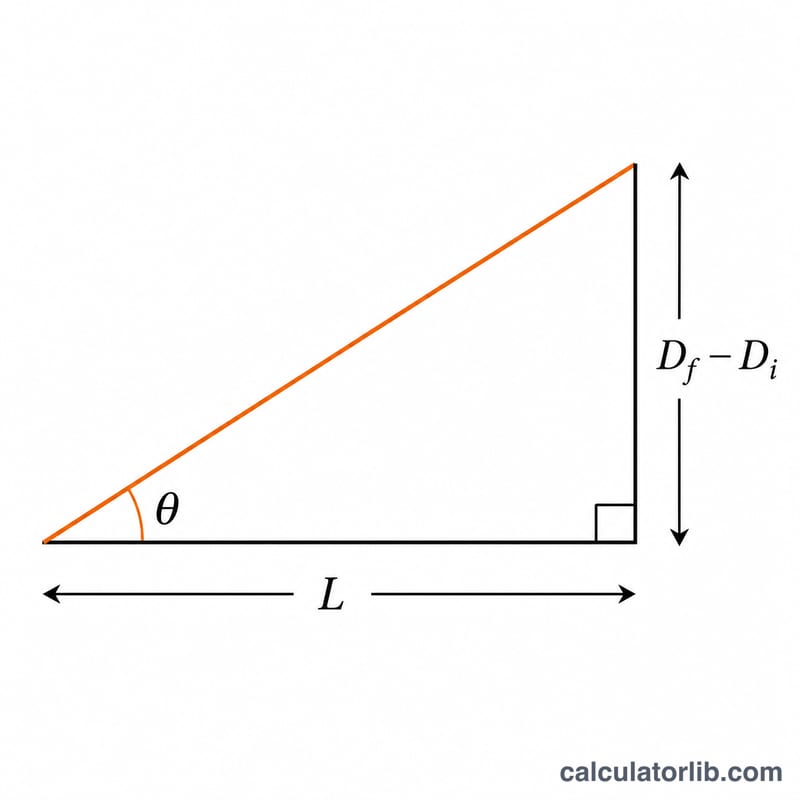
The far-field divergence is approximated by the geometric ratio $$\theta = \frac{\text{D}_f - \text{D}_i}{\text{L}}$$ Diameters are converted from millimeters to meters so the result is a dimensionless angle in radians. Multiply by 1000 to get milliradians, the most common unit for specifying laser beam quality.
Worked Example
Suppose a beam is 1 mm wide at the source and grows to 10 mm after traveling 100 m. The diameter change is \(10 - 1 = 9\) mm \(= 0.009\) m. Dividing by 100 m gives $$\theta = 0.00009 \text{ rad} = 0.09 \text{ mrad}$$ The half-angle divergence is 0.045 mrad — an excellent, well-collimated beam.
FAQ
Is this the full angle or half angle? The main result is the full-angle divergence; the table also lists the half-angle, which is simply half of it.
Do units have to match? Enter diameters in mm and distance in m as labeled — the calculator handles the conversion internally.
Why use milliradians? Milliradians give convenient small numbers for laser specs; 1 mrad spreads roughly 1 m over 1 km of travel.