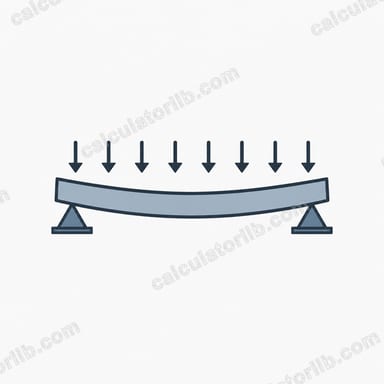

What Is the Section Modulus?
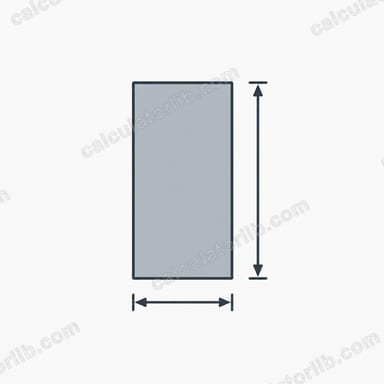
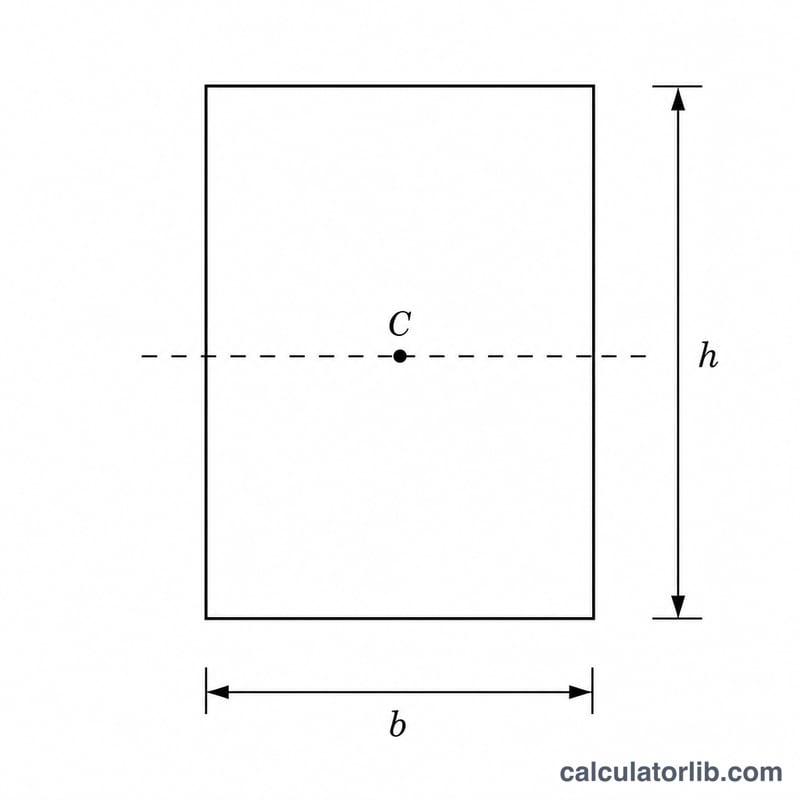
The elastic section modulus (S) is a geometric property of a cross-section that measures its resistance to bending. For a solid rectangular beam of width b and height h, the section modulus about the centroidal axis is \(S = b \cdot h^{2} / 6\). A larger section modulus means a stiffer, stronger beam in bending. This is a universal geometry/mechanics tool — the result is expressed in cubic length units (e.g. mm³, cm³, in³) depending on the units you enter.
How to Use This Calculator
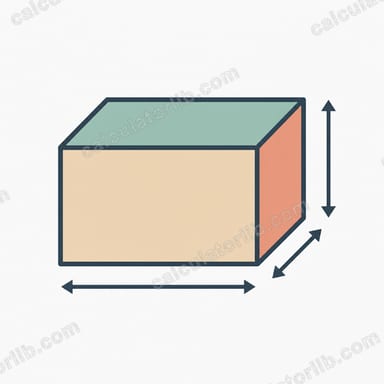
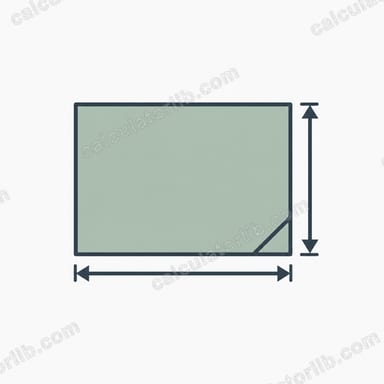
Enter the width b (the dimension parallel to the neutral axis) and the height h (the dimension in the direction of bending, measured perpendicular to the axis). The calculator returns the section modulus S, the moment of inertia \(I = b \cdot h^{3} / 12\), and the cross-sectional area. Keep your units consistent: if you enter millimetres, S comes out in mm³ and I in mm⁴.
The Formula Explained
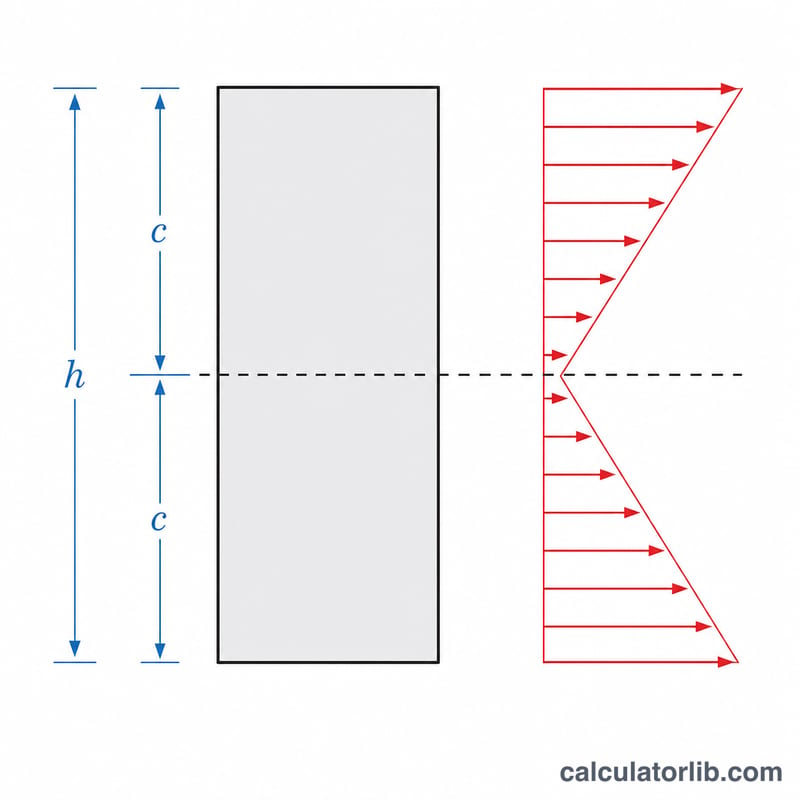
Bending stress relates to the section modulus by \(\sigma = M / S\), where M is the applied bending moment. Section modulus is derived from the moment of inertia divided by the distance to the extreme fibre: \(S = I / c\). For a rectangle, \(I = b \cdot h^{3} / 12\) and \(c = h/2\), so $$S = \frac{b \cdot h^{3} / 12}{h/2} = \frac{b \cdot h^{2}}{6}.$$ Because height appears squared, increasing the depth of a beam is far more effective at boosting strength than increasing its width.
Worked Example
For a beam with \(b = 50\) mm and \(h = 100\) mm: $$S = \frac{50 \times 100^{2}}{6} = \frac{500000}{6} \approx 83{,}333.33 \text{ mm}^{3}.$$ The moment of inertia is $$I = \frac{50 \times 100^{3}}{12} = \frac{50{,}000{,}000}{12} \approx 4{,}166{,}666.67 \text{ mm}^{4}.$$
FAQ
Which dimension is the height? The height h is the dimension parallel to the direction of the applied bending (the depth of the beam). Swapping b and h gives the section modulus for bending about the other axis.
Does this work for any unit? Yes — it is pure geometry. Just keep b and h in the same length unit; results scale accordingly (length³ for S, length⁴ for I).
What is the difference between elastic and plastic section modulus? This tool computes the elastic section modulus used in elastic bending. The plastic section modulus (\(Z = b \cdot h^{2} / 4\)) applies when the entire section yields.