
What Is the Bulk Modulus?
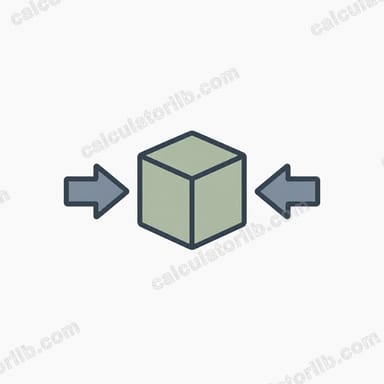
The bulk modulus (\(K\)) measures a material's resistance to uniform compression. It quantifies how much pressure is needed to produce a given relative decrease in volume. A high bulk modulus means the material is very stiff and hard to compress — diamond and steel have very high values, while gases have very low ones. \(K\) has the same units as pressure (pascals, Pa).
The Formula
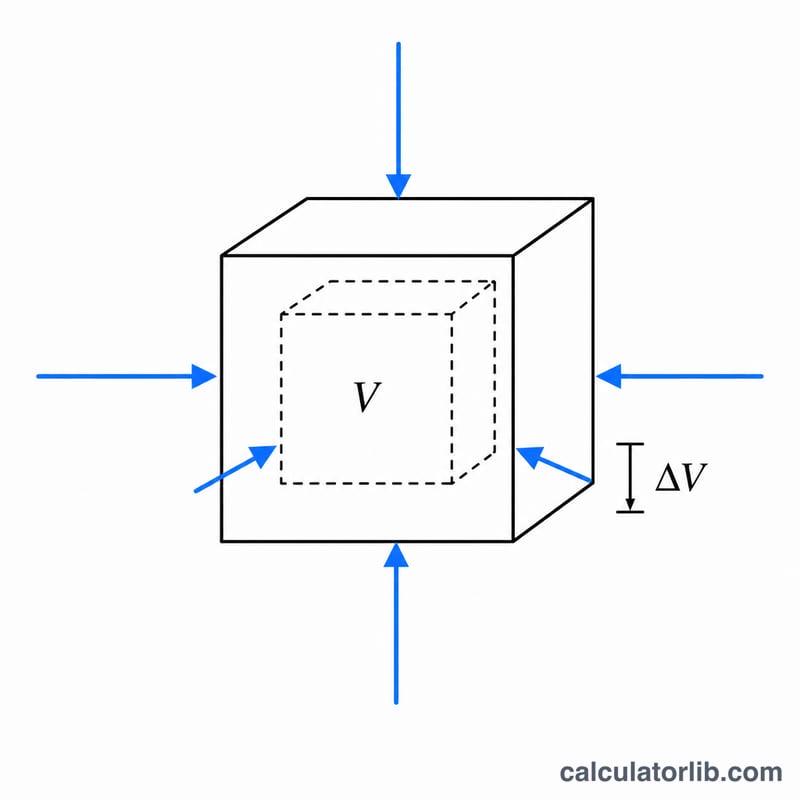
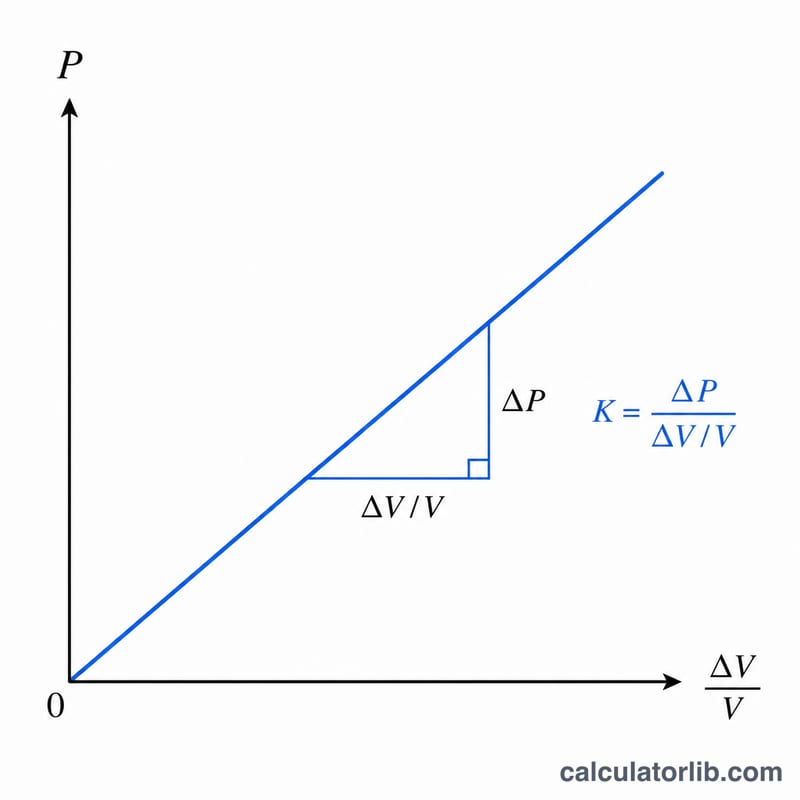
The bulk modulus is defined as:
$$K = -V \cdot \frac{\Delta P}{\Delta V} = \frac{\Delta P}{-\dfrac{\Delta V}{V}}$$
Here \(\Delta P\) is the applied change in pressure, \(V\) is the original volume, and \(\Delta V\) is the resulting change in volume. The minus sign appears because an increase in pressure (positive \(\Delta P\)) produces a decrease in volume (negative \(\Delta V\)), so \(K\) stays positive. The ratio \(\Delta V/V\) is the dimensionless volumetric strain.
How to Use This Calculator
Enter the pressure change \(\Delta P\) in pascals, the initial volume \(V\) in cubic metres, and the volume change \(\Delta V\) (use a negative number when the material is compressed). The calculator returns the bulk modulus in pascals along with the volumetric strain.
Worked Example
Suppose a sample of original volume \(V = 1 \text{ m}^3\) is subjected to a pressure increase of \(\Delta P = 1{,}000{,}000 \text{ Pa}\) (1 MPa) and its volume shrinks by \(\Delta V = -0.0005 \text{ m}^3\). The volumetric strain is \(-0.0005/1 = -0.0005\). Then $$K = -\frac{1{,}000{,}000}{-0.0005} = 2{,}000{,}000{,}000 \text{ Pa} = 2 \text{ GPa}.$$
Typical Bulk Modulus Values for Common Materials
The bulk modulus \(K\) measures a material's resistance to uniform (isotropic) compression. It is defined by \(K = -V\,\dfrac{\Delta P}{\Delta V}\) and carries units of pressure — here given in gigapascals (\(\text{GPa}\)), where \(1\ \text{GPa} = 10^{9}\ \text{Pa}\). The values below are representative room-temperature figures; real values vary with composition, temperature and (for gases) pressure.
| Material | Bulk modulus \(K\) (GPa) | Notes |
|---|---|---|
| Diamond | ~440 | One of the stiffest known solids |
| Steel (carbon) | ~160 | Typical structural steel |
| Copper | ~140 | |
| Aluminium | ~76 | |
| Glass | ~35–55 | Composition dependent |
| Mercury (liquid) | ~28 | Dense, low-compressibility liquid |
| Water | ~2.2 | ≈ 2.2 GPa at 20 °C |
| Mineral / hydraulic oil | ~1.5–1.9 | |
| Air (adiabatic) | ~0.000142 | ≈ \(1.42\times10^{5}\ \text{Pa}\) at 1 atm |
Values are drawn from standard physics and engineering references (e.g. CRC Handbook of Chemistry and Physics, Kaye & Laby tables). For gases, \(K\) is approximately equal to the pressure (isothermal) or \(\gamma P\) (adiabatic), so it scales with operating pressure rather than being a fixed material constant.
Interpreting Your Bulk Modulus Result
The magnitude of \(K\) tells you how strongly a material resists being compressed under uniform pressure:
- Large \(K\) (high stiffness, low compressibility): a big pressure change produces only a tiny fractional volume change. Hard solids such as diamond (~440 GPa) and steel (~160 GPa) fall here — they are effectively “incompressible” for most engineering loads.
- Moderate \(K\): liquids like water (~2.2 GPa) and mercury (~28 GPa) resist compression far less than metals but still strongly compared with gases.
- Small \(K\) (high compressibility): gases such as air (~\(1.4\times10^{-4}\) GPa) change volume readily; their \(K\) is comparable to the applied pressure itself.
The reciprocal of the bulk modulus is the compressibility \(\beta\):
$$\beta = \frac{1}{K}$$
So a material with \(K = 2.2\ \text{GPa}\) (water) has \(\beta \approx 4.5\times10^{-10}\ \text{Pa}^{-1}\), meaning each pascal of added pressure compresses it by about \(4.5\times10^{-10}\) of its volume. Worked example: applying \(\Delta P = 1\ \text{MPa}\) to \(V = 1\ \text{L}\) of water with \(K = 2.2\ \text{GPa}\) gives a volume change of
$$\Delta V = -\frac{\Delta P \cdot V}{K} = -\frac{(1\times10^{6})(1\times10^{-3})}{2.2\times10^{9}} \approx -4.5\times10^{-7}\ \text{m}^3,$$
about 0.45 mL — a 0.045% reduction, confirming water's near-incompressibility. The negative sign in \(K = -V(\Delta P/\Delta V)\) ensures \(K\) is positive, since volume decreases (\(\Delta V < 0\)) when pressure increases (\(\Delta P > 0\)). Bulk modulus also relates to other elastic constants: for an isotropic solid it connects to the shear modulus and Young's modulus through Poisson's ratio, and it sets the speed of sound (compression waves) in a medium.
FAQ
What units should I use? Use consistent SI units: pressure in pascals and volume in cubic metres. The result will be in pascals.
Why is \(\Delta V\) negative? Increasing pressure compresses most materials, reducing their volume, so \(\Delta V\) is negative. The negative sign in the formula then gives a positive \(K\).
How does bulk modulus relate to compressibility? Compressibility is simply the reciprocal: \(\beta = 1/K\). A material that is easy to compress has a low \(K\) and a high \(\beta\).