
What is Games Behind (GB)?
Games Behind (GB) is the standard baseball standings statistic that measures how far a trailing team sits behind the leader. It is the same calculation used across MLB, NPB and virtually every other league, so it applies universally and is not specific to any country. GB tells you how many games of progress the trailing team must make up to draw even with the leader.
How to use this calculator
Enter the leader (higher-ranked, reference) team's wins and losses, then enter the trailing (lower-ranked) team's wins and losses. The calculator returns the games behind value, typically shown to one decimal place because the divide-by-two step can produce half-games such as 0.5 or 1.5.
The formula explained
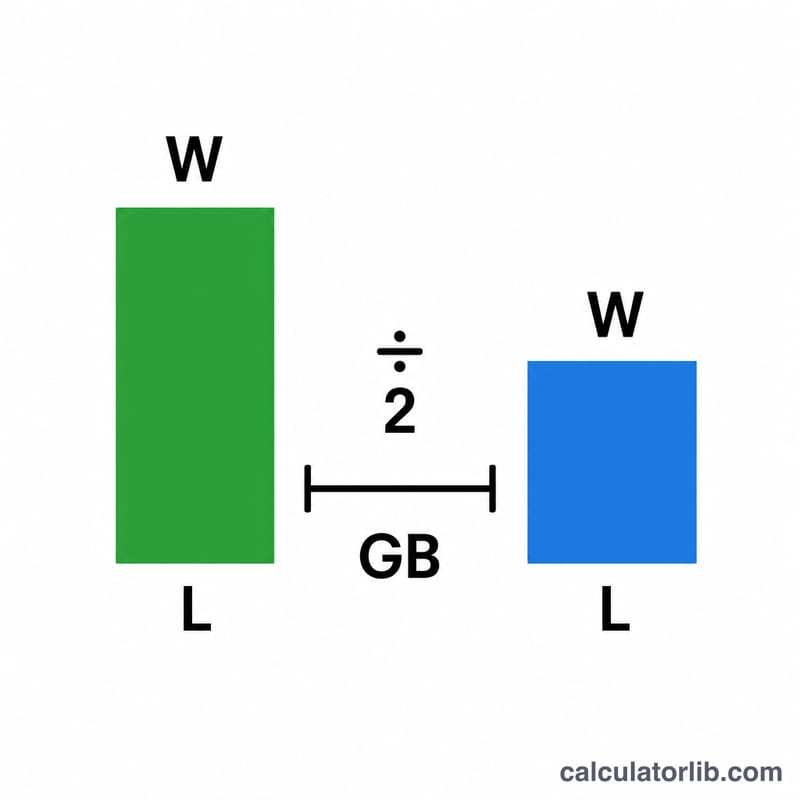
Each team has a win-loss differential equal to wins minus losses. Games Behind is half the difference of those two differentials:
$$\text{GB} = \frac{\left(\text{Leader Wins} - \text{Leader Losses}\right) - \left(\text{Trailer Wins} - \text{Trailer Losses}\right)}{2}$$
Equivalently, GB is the average of the gap in wins and the gap in losses. The formula ignores tie/draw games and does not require both teams to have played the same number of games.
Worked example
Leader: 80 wins, 35 losses, so the differential is \(80 - 35 = 45\). Trailing team: 78 wins, 36 losses, differential \(78 - 36 = 42\). $$\text{GB} = \frac{45 - 42}{2} = \frac{3}{2} = \textbf{1.5 games behind}.$$
GB Across Common Standings Scenarios
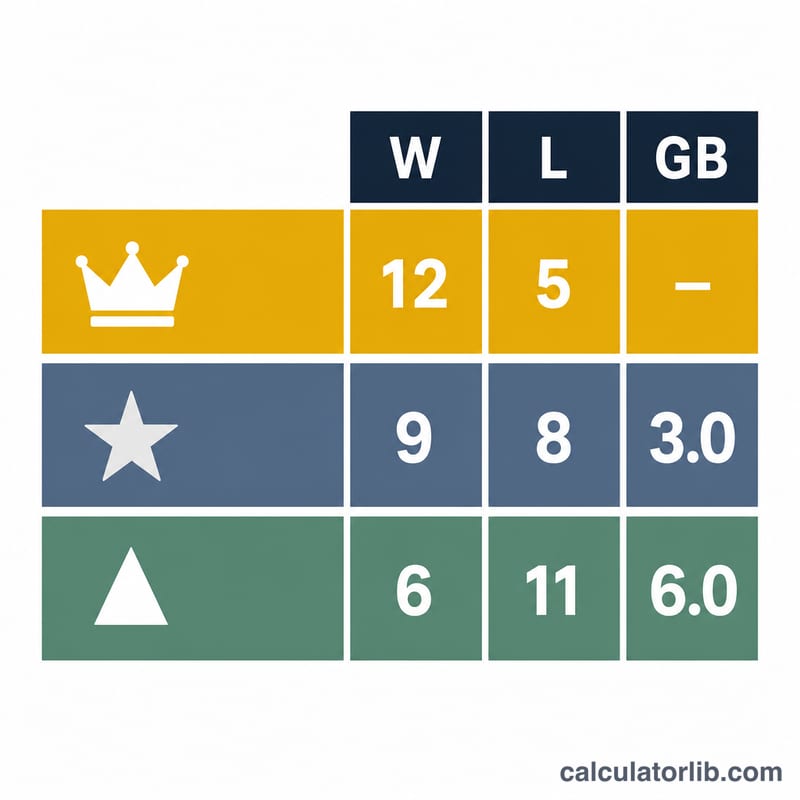
Games Behind (GB) measures how far a trailing team sits behind the division or league leader. The standard formula is:
$$\text{GB} = \frac{(\text{Leader Wins} - \text{Leader Losses}) - (\text{Trailer Wins} - \text{Trailer Losses})}{2}$$
The numerator is the difference between each team's win–loss differential, and dividing by 2 reflects that one game swings the standings by one win for the leader and one loss for the trailer (or vice versa). A half-game gap appears whenever the two teams have played a different number of games. The table below works through representative cases.
| Scenario | Leader (W–L) | Trailer (W–L) | Leader Diff | Trailer Diff | GB |
|---|---|---|---|---|---|
| Tied records | 50–40 | 50–40 | +10 | +10 | 0.0 |
| Half-game gap (unequal games played) | 50–40 | 49–40 | +10 | +9 | 0.5 |
| One full game back | 50–40 | 49–41 | +10 | +8 | 1.0 |
| Game-and-a-half gap | 50–40 | 49–42 | +10 | +7 | 1.5 |
| Trailer ahead in wins but more losses | 50–40 | 52–42 | +10 | +10 | 0.0 |
| Mid-season multi-game gap | 62–38 | 55–45 | +24 | +10 | 7.0 |
| Large late-season gap | 95–55 | 80–70 | +40 | +10 | 15.0 |
| Half-game on a large gap | 95–55 | 80–69 | +40 | +11 | 14.5 |
Two takeaways stand out. First, GB depends only on the differentials (W − L) of the two teams, not on the raw win totals — a team with more wins can still trail if it also has more losses. Second, whenever the two clubs have played a different number of games, the result lands on a half (0.5, 1.5, 14.5, etc.), which is why standings so often show a “½ game” back.
FAQ
Why can GB be a half number? Because the formula divides by two, a one-game swing in a single team's record changes GB by half a game. A value of \(0.5\) means the teams are one game apart in combined wins-plus-losses terms.
What does GB = 0 mean? The two teams have the same win-loss differential and are effectively tied, even if they have played a different number of games.
What if the result is negative? A negative GB means the team you labeled "trailing" is actually ahead of the "leader" by that many games. Swap the inputs, or read it as the leader trailing by the absolute value.