
What is hoop stress?
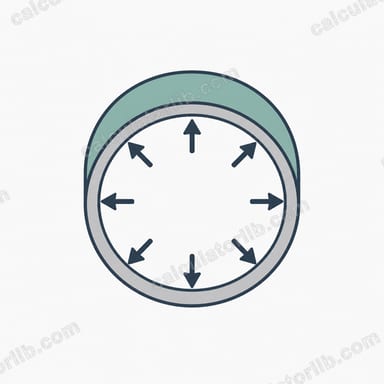
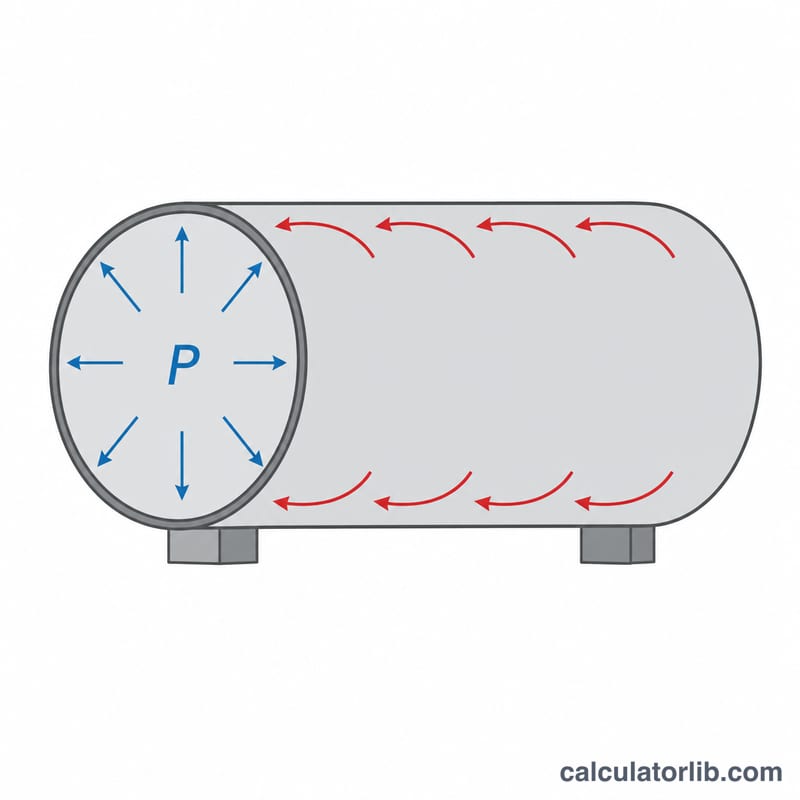
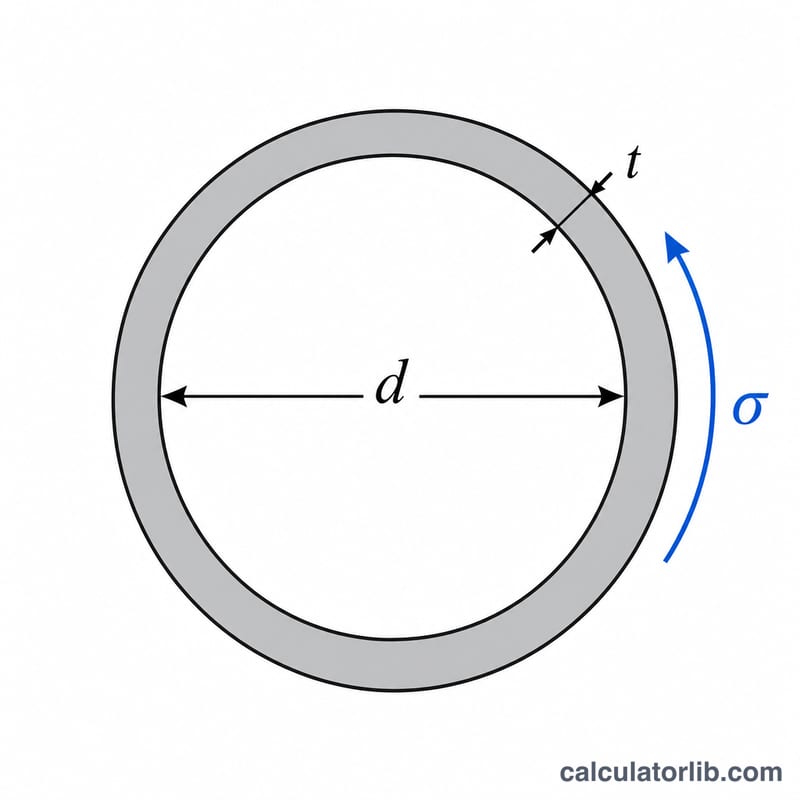
Hoop stress (also called circumferential stress) is the tensile stress that acts around the circumference of a cylindrical pressure vessel or pipe when it contains a fluid or gas under pressure. It is the stress that tends to split the cylinder along its length, which is why pressurized pipes and tanks typically fail with a longitudinal crack. This calculator uses the thin-walled (membrane) theory, valid when the wall thickness is small compared to the diameter (roughly t < d/20).
How to use this calculator
Enter the internal pressure P, the inner diameter d, and the wall thickness t. Use a consistent set of units: if P is in MPa and d and t are both in millimetres, the resulting stress is in MPa. Likewise psi with inches gives psi. The tool returns the hoop stress and the longitudinal (axial) stress, which is exactly half of the hoop value.
The formula explained
The hoop stress is given by $$\sigma_h = \frac{\text{Pressure }P \cdot \text{Diameter }d}{2 \cdot \text{Thickness }t}$$ This comes from a force balance: the pressure acting over the projected area \((P \cdot d \cdot L)\) is resisted by two longitudinal wall sections of area \((2 \cdot t \cdot L)\). The length \(L\) cancels, leaving the simple ratio above. The longitudinal stress $$\sigma_l = \frac{\text{Pressure }P \cdot \text{Diameter }d}{4 \cdot \text{Thickness }t}$$ results from the end caps and is half as large.
Worked example
A pipe carries gas at \(P = 5 \text{ MPa}\), with an inner diameter \(d = 500 \text{ mm}\) and a wall thickness \(t = 10 \text{ mm}\). Then $$\sigma_h = \frac{5 \times 500}{2 \times 10} = \frac{2500}{20} = 125 \text{ MPa}$$ and the longitudinal stress is \(62.5 \text{ MPa}\). The designer would compare 125 MPa against the material's allowable stress, including a safety factor.
FAQ
Why is hoop stress twice the longitudinal stress? The geometry resisting circumferential bursting has less material area than the cross-section resisting axial pull, so the same pressure produces double the stress around the hoop.
When is thin-wall theory valid? Generally when the wall thickness is less than about one-twentieth of the diameter. Thicker walls require Lamé's thick-wall equations.
Should I use inner or mean diameter? Thin-wall results are nearly identical; using the inner diameter is common and slightly conservative for design.