
What Is Number Density?
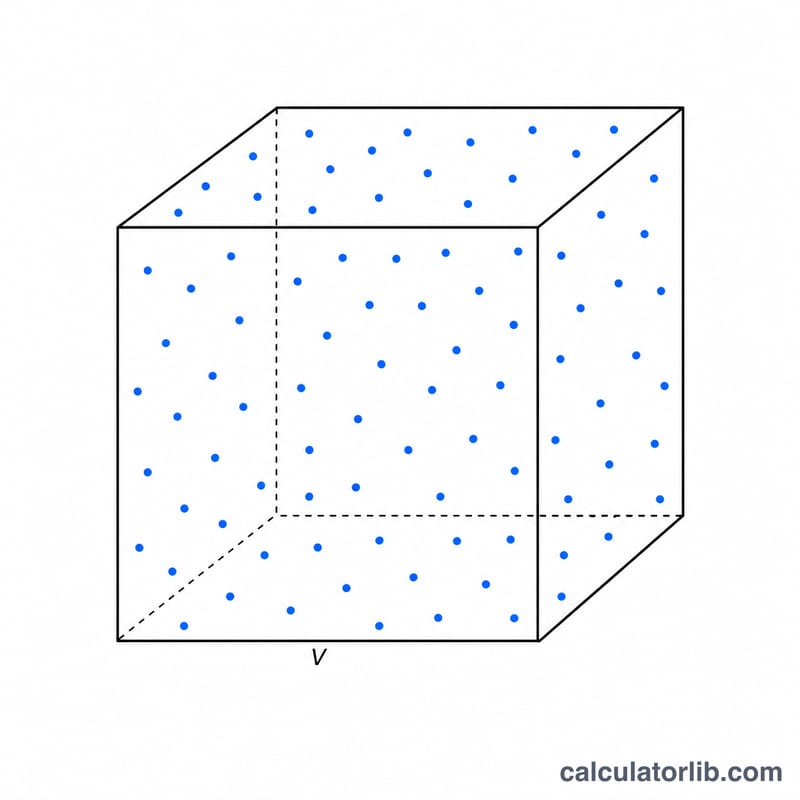
Number density is the number of particles (atoms, molecules, or ions) contained in a unit volume of a substance. It is a fundamental quantity in physics, chemistry, and materials science, used in kinetic theory, diffusion, plasma physics, and semiconductor doping. This calculator returns the number density in particles per cubic centimeter from a substance's mass density and molar mass.
How to Use This Calculator
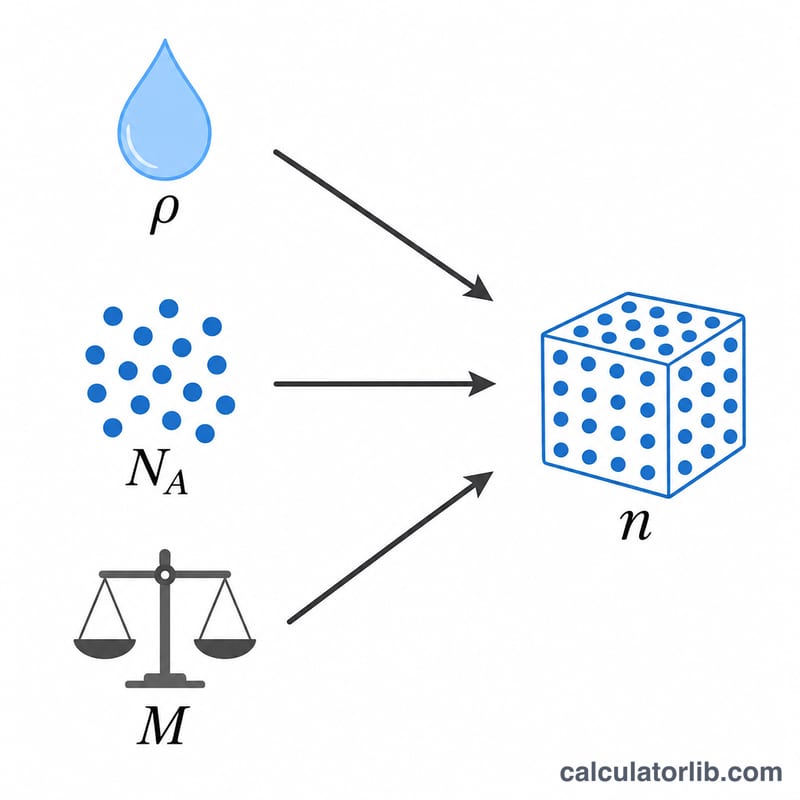
Enter the mass density ρ of the material in grams per cubic centimeter (g/cm³) and its molar mass M in grams per mole (g/mol). The tool multiplies the density by Avogadro's number and divides by the molar mass to obtain the number of particles per cm³.
The Formula Explained
The relationship is $$n = \frac{\rho \cdot N_A}{M}$$, where \(\rho\) is mass density, \(N_A = 6.02214076 \times 10^{23}\ /\text{mol}\) is Avogadro's number, and \(M\) is molar mass. Mass density (g/cm³) divided by molar mass (g/mol) gives moles per cm³; multiplying by \(N_A\) converts moles to individual particles.
Worked Example
Water has a density of about 1 g/cm³ and a molar mass of 18.015 g/mol. Then $$n = \frac{1 \times 6.02214076 \times 10^{23}}{18.015} \approx 3.343 \times 10^{22}\ \text{molecules per cm}^3.$$ So roughly 33 sextillion water molecules occupy each cubic centimeter.
FAQ
What units does the result use? Particles per cubic centimeter (cm⁻³). Multiply by 10⁶ to convert to particles per cubic meter.
Does it work for elements? Yes — use the element's mass density and its atomic (molar) mass; the result is atoms per cm³.
What is Avogadro's number? The number of entities in one mole, exactly 6.02214076 × 10²³ since the 2019 SI redefinition.