
What is ERA?
Earned Run Average (ERA) is one of the most widely used statistics for evaluating a baseball pitcher. It measures the average number of earned runs a pitcher allows per nine innings pitched. A lower ERA indicates more effective pitching. ERA is calculated the same way around the world (MLB, NPB, college, and high school baseball), so this tool is universal and not tied to any single country or league.
How to use this calculator
Enter three values: the number of complete (whole) innings pitched, the additional outs recorded in the current inning (0, 1/3, or 2/3 of an inning), and the number of earned runs charged to the pitcher. Because one inning equals three outs, a partial inning is recorded in thirds. "Earned runs" excludes runs that scored because of fielding errors (unearned runs), so be sure to enter only earned runs.
The formula explained
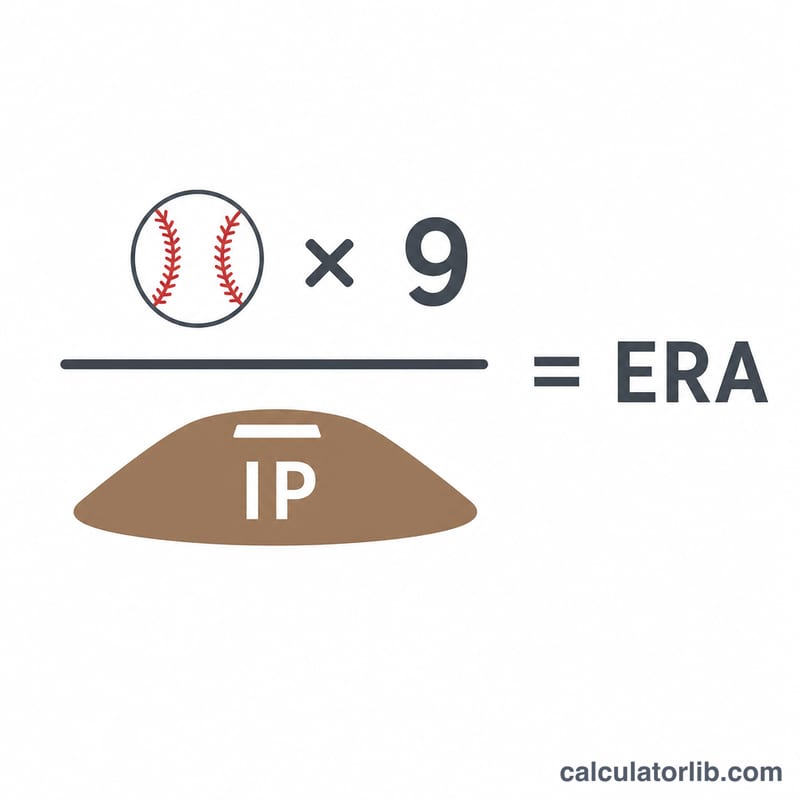
To handle partial innings cleanly, the calculation keeps everything in thirds of an inning (outs):
$$\text{ERA} = \frac{9 \times \text{Earned Runs}}{\dfrac{3 \times \text{Whole Innings} + \text{Outs}}{3}}$$
Total outs = whole innings \(\times 3\) + additional outs. ERA = (earned runs \(\times 9 \times 3\)) \(\div\) total outs. This is mathematically identical to the standard form ERA = (earned runs \(\div\) innings pitched) \(\times 9\); multiplying numerator and denominator by 3 simply avoids fractional innings. The result is rounded to two decimal places (round-half-up at the third decimal).
Worked example
Suppose a pitcher threw 69 complete innings with 0 extra outs and allowed 17 earned runs. Total outs = \(69 \times 3 + 0 = 207\). $$\text{ERA} = \frac{17 \times 9 \times 3}{207} = \frac{459}{207} = 2.2173\ldots$$ which rounds to 2.22.
Interpreting Your ERA
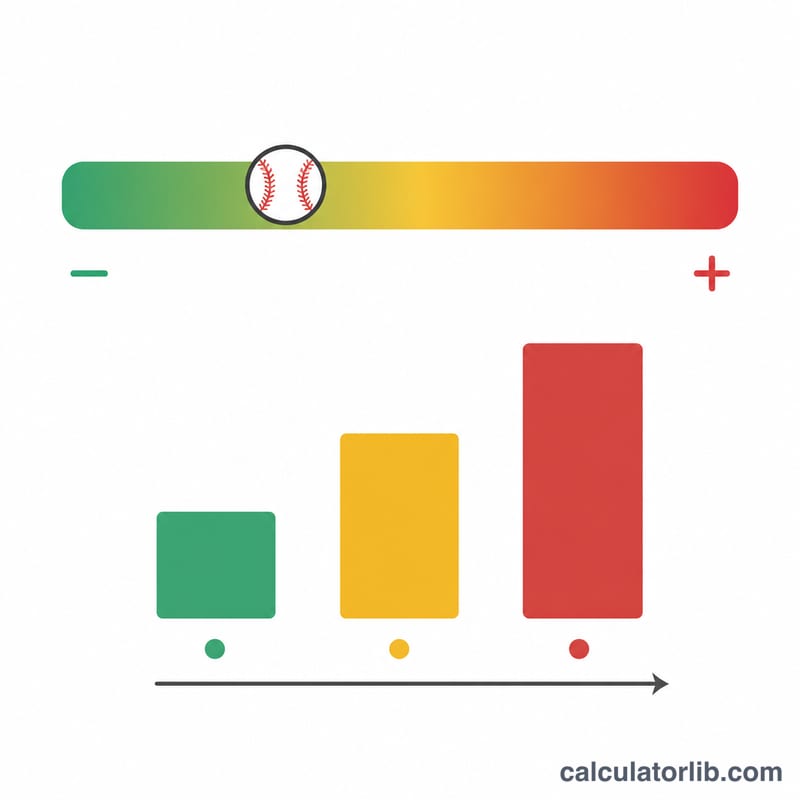
Earned Run Average (ERA) expresses how many earned runs a pitcher allows per nine innings pitched. A lower number is better. While the exact thresholds shift with the league environment and historical era, the following bands reflect how ERA is generally understood in a modern Major League Baseball context:
- Below 2.00 — Outstanding / elite. Rarely sustained over a full season; the mark of a dominant ace or an exceptional relief season.
- 2.00–3.00 — Excellent. Front-of-rotation starter or high-leverage reliever territory.
- 3.00–4.00 — Good / above average. Solid, dependable production from a rotation regular.
- 4.00–5.00 — Average to below average. Roughly league-average to back-of-rotation depending on the season's run environment.
- Above 5.00 — Poor. Generally below the threshold teams want from a regular role.
These ranges are typical MLB-context interpretations, not fixed rules. Run scoring varies year to year and across leagues, ballparks, and eras, so what counts as a "good" ERA in a high-offense season can differ from a low-offense one. For fair comparison, ERA is often viewed alongside the league average ERA for the same season (the basis for park- and league-adjusted metrics such as ERA+).
FAQ
What counts as an earned run? An earned run is a run charged to the pitcher that scored without the help of a fielding error or passed ball. Unearned runs do not count toward ERA.
What does 1/3 or 2/3 of an inning mean? Each out is one-third of an inning. If a pitcher recorded one out beyond a complete inning, that is 1/3; two outs is 2/3. Three outs would simply be one more whole inning.
Why 9 innings? A standard baseball game is nine innings, so ERA is normalized to nine innings for comparison. Some youth or softball leagues play seven innings, but this calculator fixes the figure at nine.