
What Is Principal Stress?
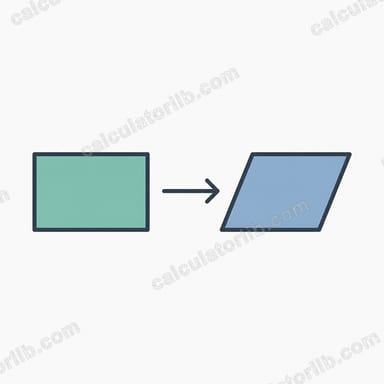
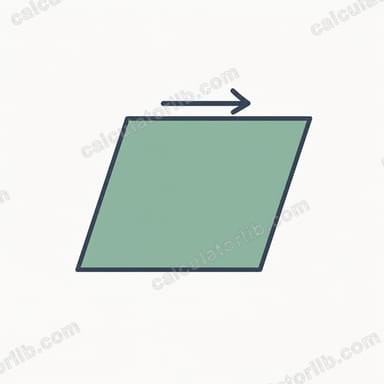
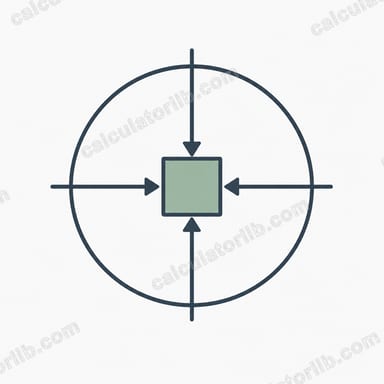
When a material element is loaded in two dimensions, the stresses acting on it depend on the orientation of the cutting plane. The principal stresses are the maximum (\(\sigma_1\)) and minimum (\(\sigma_2\)) normal stresses that occur on specific planes where the shear stress vanishes. Engineers use these values to predict yielding and failure of structural and machine components under combined loading.
How to Use This Calculator
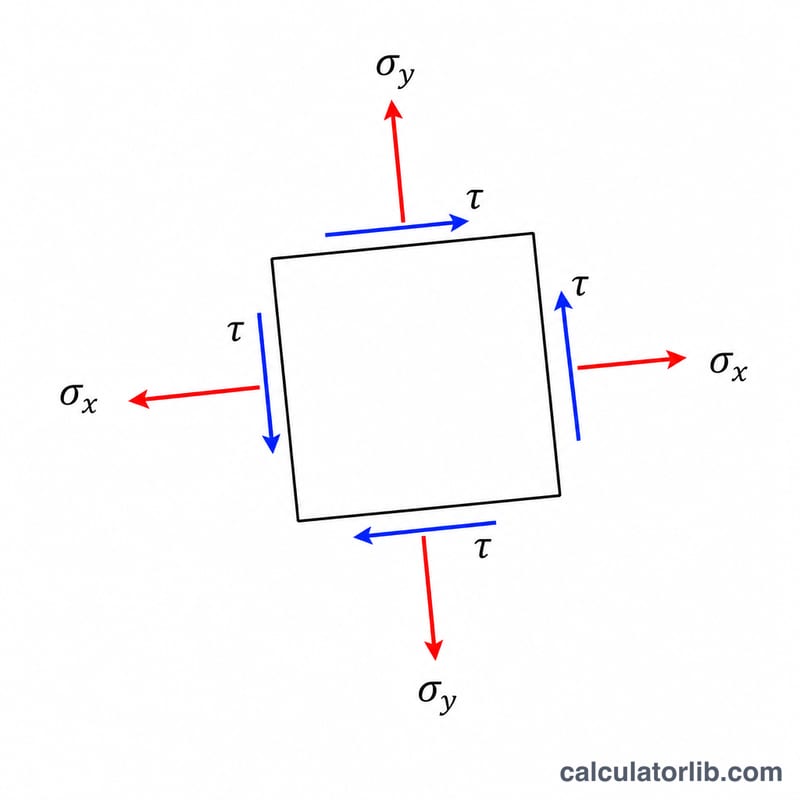
Enter the three components of the plane stress state: the normal stress in the x-direction (\(\sigma_x\)), the normal stress in the y-direction (\(\sigma_y\)), and the shear stress (\(\tau_{xy}\)). Use any consistent unit (MPa, ksi, psi). The calculator returns \(\sigma_1\), \(\sigma_2\), the maximum in-plane shear stress \(\tau_{max}\), and the principal angle \(\theta_p\) that orients the principal planes.
The Formula Explained
The principal stresses come from rotating the stress tensor to the orientation where shear is zero:
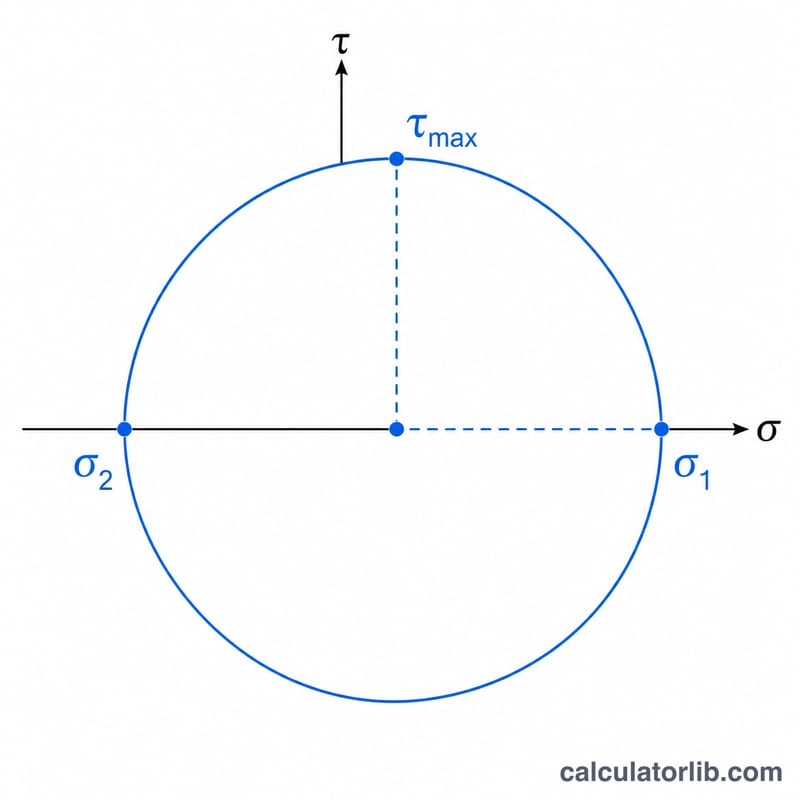
$$\sigma_{1,2} = \frac{\sigma_x + \sigma_y}{2} \pm \sqrt{\left(\frac{\sigma_x - \sigma_y}{2}\right)^2 + \tau_{xy}^{2}}$$The first term is the average normal stress (the center of Mohr's circle), and the square-root term is the radius of Mohr's circle, which equals the maximum shear stress \(\tau_{max}\). The principal angle is \(\theta_p = \frac{1}{2}\,\tan^{-1}\!\left(\frac{2\,\tau_{xy}}{\sigma_x - \sigma_y}\right)\).
Worked Example
For \(\sigma_x = 50\), \(\sigma_y = 10\), \(\tau_{xy} = 20\): average = 30, radius = \(\sqrt{20^2 + 20^2} = \sqrt{800} \approx 28.28\). So \(\sigma_1 \approx 58.28\), \(\sigma_2 \approx 1.72\), \(\tau_{max} \approx 28.28\), and \(\theta_p = \frac{1}{2}\,\tan^{-1}(40, 40) = 22.5°\).
FAQ
What are the units? The output uses whatever stress unit you input — the formula is unit-agnostic as long as \(\sigma_x\), \(\sigma_y\), and \(\tau_{xy}\) share the same unit.
What does a negative \(\sigma_2\) mean? A negative principal stress indicates compression on that plane, while positive values indicate tension.
Is this plane stress or plane strain? These equations describe the in-plane (2D) plane stress state; the third principal stress out of plane is assumed zero.